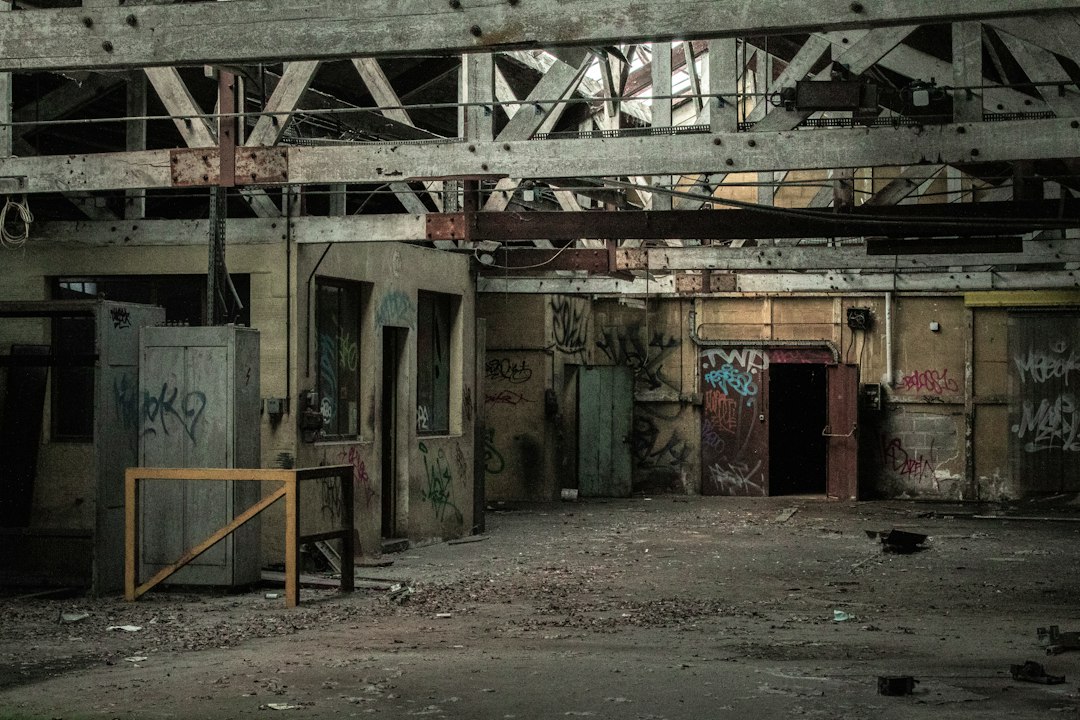
Photo by ALEXANDRE LALLEMAND on Unsplash
Why Movie Warehouses Are Always Abandoned and Full of Barrels
The climactic fight breaks out in an abandoned warehouse. Shafts of dusty light cut through high windows. Metal barrels line the walls. A chain-link cage divides the space. The hero and villain circle each other among pallets and oil drums, and you’ve seen this location a hundred times before.
Film warehouses follow a template so consistent it’s become visual shorthand. They’re always abandoned, always filled with industrial debris, and almost always lined with metal drums that serve no clear purpose. It’s not laziness—it’s a calculated production design choice rooted in logistics, cinematography, and narrative economy.
The Practical Appeal of Empty Industrial Spaces
Warehouses offer production advantages that studios and location scouts prioritize. They provide large, controllable volumes with high ceilings, allowing room for lighting rigs, camera cranes, and stunt choreography without the spatial constraints of a dressed interior set. The concrete floors handle heavy equipment and permit pyrotechnics or water effects that would damage finished surfaces.
Rental costs for decommissioned industrial buildings are often lower than active commercial spaces, and they come with fewer restrictions. Filming can run late without disturbing tenants. Walls can be marked, windows broken, and surfaces scorched. The space doesn’t need to be returned to pristine condition, which reduces insurance overhead and simplifies turnaround.
Industrial zones also sit far enough from residential areas that noise complaints are uncommon, a key consideration for scenes involving gunfire, explosions, or heavy machinery.
Visual Clarity Through Emptiness
An empty warehouse reads as a blank canvas. There’s no narrative clutter—no products, branding, or signage to date the scene or create clearance issues. The audience instantly understands the space as neutral, liminal territory where normal rules don’t apply. It’s not a workplace, not a home. It’s a space where confrontation is inevitable.
The sparse environment keeps attention on the characters. When the frame isn’t crowded with detail, blocking and movement stand out. A figure moving through empty space draws the eye. The visual language is clean, almost theatrical.
The Barrel Question
Those ubiquitous metal drums serve multiple functions. Visually, they add mid-ground geometry and vertical rhythm to compositions. They break up the monotony of open floor space, providing depth cues and framing opportunities without obstructing sightlines the way walls or machinery would.
In action scenes, barrels are movable, destructible, and safe. They can be knocked over, used as cover, or rigged to explode without the weight or danger of real industrial equipment. They’re light enough for stunt performers to throw or roll, and they create noise and movement that sells impact.
Barrels also code as “industrial” without specifying an industry. They could hold anything—or nothing. That ambiguity keeps the location from feeling tied to a specific business or time period. A warehouse full of barrels feels generic by design, which is exactly the point.
Atmospheric Control
Warehouses are stages for controlled atmosphere. High windows allow shafts of directional light that cinematographers can shape with minimal additional rigging. Dust, haze, or smoke fills the volume and makes light beams visible, adding texture and mood. The concrete and metal surfaces reflect sound, giving dialogue and impacts a cavernous, echoing quality that reads as isolation or danger.
The architecture itself is photogenic. Exposed beams, corrugated metal, chain-link partitions, and peeling paint provide texture and shadow without requiring set dressing. The decay suggests abandonment and lawlessness—a space outside normal oversight, where anything can happen.
Narrative Shorthand for Danger
Audiences have learned to read the abandoned warehouse as a threshold. It’s where deals go wrong, hostages are held, and final confrontations play out. The location signals that the story is moving into dangerous, unregulated space. The hero is entering on the villain’s terms.
This shorthand is efficient. No exposition is needed. The moment the camera reveals the location, the audience knows what kind of scene is coming. That predictability isn’t a flaw—it’s a feature. The warehouse is a cinematic convention that works because it’s been reinforced across decades of action films, thrillers, and crime dramas.
The empty warehouse endures not because filmmakers lack imagination, but because it solves a dense cluster of production problems while delivering a universally understood visual and emotional cue. It’s a tool, refined through repetition, that still does exactly what it was designed to do.