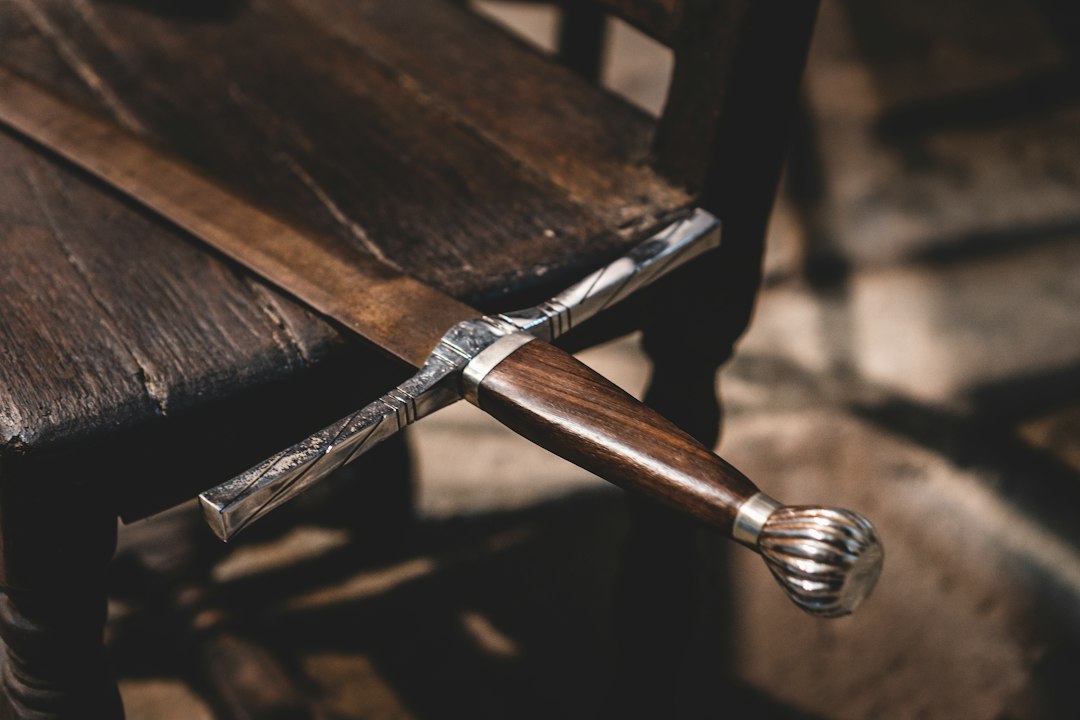
Photo by Jonathan Kemper on Unsplash
Why Movie Swords Weigh Half as Much as Real Ones
When a hero swings a broadsword in a film, executing elaborate flourishes and lightning-fast strikes for minutes at a time, they’re wielding a weapon that would feel shockingly light in your hand. Most screen swords weigh between one and two pounds, while their historical counterparts typically ranged from three to five pounds or more.
This weight difference isn’t a minor shortcut. It’s a calculated production choice that makes modern fight choreography possible.
The Physics of Screen Combat
A real medieval longsword weighs roughly three to four pounds, which doesn’t sound like much until you swing it continuously for twelve hours of shooting. The fatigue factor alone would make complex choreography dangerous—tired actors make mistakes, and mistakes with even blunt steel can cause serious injury.
Lightweight screen swords solve multiple problems at once. They allow actors to perform faster, more visually dynamic moves without the physical conditioning of a historical swordsman. They reduce the risk of strain injuries during long shooting days. And crucially, they enable the kinds of rapid, intricate exchanges that audiences have come to expect from screen combat, sequences that would be physically impossible to sustain with period-accurate weapons.
Materials and Construction
Modern prop swords use aluminum, fiberglass, rigid foam, or resin. Aluminum is the workhorse for contact choreography—it can withstand repeated blade-on-blade strikes while remaining significantly lighter than steel. High-end aluminum swords are machined to look identical to steel on camera, complete with edge bevels and fuller grooves.
For wide shots or background action, foam and resin swords go even lighter. Urethane rubber swords weigh mere ounces and provide an extra safety margin for large battle scenes where dozens of fighters share tight quarters. The tradeoff is sound—aluminum produces a satisfying metallic ring when struck, while foam and resin require every impact to be dubbed in post-production.
Hero swords, the versions used for close-ups, may actually be steel, but they’re almost never swung. They’re held, drawn from scabbards, or displayed. The moment action begins, the actor switches to the aluminum stunt version.
What the Camera Hides
Directors of photography collaborate with prop departments to sell the illusion. Certain lighting setups make aluminum read as steel. Camera angles avoid lingering on blade flex—aluminum swords, being softer, can visibly bend during hard strikes. Editors cut around the flex or use it to their advantage, letting a slight bend suggest the force of impact.
Sound design completes the transformation. Every clash, scrape, and ring is added or enhanced in post. Foley artists record real steel-on-steel impacts, which are then synced to the lightweight props on screen. The result is a weapon that looks, sounds, and moves like steel but behaves like aluminum.
The Tradeoff
Lightweight swords change the vocabulary of screen combat. Fights become faster, more acrobatic, less grounded in historical technique. An actor can spin a two-pound sword with one hand; doing that with a four-pound blade requires genuine strength and control. The spectacle increases, but the physicality shifts away from what actual swordplay looked and felt like.
Some period films push back against this trend, using heavier props to force more deliberate, grounded choreography. But most productions accept the tradeoff: a sword that weighs half as much unlocks fight sequences that are twice as watchable, even if they bear little resemblance to historical combat.
The irony is that the lighter the sword, the more work it creates elsewhere. What the props department solves, the stunt coordinators, editors, and sound designers must compensate for. The result is seamless, but it’s built on a foundation of aluminum pretending to be steel.