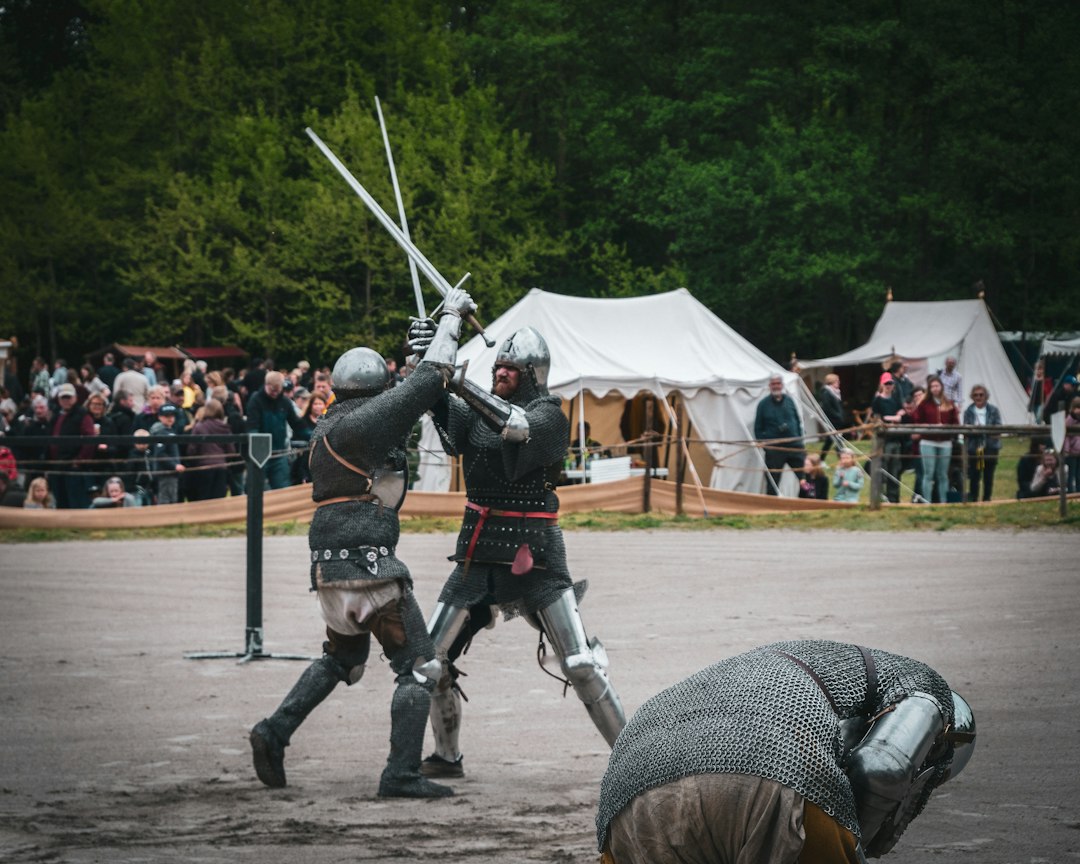
Photo by Casper Johansson on Unsplash
Why Movie Swordfights Never Show Exhaustion
Watch any sword duel in cinema and you’ll see combatants exchange dozens of strikes, leap across furniture, and trade verbal barbs—all without breaking rhythm or gasping for air. The fight might span three minutes of screen time, yet neither fighter shows the muscle fatigue, labored breathing, or slowing reflexes that would cripple a real person in under thirty seconds.
This isn’t an oversight. It’s a deliberate narrative choice that prioritizes drama over physiology, and understanding why reveals how film constructs its own physics.
Real Sword Fighting Burns Out Fast
Historical fencing manuals and modern HEMA practitioners confirm what the body already knows: swinging a three-pound sword with enough force to parry, strike, and recover is exhausting. Adrenaline accelerates heart rate, fine motor control deteriorates within seconds, and the lactic acid buildup in the shoulders and forearms creates a narrow window of effective fighting before technique collapses.
Medieval trial by combat often ended when one fighter could no longer lift their weapon. Dueling manuals emphasized economy of motion precisely because fatigue was the real enemy. A historical sword fight that lasted two uninterrupted minutes would be extraordinary.
Cinema Builds Stamina Into Choreography
Film swordfights are designed as dances, not duels. The choreography prioritizes visual clarity, spatial storytelling, and escalation. Fighters move through the environment—crashing through tables, ascending staircases, swinging from chandeliers—not because it’s tactically sound, but because it sustains visual interest and gives the scene geography.
Showing realistic fatigue would require the rhythm to break: pauses, stumbling, defensive retreats. It would also require actors to perform labored breathing and muscle failure, which reads on screen as weakness or incompetence rather than realism. Audiences interpret heavy breathing as a sign that a character is losing, so heroes stay composed to signal control.
Editing Hides the Seams
What looks like a continuous three-minute duel is often stitched together from dozens of short takes, each lasting only seconds. Actors perform a flurry of moves, then stop, reset, and film the next segment. This gives them time to recover between takes, and the editor reassembles the pieces into a seamless flow.
Close-ups on faces, reaction shots, and cutaways to bystanders also serve as invisible rest points. The audience experiences the fight as relentless, but the construction is rhythmic and controlled, with built-in breathing room that never interrupts the momentum.
When Fatigue Does Appear, It’s Narrative
Occasionally, a film will show a fighter tiring—but only when the story demands it. The exhaustion arrives at a precise dramatic moment: the hero has been fighting too long, the villain gains the upper hand, and the scene escalates into a final desperate exchange. The fatigue isn’t biological; it’s a plot beat.
These moments work because they’re rare. The baseline assumption in screen combat is endurance, so when a character finally slows down, it signals stakes and vulnerability. The effect depends on the contrast.
The Language of Cinematic Combat
Screen fights obey their own grammar. They communicate power, skill, and emotional state through choreography, not biology. A fighter who never tires signals mastery and control. A fighter who begins to falter signals a turning point. The body in a movie sword fight is a storytelling instrument, not a realistic simulation of human limits.
This is why even grounded, gritty action films rarely show true exhaustion until the final act. The language of cinema has trained audiences to accept tireless combat as the norm, and breaking that convention requires a reason.