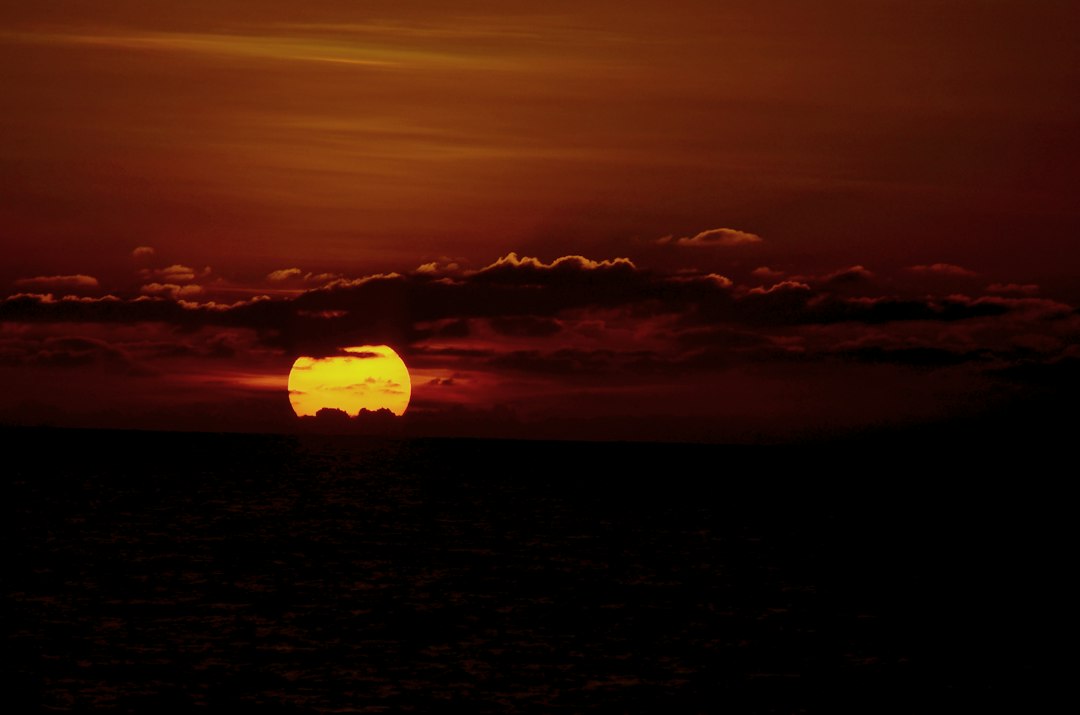
Photo by Hassan Maayiz on Unsplash
Why Movie Sunsets Always Look Perfect
The sun sets on cue in movies. It glows at exactly the right intensity, backlights the actors with a warm rim, and bathes the scene in rich amber and gold. Real sunsets fade unevenly, disappear behind clouds, or fail to deliver drama at all. Movie sunsets never disappoint because they’re carefully orchestrated, not passively captured.
Scheduling Around the Window
Cinematographers call the period around sunset “magic hour” or “golden hour,” but the actual usable window is shorter than most people think. Depending on latitude and season, the ideal light might last only fifteen to thirty minutes. That means the crew has one or two takes to get the shot right before the color temperature shifts or the sun drops below the horizon entirely.
To maximize that window, productions schedule sunset shots with military precision. The director of photography calculates the exact time the sun will hit the desired angle, and the entire crew rehearses beforehand with stand-ins. By the time the light is right, everyone knows their blocking, the camera movement is locked, and the actors are ready to perform. There’s no room for improvisation when the sun is your key light and it’s moving.
Shaping and Enhancing Natural Light
Even during magic hour, the sun rarely cooperates perfectly. It might be too high, too harsh, or partially obscured. Crews use reflectors and diffusion frames to sculpt the light, bouncing warm fill onto actors’ faces or softening direct rays that would otherwise create unflattering shadows.
In some cases, cinematographers add artificial light to extend or enhance the sunset look. A large HMI or LED panel gelled with warm orange can simulate the sun’s angle and color, allowing the crew to shoot “magic hour” for hours. This approach is especially common on tight schedules or when weather makes natural light unreliable. The goal is to match the quality of real sunset light, not replace it with something obviously artificial.
Color Grading the Sky
What you see in the final film is rarely what the camera captured on set. Colorists push the warmth, deepen the oranges and magentas, and sometimes isolate the sky to intensify its gradient. A sunset that looked pleasant but unremarkable on set becomes rich and emotionally charged in post-production.
Digital tools allow for fine control over every part of the frame. The sky can be made more saturated while skin tones stay natural. Highlights in the clouds can be pulled up to create a sense of drama. This kind of enhancement is standard practice, not trickery. The sunset is there, but the grade amplifies what the story needs it to convey.
Timing for Emotional Beats
Sunsets in film aren’t just about beautiful light—they’re about storytelling. A sunset signals endings, transitions, melancholy, romance, or the close of a chapter. Directors and cinematographers choose to shoot at sunset because the visual language supports the narrative moment. The warmth and softness of the light invite reflection, while the fading day suggests time passing or something coming to a close.
Because sunset is so closely tied to emotion, filmmakers rarely let it happen by accident. If the script calls for a sunset, the production builds the schedule around it. If the natural light isn’t cooperating, they’ll recreate it. The result is a sunset that feels inevitable, as if the world itself is responding to the characters’ journey.
The Illusion of Naturalism
The perfection of movie sunsets is invisible by design. Audiences don’t notice the reflectors, the color grading, or the fact that the “sunset” was shot at dawn with corrective gels. They see a moment that feels real and emotionally true, even though every element was shaped by the crew. That’s the craft: making control look like luck, and turning a fleeting atmospheric condition into a repeatable, reliable storytelling tool.