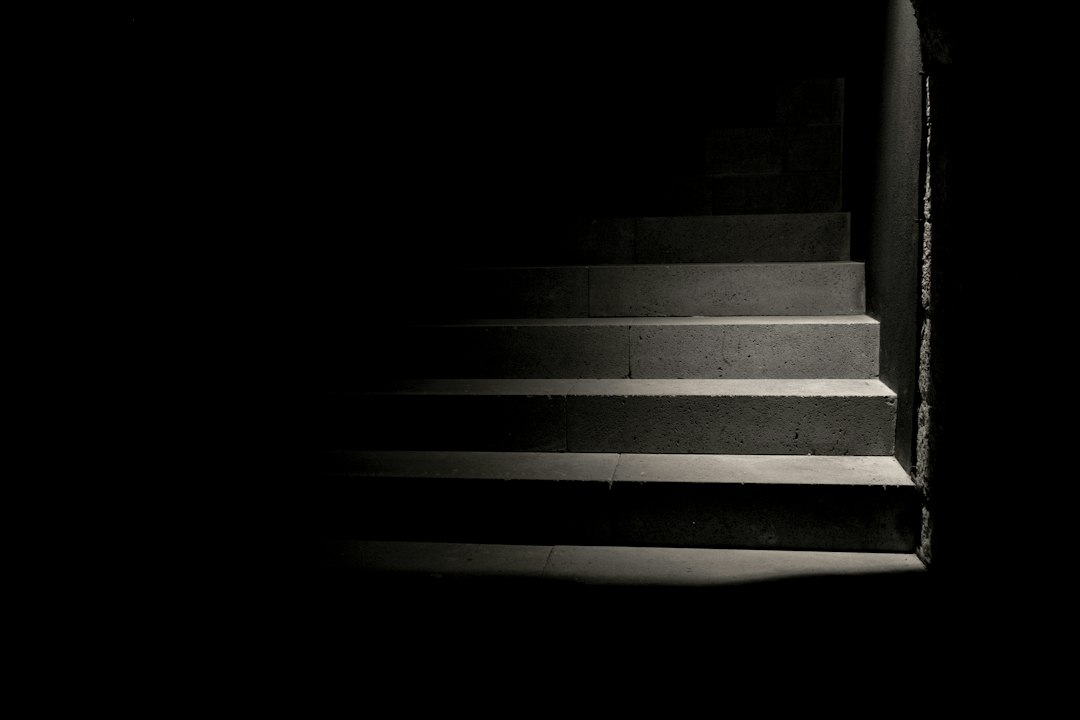
Photo by Carolina Pimenta on Unsplash
Why Movie Stairs Creak in Horror Films
Every horror fan knows the sound: a character begins climbing a staircase in a darkened house, and each footfall produces a long, drawn-out creak that seems to announce their presence to whatever waits above. Real stairs do creak, of course, but movie stairs creak with purpose, precision, and a frequency that would suggest every horror house was built last week with deliberately loose floorboards.
The creak is never accidental. It’s engineered in post-production by foley artists who understand that sound can manufacture dread more efficiently than visuals alone. A staircase is already a vulnerable space—you’re between floors, exposed, committed to a direction—and the creaking amplifies that vulnerability by destroying any hope of stealth.
The Acoustic Anatomy of Dread
Foley artists record stair creaks separately from the actor’s footsteps, often using a custom-built “creak box”—a small platform with loose boards that can be manipulated to produce groans at specific pitches. The sound is then layered into the scene with exaggerated duration and volume. Where a real stair creak might last a fraction of a second, a movie creak sustains for a full second or longer, hanging in the air like a verbal announcement.
The pitch matters too. Lower, slower creaks suggest age and decay, implying the house itself is complicit in the horror. Higher, sharper creaks feel more immediate and alarming, like a warning system the character has just triggered. Sound designers will often pitch-shift and EQ the creaks to sit in a frequency range that naturally unsettles human hearing—usually in the low-mid range where our ears are primed to detect threats.
Breaking the Silence
Horror films rely on contrast. Long stretches of silence make audiences lean forward, straining to hear, which makes any sudden sound feel like a violation. The stair creak is the perfect middle ground: it’s not loud enough to be a jumpscare, but it’s invasive enough to shatter the quiet and remind viewers that the character is not alone, or worse, that they’re making themselves known.
The rhythm of creaks also matters. Irregular spacing—creak, pause, creak creak, long pause—creates unpredictability. It suggests hesitation, fear, someone trying and failing to move quietly. Regular, evenly spaced creaks can be even worse, implying confidence or inevitability, as if whatever is climbing doesn’t care about being heard.
The False Safety of Descent
Interestingly, descending stairs in horror films often creak less than ascending ones. The psychological reason is straightforward: going upstairs means moving toward danger, into the unknown. Going down suggests escape, a return to the ground floor and the front door. By keeping descents quieter, filmmakers preserve a sliver of hope—right up until the moment they need to shatter it.
When a descent does feature heavy creaking, it’s usually because the route has been cut off, and the character is being forced into a basement or cellar. Now the creaks serve a different function: they’re marking each step away from safety, a countdown into darkness.
Why We Accept the Exaggeration
Audiences accept hyper-creaky stairs for the same reason they accept the Wilhelm scream or perfectly timed thunder: it’s a convention that serves the story. We don’t pause the film to wonder why the protagonist didn’t oil the hinges or replace the floorboards. We understand that the creak is part of the film’s language, a auditory shorthand for “you are in danger.”
The stair creak has become so embedded in horror grammar that its absence can be weaponized. A character climbs a staircase in total silence, and suddenly the audience is more frightened, because the expected cue has been withheld. The rules have changed. Anything can happen now.
In the end, the movie stair creak is a small miracle of sound design: a mundane, everyday noise transformed through exaggeration and context into an instrument of terror. It’s proof that in horror, what you hear is just as important as what you see—and sometimes, considerably more effective.