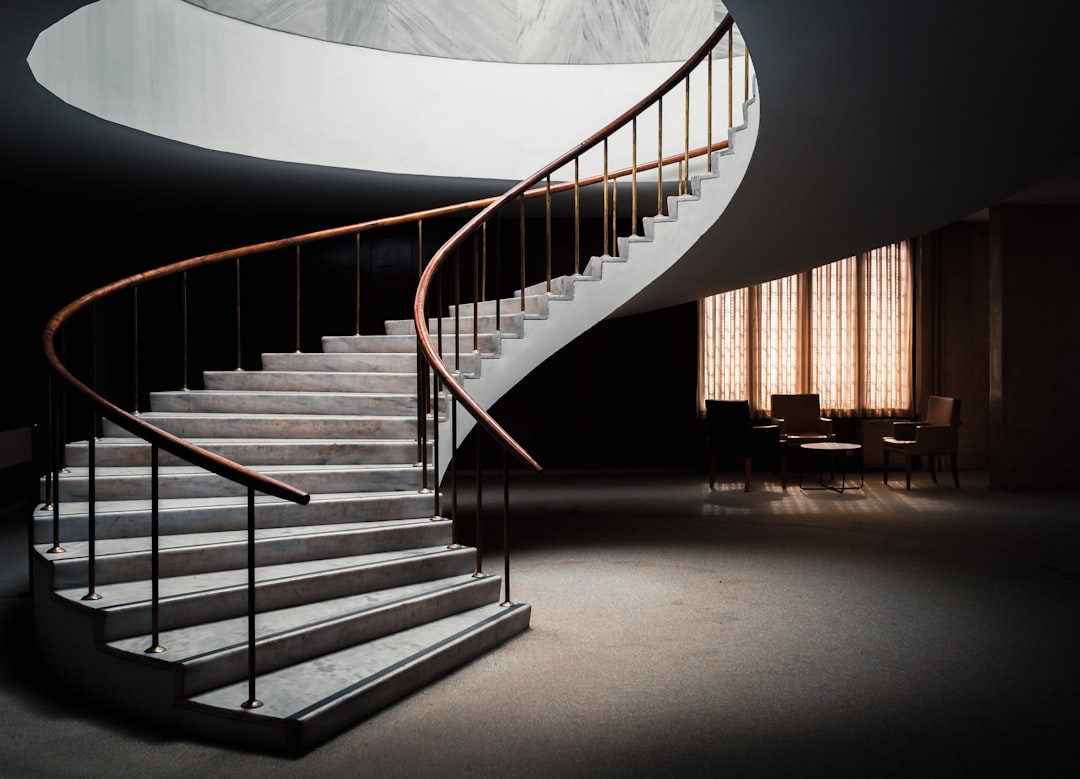
Photo by Serhat Beyazkaya on Unsplash
Why Movie Staircases Always Have Dramatic Lighting
Walk up the stairs in your home and you’ll find overhead lighting, maybe a window, perhaps some shadow pooling in the corners. Functional. Unremarkable. Now think of a staircase in a film: shafts of light cutting through darkness, silhouettes descending into frame, faces half-lit as characters pause mid-step. Staircases in cinema are rarely just a way to get from one floor to another. They’re stages, and they’re almost always dramatically lit.
The Geometry of Drama
Staircases offer filmmakers something rare in architecture: built-in diagonal lines and natural elevation changes within a single shot. While most interior spaces are horizontal planes, staircases create vertical movement and depth without cutting away. A character at the top of a staircase occupies a position of literal height, which translates immediately to visual power or authority. Someone at the bottom looks up, vulnerable or supplicant.
This geometry invites dramatic lighting because the angles already exist. Cinematographers can rake light across the steps to create repeating patterns of light and shadow, turning a functional space into a sculptural composition. Side lighting from a window or practical source catches each riser and tread, emphasizing texture and dimension. The result is a location that feels cinematic by default.
Transformation and Threshold
Staircases are liminal spaces—they exist between destinations. In storytelling terms, they’re thresholds where characters transition from one state to another, physically and emotionally. A character descending into a basement moves toward danger or revelation. Someone climbing toward an attic ascends into memory or madness. The lighting amplifies this sense of crossing over.
Filmmakers often light staircases to suggest this in-between quality. Low, directional light sources create pools of illumination separated by shadow, so a character moves through alternating zones of visibility and obscurity. The technique mirrors the narrative uncertainty of the moment. We’re watching someone move toward something unknown, and the lighting makes that tension visible.
Practical Sources and Motivated Design
Despite the theatrical result, staircase lighting in film often begins with practical sources: a window on the landing, a hanging fixture, a door cracked open at the top of the stairs. Production designers and cinematographers choose these sources carefully, positioning them to justify the dramatic pools and shafts of light that will be enhanced or replicated with film lights.
A window halfway up a staircase becomes an excuse to pour daylight across the steps at a steep angle. A chandelier allows a single overhead source that casts long shadows downward. Even a sliver of light from under a door can justify a thin beam that cuts through the dark. The lighting feels motivated—rooted in a logical source—while still serving the drama.
Controlling the Eye
Staircases also solve a compositional problem: how to keep the viewer’s eye moving through the frame. A character walking across a flat room can feel static in a locked-off shot, but a character moving up or down stairs creates inherent dynamism. The diagonal line of ascent or descent leads the eye naturally through the composition.
Dramatic lighting reinforces this. A pool of light at the top of the stairs draws our attention upward. Shadows on the lower steps push our gaze toward the illuminated figure. The interplay of light and dark creates a visual pathway that guides where we look and what we anticipate. The staircase becomes a compositional tool as much as a location.
The Shorthand of Mood
Over decades of cinema, dramatically lit staircases have become visual shorthand. We recognize the iconography: a noir detective climbing toward a shadowy office, a horror protagonist descending into a darkened cellar, a period drama character pausing on a grand staircase in a pool of window light. The lighting isn’t just aesthetic—it signals genre, tone, and narrative weight.
Filmmakers lean into this because audiences read it instantly. A brightly, evenly lit staircase feels mundane, domestic, safe. A staircase carved into zones of light and shadow feels charged with possibility or threat. The lighting choice sets expectations before a word of dialogue is spoken.
Staircases are architecture, but in film, they’re also opportunity. The lines, the levels, the movement between floors—all of it invites light to become part of the storytelling. And filmmakers rarely pass up the chance.