Photo by Marvin Radke on Unsplash
Why Movie Scientists Always Use Beakers and Colored Liquids
Walk into any movie laboratory and you’ll see the same setup: bubbling beakers filled with neon liquids, racks of test tubes in jewel tones, and steam rising from glass flasks connected by rubber tubing. Real scientific labs look nothing like this. So why does cinema keep returning to this visual shorthand?
The Visual Language Problem
Film has seconds to establish that a character is a scientist and that scientific work is happening. Production designers solve this by reaching for the most recognizable lab equipment—the kind that lives in collective memory from high school chemistry class. Beakers, Erlenmeyer flasks, and test tubes read as “science” to audiences worldwide, even though working researchers often use enclosed analyzers, computer interfaces, and equipment that looks more like a microwave than classical glassware.
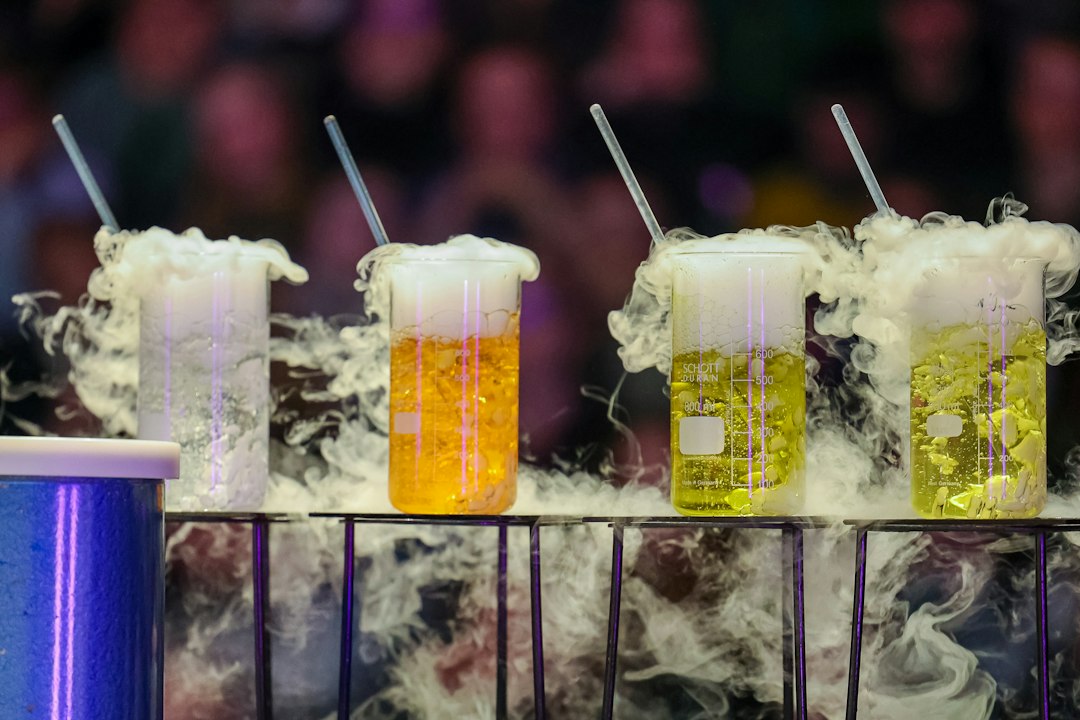
The colored liquids serve the same purpose. Clear or pale solutions don’t photograph well and don’t signal activity. Bright blues, greens, and purples catch the eye and suggest chemical reactions in progress. Add some dry ice for fog effects and a few bubbling tubes, and you’ve built a laboratory that communicates its function in a single frame.
Production Design Efficiency
Real labs are cluttered with safety equipment, labeled bottles, and mundane supplies. They’re lit with fluorescent overheads and filled with beige plastic. None of this looks cinematic, and none of it helps the audience understand what’s happening.
Movie labs are built for clarity. Each element exists because it contributes to the scene’s visual storytelling. The glassware is oversized so it’s visible in wide shots. The liquids are backlit or placed near practical light sources. The equipment is arranged for composition rather than workflow, with hero props positioned where the camera can see them and the actor can interact with them naturally.
The Mad Scientist Inheritance
Cinema’s laboratory aesthetic traces back to early horror and science fiction films, where production designers borrowed from theatrical traditions and the illustrated science fiction of the 19th century. These films established the visual vocabulary: the bubbling retorts, the electrical equipment with visible arcs, the glass vessels filled with mysterious substances.
That language proved durable because it works. Audiences don’t need to understand organic chemistry to recognize that a character mixing colored liquids in glassware is doing something scientific. The imagery functions as visual exposition, freeing up dialogue and screen time for story rather than procedural explanation.
When Accuracy Matters
Productions with scientific consultants sometimes push back against the beaker-and-colored-liquid default, especially in stories where the science itself is central to the plot. These films might show real PCR machines, proper pipetting technique, or accurate computer modeling interfaces.
But even scientifically rigorous films often preserve some version of the visual shorthand. A researcher might work at a legitimate-looking computer setup, but the establishing shot of the lab will still feature some recognizable glassware. The colored liquids might be more subdued, but they’re still present, still backlit, still doing their job of signaling “laboratory” to anyone watching.
The Convention Endures
Movie labs continue to look like movie labs because the visual language is efficient and universally understood. Real scientists might roll their eyes at the bubbling beakers and neon liquids, but audiences immediately grasp what they’re seeing. In a medium where every second of screen time costs money and every frame must serve the story, that instant recognition is worth more than documentary accuracy.
The beakers and colored liquids aren’t meant to represent how science actually works. They’re meant to represent science itself—to create a visual environment where scientific activity is obvious, photogenic, and dramatically useful. Like so many cinema conventions, the movie laboratory persists because it solves a storytelling problem elegantly, even if it bears little resemblance to the real thing.