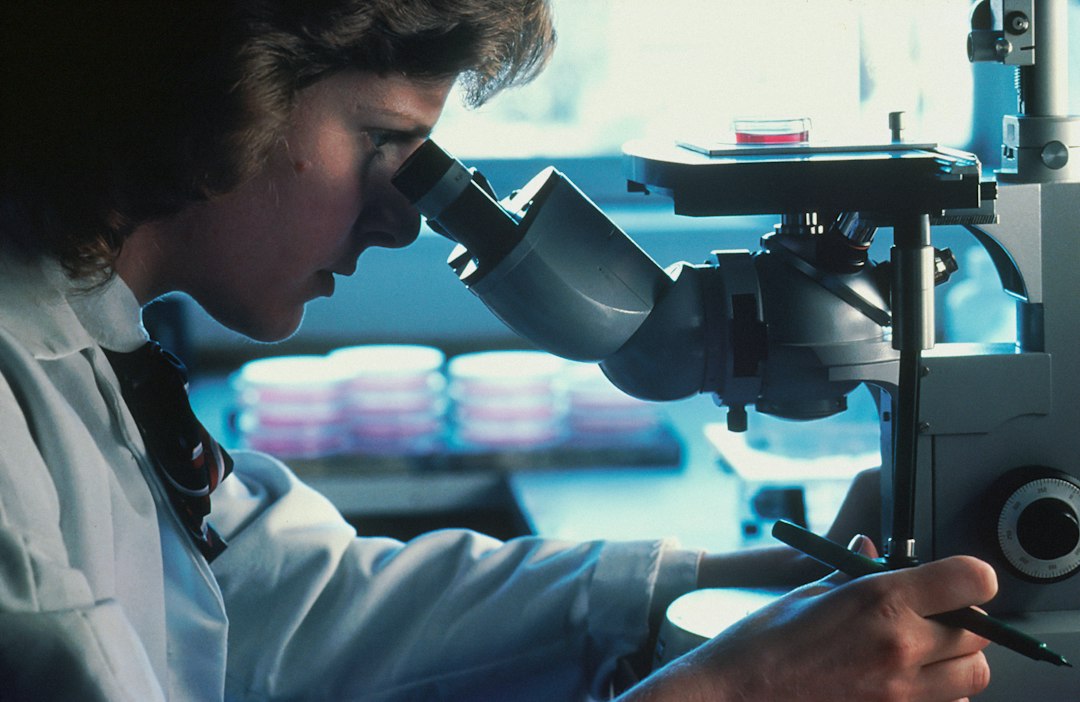
Photo by National Cancer Institute on Unsplash
Why Movie Scientists Always Work Alone at Night
In countless films, the pivotal breakthrough happens the same way: a scientist sits alone in a darkened lab, bathed in the cold glow of a monitor or the warm light of a single desk lamp, surrounded by empty corridors and silent equipment. It’s past midnight. Everyone else has gone home. And that’s precisely when the discovery happens.
This isn’t how research actually works—most labs operate on day shifts, breakthroughs emerge from collaborative teams, and important findings are rarely the result of one person’s solitary eureka moment. But cinema keeps returning to this image because it solves several storytelling problems at once.
Isolation Raises the Stakes
A scientist working alone is vulnerable. When the experiment goes wrong, the contamination spreads, or the creation escapes, there’s no one to help. No colleague in the next room, no security guard making rounds, no lab partner to hit the emergency shut-off. The isolation turns a research scene into a suspense sequence.
This vulnerability works even outside horror and thriller contexts. In dramas, the lone scientist carries the full weight of responsibility. There’s no one to share the burden of the decision, to talk through the ethics, to stop them from crossing the line. The absence of witnesses makes the moment feel consequential.
Night Signifies Obsession
Characters who work through the night signal something to the audience: they’re driven past the point of balance. They’ve lost perspective, skipped meals, ignored their families. This visual shorthand establishes obsession without dialogue.
The darkened lab becomes a visual metaphor for tunnel vision. The scientist has narrowed their world to a single problem, and the cinematography reflects that narrowing. One pool of light, one face, one screen. Everything outside that circle has fallen away.
Darkness Is Cinematic
Night scenes allow cinematographers to control light completely. A daytime lab is fluorescent, flat, institutional—visually uninteresting and difficult to shoot with mood. But a lab at night becomes a canvas. Practical monitors provide motivated blue light on faces. A desk lamp creates warm key light. Shadows can hide or reveal equipment. The contrast range gives the frame depth and texture.
The darkness also allows production designers to be selective. In a fully lit daytime scene, every corner of the lab must be dressed, every prop justified, every surface finished. At night, large portions of the set disappear into shadow. The visible elements can be carefully composed while the rest remains implied.
Silence Focuses Attention
An active daytime lab is full of competing sounds: conversations, equipment hum, footsteps, phones, doors. At night, the soundtrack narrows to the essential. The click of a keyboard. The whir of a centrifuge. Breathing. Each sound becomes distinct and meaningful.
This acoustic isolation serves the same function as the visual isolation—it focuses attention on the single moment that matters. When the only sounds are the ones the scientist makes, every action feels deliberate. When the discovery happens, there’s nothing to compete with the audience’s realization of what it means.
The Breakthrough Becomes Private Drama
Science in reality is incremental, collaborative, bureaucratic. Results are reviewed, replicated, debated. But cinema needs compressed drama, and the lone scientist at night delivers it. The breakthrough can happen in real time, on screen, with visible emotional stakes.
The scientist’s face is the only face. Their reaction is the audience’s guide to whether this is triumph or disaster. There’s no committee to dilute the impact, no institutional response to delay the consequences. The moment is pure: discovery, realization, decision.
The trope persists because it works. It turns research into cinema—taking an inherently collaborative, procedural process and transforming it into a visual, emotional, narratively efficient beat. The empty lab at night isn’t realism. It’s a grammar, refined over decades, for how to make science feel like drama.