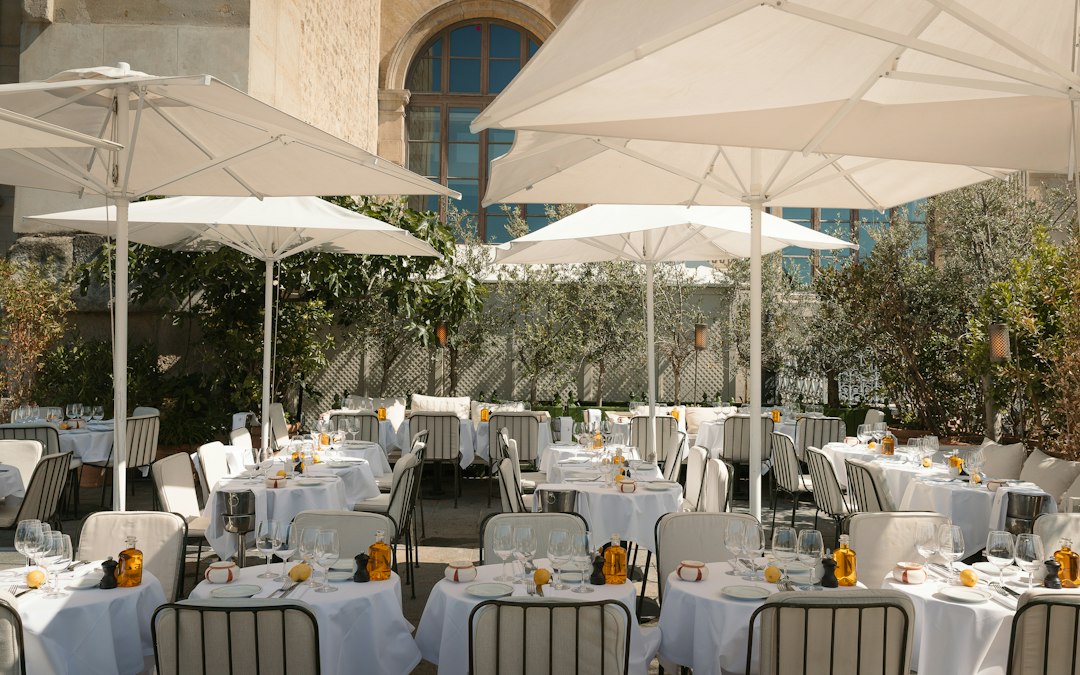
Photo by Nikita Pishchugin on Unsplash
Why Movie Restaurants Always Have White Tablecloths
When characters meet for a pivotal dinner scene in a movie, chances are they’re seated at a table draped in white linen. It’s so common that the absence of a white tablecloth feels like a deliberate choice—a diner, a dive bar, somewhere coded as “low” rather than “high.” The white tablecloth has become visual shorthand for a certain kind of restaurant, but its ubiquity on screen goes beyond realism. It’s a production design decision rooted in practical filmmaking needs and the semiotics of class.
The Bounce Board You Can Eat Off
White tablecloths solve a lighting problem. In a dimly lit restaurant interior—often chosen for mood or to hide the fact that it’s a controlled set—a white surface becomes a natural fill light. It bounces illumination upward onto actors’ faces, softening shadows under the chin and eyes without requiring additional equipment in the shot. This is especially useful in tight two-shots or close-ups across a table, where rigging lights overhead or from the side might intrude into the frame or cast unwanted shadows on the opposite actor.
The result is faces that read clearly on camera even in low-key lighting. Cinematographers have long relied on reflective surfaces at table height—white plates, light-colored menus, even strategically placed napkins—but a full white tablecloth does the job across the entire scene with no additional thought. It’s a passive lighting tool baked into the production design.
Class Signaling in a Single Prop
The white tablecloth also communicates status instantly. In the grammar of cinema, it tells the audience this is an upscale establishment without requiring exposition or a wide shot of the entire restaurant. No need to linger on the wine list or show a valet outside; the linen does that work in the first frame.
This shorthand is especially efficient in scenes where the restaurant itself isn’t the focus. If the scene is about a business negotiation, a breakup, or a tense family conversation, the setting needs to register quickly and then disappear into the background. The white tablecloth sets the socioeconomic context—these characters have money, or they’re pretending to, or someone is trying to impress someone else—and then gets out of the way.
Continuity and the Neutral Canvas
White tablecloths also provide a neutral base that doesn’t compete with costumes, props, or the actors themselves. A boldly patterned tablecloth or a dark, textured surface can create visual noise, making it harder for the eye to settle on what matters: the faces, the gestures, the glass of wine being gripped too tightly.
From a continuity standpoint, white linen is forgiving. Small inconsistencies in the draping or position of objects are less visible than they would be on a dark or patterned cloth. When a scene is shot over multiple takes and angles, and props are moved or reset slightly between setups, the uniformity of white fabric helps maintain the illusion of continuous action.
The Real-World Echo
White tablecloths do exist in real upscale restaurants, of course, though their prevalence has declined in recent decades as fine dining has shifted toward more casual or minimalist aesthetics. But cinema has a way of codifying visual tropes long after the real world has moved on. The white tablecloth persists on screen because it works—technically, narratively, and symbolically.
It’s a small choice that carries outsize meaning, a piece of fabric that functions as lighting equipment, class signifier, and narrative framing device all at once. The next time you watch a character order wine under soft, flattering light, look down at the table. Chances are, it’s white.