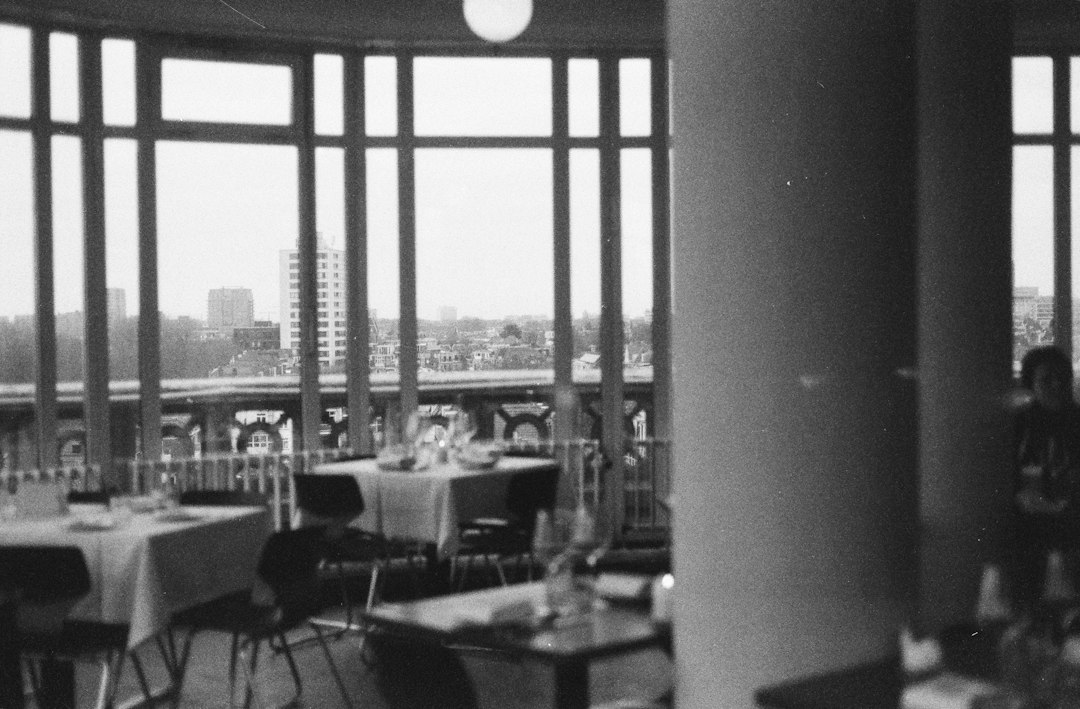
Photo by Tanya Prodaan on Unsplash
Why Movie Restaurants Always Have Window Tables
Watch any film with a restaurant scene and you’ll notice a pattern: the characters almost always sit at a table right by the window. It’s not just convenient blocking. The window table solves multiple technical and creative problems at once, which is why it shows up across decades and genres.
Natural Light and Production Control
Windows give cinematographers a powerful, controllable light source. Even when shooting interiors on a soundstage, a large window acts as a natural-looking key light that can be motivated by “daylight” from outside. The crew can position HMI lights or LED panels just outside the window to create soft, directional illumination that looks realistic without extensive overhead rigging.
This matters because restaurant interiors are notoriously difficult to light. The ceiling fixtures in real restaurants rarely provide cinematic quality light, and hanging film lights from the ceiling takes time and limits camera angles. A window eliminates that problem. The light motivation is built into the frame, and the source direction stays consistent across coverage.
Depth and Visual Interest
A window table creates automatic depth in the frame. Instead of shooting characters against a flat wall or generic restaurant background, the cinematographer gets layers: the characters in the foreground, the window frame in the middle ground, and the world outside in the background. That layering makes the image more dynamic and gives the viewer’s eye somewhere to travel.
The background through the window also provides narrative context without dialogue. A busy street suggests urban energy. A quiet park implies leisure. A rainy evening sets mood. The restaurant interior becomes a foreground element while the window serves as a visual portal to the story’s larger world.
Isolation Within Crowds
Placing characters at a window table also creates psychological separation. Even in a crowded restaurant, the window acts as a boundary that sets the main characters apart from the background extras. It frames the important conversation and signals to the audience where to focus attention.
This is especially useful in romantic or dramatic scenes where emotional intimacy matters. The window behind the characters creates a private bubble within a public space, letting the scene feel both exposed and contained at the same time. The couple or conspirators get their own visual zone without needing a completely empty restaurant, which would feel staged and unrealistic.
Blocking and Camera Placement
Window tables give directors clean blocking options. Characters can be seated facing each other in a classic two-shot, or side by side looking out at the view, which opens up different emotional dynamics. The window also provides a natural place for characters to look away during tense moments, giving actors a motivated physical action that reads on camera.
For the camera department, a window table means fewer obstacles. There’s open space on at least one side of the frame, which allows for dolly moves, over-the-shoulder coverage, and clean singles without having to navigate around other tables and extras. The window itself can be used as a framing device, with reflections adding another visual layer when the cinematographer wants it.
Production Design Efficiency
From a production standpoint, dressing the area near a window requires less work than building out an entire restaurant interior. The window draws the eye and provides visual interest, so the production designer can focus detail there and simplify the rest of the set. The depth of field often keeps background elements soft anyway, so a few well-placed extras and ambient light sell the illusion of a full establishment.
The window table isn’t just a cliché. It’s a practical, repeatable solution that serves the story, the cinematography, and the production schedule all at once. Once you notice it, you’ll see it everywhere, working quietly in the background of countless scenes.