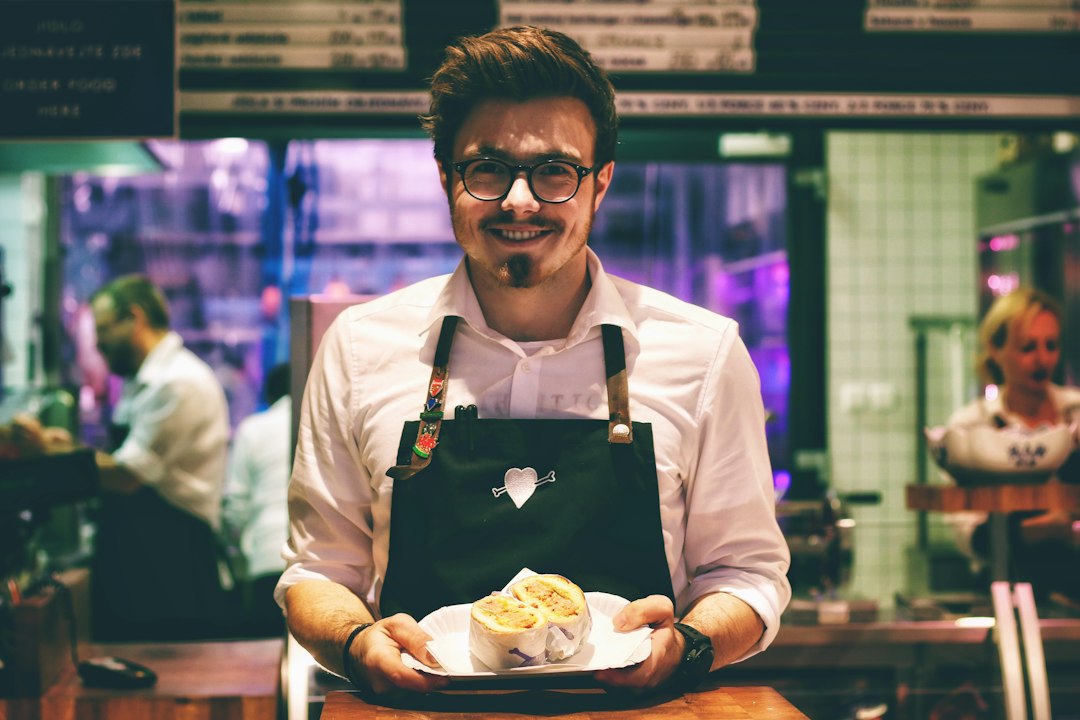
Photo by Petr Sevcovic on Unsplash
Why Movie Restaurants Seat Waiters Against the Wall
Watch any restaurant scene in a film and you’ll notice something odd: the waiter appears, delivers a line or sets down plates, then retreats to hover near a wall or doorway. They’re always visible in the background, but never crossing through the middle of the frame during important dialogue. This isn’t naturalistic behavior—real servers move fluidly through dining rooms, crossing sight lines constantly—but it’s essential blocking that solves one of the trickiest problems in shooting dialogue scenes.
Keeping the Background Active But Controlled
An empty restaurant reads as fake. Even if the story logic suggests a quiet night, a completely static background makes the scene feel like a stage play rather than a living location. Restaurants need movement—the clink of glasses, a server passing by, someone at another table—to feel real.
But that movement becomes a problem the moment you’re cutting between two actors in conversation. If a waiter walks behind one character during their close-up, then disappears when you cut to the reverse angle, the audience notices the discontinuity. Their brain registers that something changed between cuts, pulling attention away from the dialogue.
Positioning servers against the wall solves this. The waiter stays in the wide shot and the over-the-shoulder angles, visible enough to keep the space feeling occupied, but out of the tight singles on each actor’s face. They’re present without becoming a continuity headache.
The Geometry of Coverage
The standard way to shoot a two-person conversation is shot-reverse-shot: a medium or wide establishing shot, then closer angles on each character as they speak. The camera typically sits just behind one character’s shoulder, framing the other.
If a server walked through the center of the frame during this setup, you’d need to either include them in every matching angle—requiring precise choreography across multiple takes—or cut around them, losing control of the edit. Neither option is efficient.
By keeping the server pinned to the periphery, the director of photography can frame the principal actors without worrying about background figures wandering into inconsistent positions. The server becomes set dressing that moves just enough to register as human, but not so much that they complicate the edit.
Motivated Hovering
The trick is making the hovering look natural. A waiter standing motionless against a wall looks as artificial as an empty room. So servers are given tiny bits of business: folding napkins at a side station, checking their order pad, glancing toward the kitchen, wiping down a nearby table.
These actions justify their presence and keep them from pulling focus. The movement is minimal and rhythmic, occupying the same general zone frame after frame. The audience accepts them as environmental detail—the way you’d accept a fish tank or a ticking clock—rather than as characters whose position should be tracked.
The Exception for Plot-Relevant Servers
When the server actually matters to the story—delivering a key piece of information, interrupting at a crucial moment, or serving as a comic beat—the blocking inverts. Now the server moves from background to foreground, often stepping directly between the two main characters.
This shift in spatial relationship signals to the audience that the server has become narratively important. The scene stops being about the conversation and starts being about the interruption. Once their moment is over, they retreat back to the wall, restoring the focus to the principal actors.
Why It Matters
This kind of blocking is invisible by design. You’re not supposed to notice that every waiter in every film lingers near walls and doorways. But once you see it, you can’t unsee it—and you start to appreciate how much deliberate control goes into making a scene feel spontaneous.
The restaurant isn’t a neutral location. It’s a constructed space where every person, every movement, every object is placed to support the story being told in the foreground. The waiter against the wall isn’t lazy filmmaking. It’s precise filmmaking disguised as casualness.