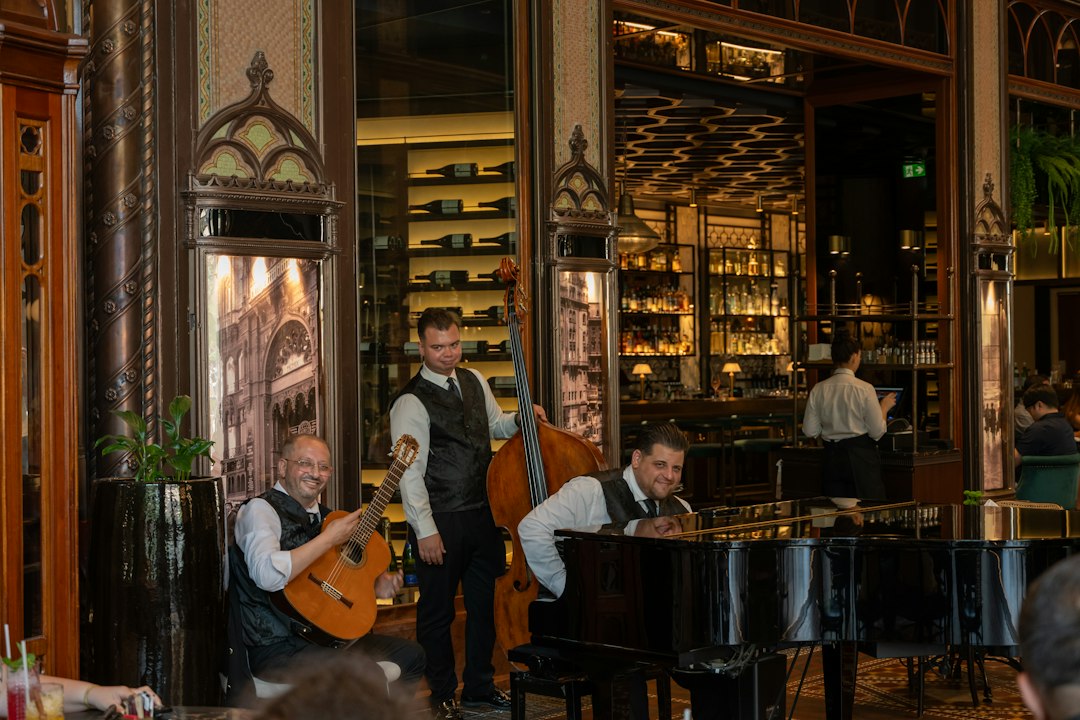
Photo by Carrie Borden on Unsplash
Why Movie Restaurants Always Have Someone Playing Piano
Watch enough films and you’ll notice a pattern: whenever characters enter an upscale restaurant, there’s often a pianist in the corner, playing soft jazz or classical music. It happens so frequently that it feels like every high-end establishment in the movie universe employs a live musician. The reality, of course, is that most fine dining restaurants pipe in recorded music or operate in relative quiet. So why does cinema love the restaurant pianist?
Diegetic Sound Without Licensing Headaches
The most practical reason is legal. When a scene needs atmosphere, filmmakers face a choice: use existing recorded music and pay licensing fees, or create original music that exists within the story world. A pianist playing in the background gives the scene musical texture while remaining diegetic—the music exists in the characters’ world, not just the soundtrack.
This also means the music can be composed specifically for the film, tailored to the scene’s emotional needs, and recorded during post-production without the complexity of clearing a famous song. The composer writes a few bars of generic restaurant jazz, it gets mixed at a lower level than dialogue, and the scene has instant sophistication.
Visual Shorthand for Class and Expense
A live pianist immediately signals that this restaurant is expensive and refined. It’s a visual and aural shorthand that requires no exposition. The audience understands the setting’s social tier within seconds. This matters especially in scenes where characters are trying to impress someone, celebrate an occasion, or have a serious conversation in a space that reflects their status or aspirations.
The piano itself often appears in soft focus behind the characters, a compositional element that adds depth to the frame while reinforcing the upscale atmosphere. It’s production design and sound design working in tandem—a two-for-one storytelling economy.
Controllable, Unobtrusive Audio
Unlike a full band or recorded pop music, a solo piano can be mixed to sit perfectly beneath dialogue. It’s harmonically rich enough to feel present but melodically simple enough not to compete with spoken lines. The filmmaker controls the volume, the tempo, and even the style in post-production, adjusting it to match the emotional arc of the conversation.
If the scene turns tense, the piano can fade out or shift to dissonant chords. If romance blooms, it can swell slightly. This flexibility makes the restaurant pianist a remarkably versatile tool—ambient when needed, expressive when the moment calls for it.
A Practical Background Action
From a production standpoint, having an actor mime playing piano gives the scene movement and life without complicating the shot. The pianist becomes a piece of controlled background action, something the camera can drift past or include in an establishing wide shot. It’s far easier to direct than coordinating a crowd of extras engaged in conversation, and it never pulls focus from the main scene.
The piano also justifies the acoustic quality of the space. Restaurants are often echoey, difficult environments for recording clean dialogue. The presence of live music gives the sound team a reason to treat the room’s acoustics more liberally—it’s supposed to have some reverb and ambiance.
The Exception That Proves the Rule
Occasionally, a film will subvert this convention for effect. A gritty drama might place characters in a silent, sterile restaurant to emphasize discomfort or alienation. A comedy might exaggerate the trope, placing an overly enthusiastic pianist right next to the couple trying to have an intimate conversation. But these exceptions only work because the audience has internalized the standard: upscale restaurant equals live piano.
The movie restaurant pianist endures because it solves multiple problems at once—legal, practical, aesthetic—while reinforcing the kind of world the story wants to inhabit. It’s invisible craft, a background choice that shapes how we read a scene without ever announcing itself.