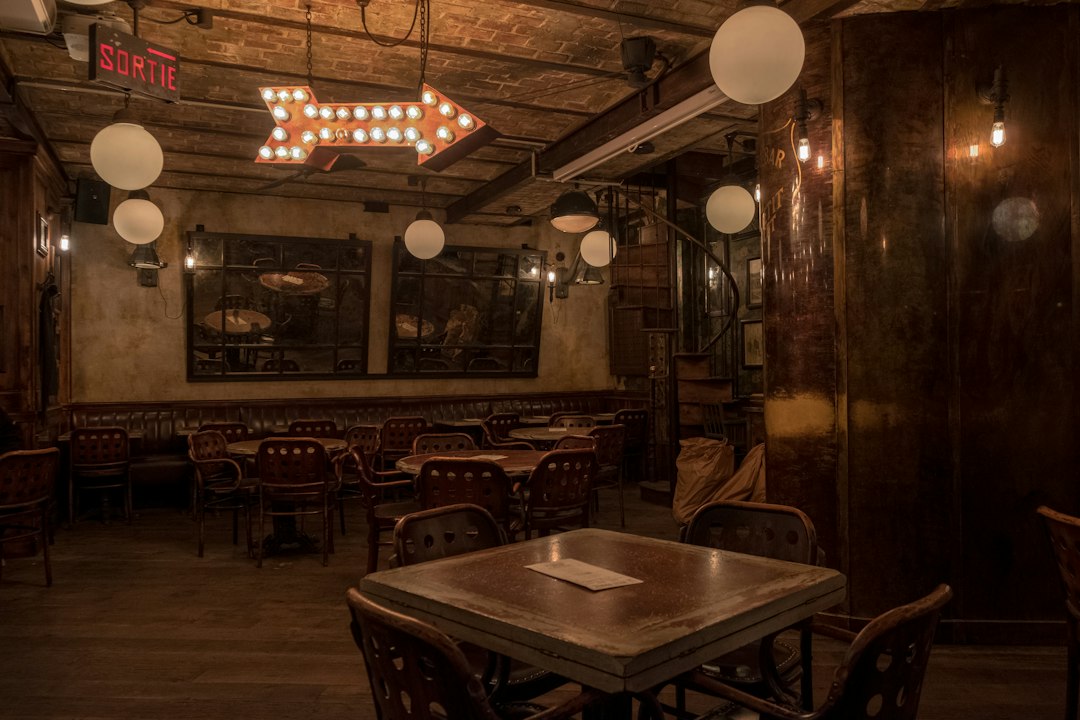
Photo by Nicolas Hoizey on Unsplash
Why Movie Restaurants Are Always Empty
Watch a romantic dinner scene or tense business lunch in almost any film and you’ll notice something odd: the restaurant is nearly deserted. Maybe one or two other tables have diners, politely ignoring our protagonists. But where are the crowds, the bustle, the ambient chaos of a real dining room at peak hours?
This isn’t lazy set dressing. It’s a deliberate choice driven by sound, focus, and the practical realities of controlling a film set.
The Sound Problem
Film sets run on dialogue clarity. Every word needs to be captured cleanly by boom microphones positioned just out of frame, and wireless lavs hidden under costumes. A real restaurant filled with fifty chattering diners creates an acoustic nightmare.
Even professional background actors instructed to mime conversation produce movement noise—silverware, chairs scraping, fabric rustling. Multiply that by dozens of people and the principal actors’ dialogue becomes nearly impossible to isolate. Yes, ADR can replace lines in post-production, but it’s expensive, time-consuming, and never quite matches the organic quality of production sound.
The solution: keep background population minimal. A strategically placed couple at a distant table suggests the space is operational without overwhelming the soundtrack. If the scene absolutely requires a packed house, productions sometimes add dense background crowds and then minimize their audio contribution through careful mic placement and post-production mixing—but most directors prefer to avoid the problem entirely.
Visual Focus and Depth
Cinematographers work constantly to direct the viewer’s eye toward what matters. A densely packed restaurant creates competition for attention. Even when background actors are carefully instructed to remain subdued, human movement naturally draws the eye.
Shallow depth of field helps—blurring the background into soft bokeh—but not every scene can be shot wide open at f/1.4. Some compositions require deeper focus to establish spatial relationships or show reactions across the room. An empty or nearly empty restaurant gives the camera breathing room to work at various apertures without worrying about distracting motion in the mid-ground.
Negative space also has emotional value. An empty dining room can underscore intimacy, isolation, or the characters’ separation from the ordinary world. It makes the space feel like it belongs to them, at least for the duration of the scene.
Practical Production Constraints
Every person on camera costs money. Background actors must be hired, costumed, fed, and managed. Multiply that by dozens of extras across multiple takes over several hours, and the budget impact becomes significant.
Beyond cost, there’s choreography. Each background actor needs blocking—where to sit, when to gesture, when to take a sip—and those actions must repeat consistently across every take. The more people in frame, the higher the chance someone breaks continuity: a wine glass that was full is now empty, a jacket on a chair has disappeared, someone looked directly at the camera.
Smaller background populations mean fewer continuity headaches and faster shooting days. Directors can focus on the principals without worrying that Table 7 ruined Take 9.
When Crowds Do Appear
Not every film follows this convention. Widescreen ensemble pieces, heist films, and stories where the crowd itself is narratively important will fill the restaurant. But even then, those crowded scenes are usually brief, highly controlled, and often rely on wider shots where individual background movements are less noticeable.
The next time you watch an intimate dinner scene, notice the emptiness. It’s not that fictional characters prefer dining in ghost towns. It’s that filmmakers need control over every element in the frame—and sometimes the best way to tell a story is to clear the room.