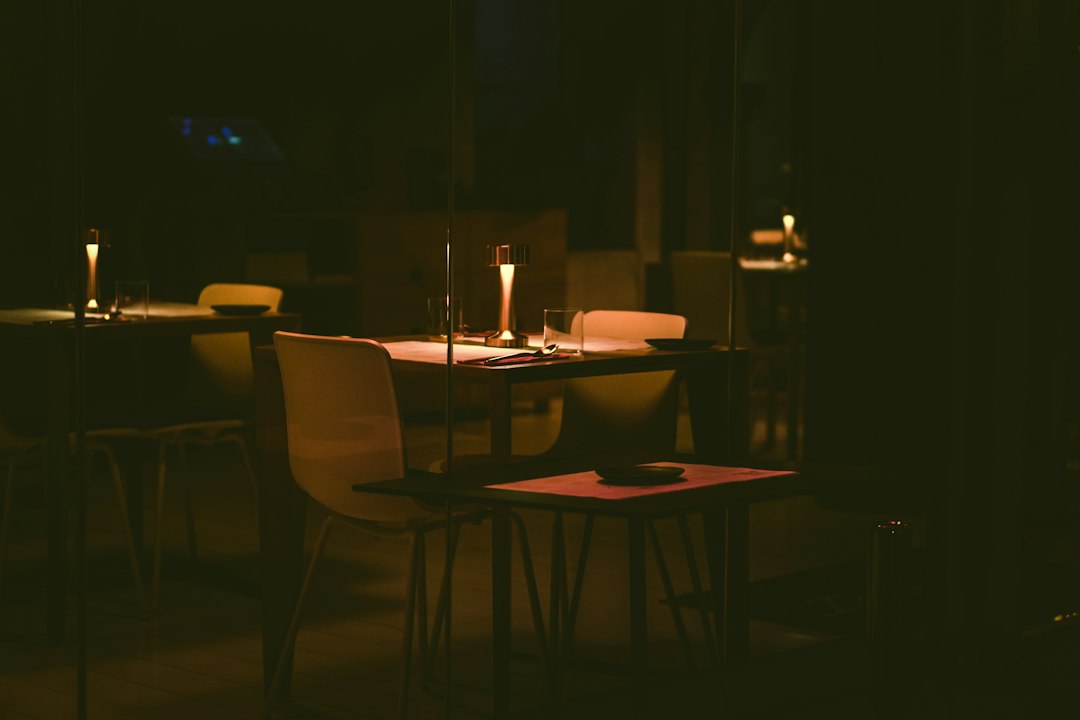
Photo by Ivan Benets on Unsplash
Why Movie Restaurants Are Always Candlelit
Watch any dinner scene in a film and you’ll notice something: candles everywhere. Not just on the table between two characters, but scattered across the frame—votives on nearby tables, tapers in the background, tea lights dotting the bar. The restaurant glows like a vigil site. This isn’t about setting a mood for the characters. It’s about giving the cinematographer a tool that solves several problems at once.
Motivated Light Sources
Cinematographers work with a principle called motivated lighting: every beam of light in the frame should appear to come from a visible, logical source within the world of the story. A table lamp. A window. A streetlight outside. Candles are the perfect cheat. They’re small, they’re expected in restaurants, and they give the DP permission to place soft, warm light exactly where it’s needed—right on the actors’ faces—without the audience questioning why that patch of the frame is so beautifully lit.
Candles also flicker, which adds organic movement to an otherwise static shot. That subtle variation in brightness keeps the image alive. It’s the same reason fires and practical lamps show up so often in period dramas: they justify the presence of warm, directional light in a scene that might otherwise feel flat or artificially lit.
Controlling the Environment
Restaurant scenes are notoriously difficult to shoot. Real dining rooms have overhead fluorescents, harsh ceiling fixtures, or worse—mixed color temperatures from windows, tungsten bulbs, and LED spots all fighting each other. To get a clean, cinematic image, the crew needs to control the light completely. That usually means turning off every existing light and relighting the entire space from scratch.
Candles give them a reason to do exactly that. Dim the overheads, kill the practicals, and let the “candlelight” (really a carefully hidden LED or tungsten source) become the dominant illumination. The result is a soft, controlled pool of light that wraps around faces, separates subjects from the background, and eliminates the unflattering shadows cast by overhead fixtures. The candle is the alibi for the lighting setup.
Depth and Separation
Cinematographers love candles in the background because they create depth. When you place a flickering light source behind your subject—on another table across the room, for instance—it adds a layer of visual interest and separates the actor from the backdrop. The human eye is drawn to light, so those scattered candles guide the viewer’s attention through the frame while reinforcing the sense of three-dimensional space.
This is especially useful in restaurants, which tend to be crowded, cluttered environments. A well-placed candle in the mid-ground or background gives the cinematographer a way to punctuate the composition without relying on complex blocking or camera movement.
Practical Flames vs. Movie Magic
Not every candle you see on screen is actually burning. Real flames are unpredictable, dim, and often not bright enough to register properly on camera—especially in digital cinematography, where sensors may struggle with the extreme contrast between a candle’s hot core and the surrounding darkness. Many “candles” are LED units designed to mimic the flicker and color temperature of flame. Others are enhanced in post-production, with the intensity boosted or the glow extended artificially.
But even when the candle is fake, its presence in the frame is doing real work. It’s a visual cue that tells the audience, “This space is intimate, low-lit, and romantic,” which in turn gives the cinematographer license to use soft, low-key lighting across the entire scene.
The Restaurant as Controlled Set
Film restaurants are built or dressed to be shot, not to serve food. That means fewer windows (to avoid uncontrollable daylight), darker walls (to absorb spill light), and strategic placement of practical light sources. Candles fit that paradigm perfectly. They’re inexpensive, easy to control, and infinitely adjustable. Need more light on the actor’s face? Add another votive. Want to warm up the background? Scatter a few tapers on the bar.
The candlelit restaurant isn’t a cliché. It’s a lighting design disguised as set dressing.