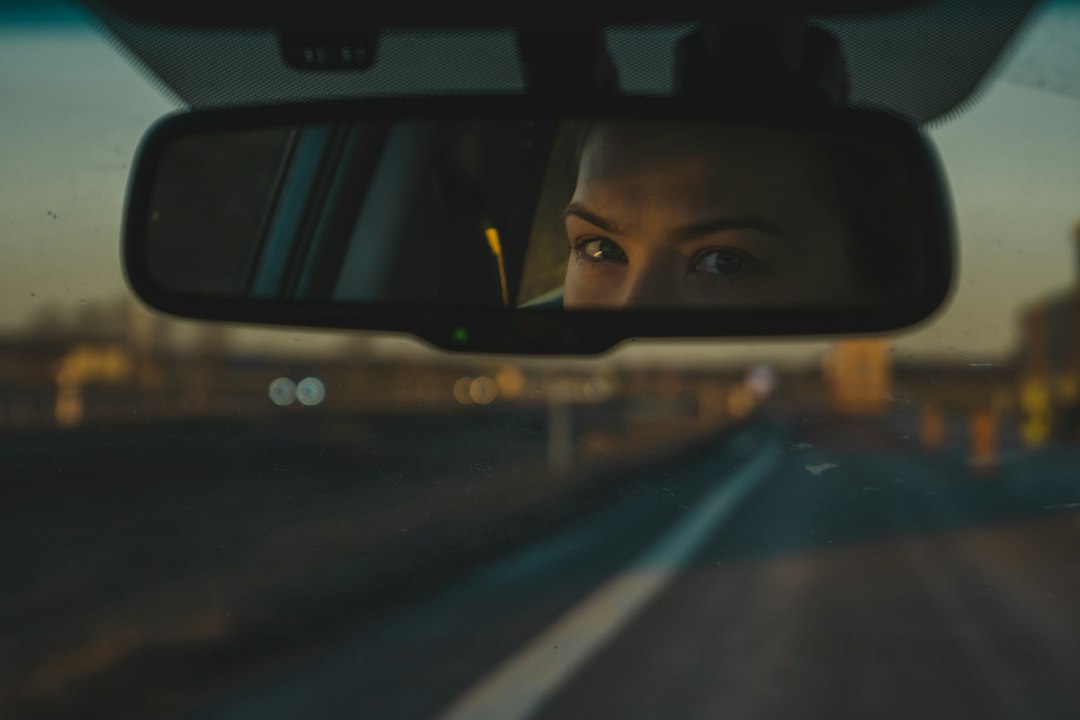
Photo by Robin Edqvist on Unsplash
Why Movie Rearview Mirrors Are Adjusted On Screen
You’ve seen it dozens of times: a character gets into a car, settles behind the wheel, and reaches up to adjust the rearview mirror before pulling away. It happens in thrillers, road movies, dramas, even comedies. The gesture feels natural enough that most viewers never question it. But watch closely and you’ll notice something odd—the mirror often doesn’t look misaligned to begin with.
This isn’t about realism. It’s about camera.
The Blocking Problem
Car interiors are cramped shooting environments. The camera needs a clear sightline to the actor’s face, the windshield, and ideally the road ahead. But a rearview mirror sits exactly where a cinematographer wants the cleanest frame: right in the center of the upper third, directly in front of the actor’s face.
In a real car, the mirror is angled to show the driver what’s behind them. On a film set, that angle becomes a compositional obstacle. It can block part of the actor’s face, cast a shadow, or create an unwanted shape that cuts through the frame. Adjusting it on camera solves the problem in a way that feels motivated by character action rather than production necessity.
The Psychology of Settling In
The adjustment also works as a micro-ritual. It signals that the character is taking control, preparing to move, entering a different emotional or physical space. In tense scenes, the gesture can heighten focus or delay the moment before something happens. In quieter moments, it’s a beat that lets the actor transition from stationary to active mode without dialogue.
Directors use it the same way they use characters checking their watch, zipping a jacket, or fastening a seatbelt—small actions that give the audience a moment to register a shift. The mirror adjustment is particularly useful because it’s an upward motion that naturally lifts the actor’s eyeline, opening up their face to the camera and creating a cleaner shot.
Practical Coverage
Adjusting the mirror also gives the editor an option. If the scene requires cutting between different takes or camera angles inside the car, the adjustment can act as a transitional action that helps mask the edit. The movement draws the eye, and the brief shift in hand position or head tilt can smooth over a change in framing or lighting that might otherwise feel abrupt.
It also gives the actor something physical to do while delivering a line or reacting to new information. Instead of sitting static behind the wheel, they have a reason to move their hand, shift their posture, or glance upward—all of which add texture to the performance and help vary the visual rhythm of the shot.
When It Doesn’t Happen
Not every car scene includes the adjustment, and its absence can be just as deliberate. In chase sequences or moments of sudden urgency, characters skip the ritual entirely and throw the car into gear. The lack of adjustment reinforces the chaos or immediacy of the moment. In scenes where a character is already in motion or the camera is mounted outside the vehicle, the mirror becomes irrelevant to the composition, so there’s no need to touch it.
The adjustment is most common in shots where the camera is inside the car, the scene is dialogue-driven or emotionally weighted, and the cinematographer needs to optimize the frame around the actor’s face. It’s a small cheat that serves composition, performance, and pacing all at once—and it works because it mirrors a gesture people actually do, even if the on-screen version happens far more consistently than it ever would in real life.
A Gesture That Hides in Plain Sight
Like so many filmmaking techniques, the rearview mirror adjustment succeeds because it doesn’t announce itself. It feels like behavior, not craft. But once you start watching for it, you’ll see it everywhere: the slight upward tilt, the two-finger nudge, the glance into the mirror that isn’t really checking the road behind but opening the actor’s face to the lens. It’s a small move that clears the frame and keeps the focus exactly where the story needs it.