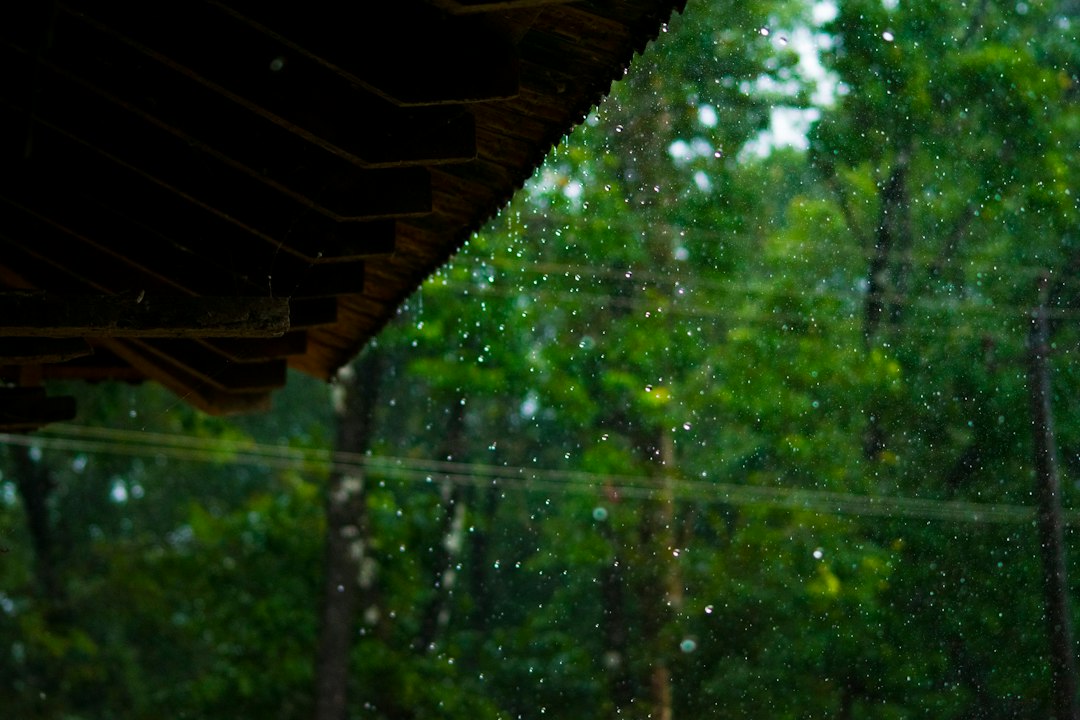
Photo by TARUN RAJ BN on Unsplash
Why Movie Rain Always Looks Silver on Screen
Watch any movie with a rain scene and you’ll notice something odd: the rain always appears as brilliant silver streaks against the darkness, each droplet catching light like falling metal. Step outside during an actual rainstorm and you’ll see something completely different. Real rain, especially at night, is nearly invisible.
This disconnect exists because cameras don’t see rain the way our eyes do. Human vision processes a three-dimensional scene with depth perception and constant micro-adjustments. A camera captures a flat image at a fixed exposure. Without special treatment, rain simply disappears into the frame, registering as barely perceptible gray specks if it registers at all.
The Backlighting Solution
The solution is backlighting. Cinematographers place powerful lights behind the rain, between the downpour and the background. When rain falls through these light sources, each droplet becomes a tiny reflective surface, transforming invisible water into visible silver streaks.
This technique works because water droplets scatter light effectively when illuminated from behind. The same principle makes dust visible in a shaft of sunlight streaming through a window. Position the light source behind the particles and they glow. Put it in front and they vanish.
Most rain scenes use large HMI lights positioned out of frame, aimed toward the camera through the rain. The key is keeping the light source itself out of the shot while ensuring its beam fills the space where rain is falling. If you watch carefully, you’ll notice movie rain often appears brightest in the mid-ground, with foreground and deep background rain less visible—a telltale sign of where the backlight is positioned.
Why Rain Towers Exist
Natural rain rarely falls heavily enough or consistently enough for filming. Productions use rain towers, rain bars, or crane-mounted sprinkler systems to create controllable artificial rain. These systems pump hundreds of gallons per minute through perforated pipes, creating uniform rainfall that can be turned on and off between takes.
But artificial rain creates the same visibility problem as natural rain, just more controllably. The water still needs backlighting to read on camera. Productions typically use multiple light sources at different distances to create depth, ensuring rain appears visible throughout the frame rather than in a single plane.
The Color Temperature Factor
That silver appearance isn’t just about brightness—it’s about color temperature. Most rain backlighting uses daylight-balanced HMI lights, which produce a cool, blue-white light around 5600K. This cool tone contrasts with the warmer light sources often used for foreground subjects and practical lights in the scene, making the rain stand out even more distinctly.
The contrast between cool-toned rain and warm-toned environments has become a visual shorthand. Our brains have been trained by thousands of movie rain scenes to associate that silver-blue streak pattern with rain, even though it bears little resemblance to what rain actually looks like in most real-world conditions.
When Rain Doesn’t Glow
Occasionally, filmmakers deliberately avoid the backlit silver rain look. Daytime rain scenes in overcast conditions can show rain more naturally because ambient light is already diffused and even. Heavy rain in these conditions reads on camera without additional backlighting, though it typically appears as gray streaks rather than silver ones.
Some directors avoid artificial rain altogether, shooting during actual weather and accepting whatever visual result they get. This approach creates a more naturalistic look but sacrifices control. The rain might be too light, too heavy, or simply invisible in the final image.
The backlit silver rain technique persists because it works. It creates a consistent, readable, dramatic representation of rain that audiences immediately recognize. Real rain may be invisible, but movie rain needs to announce itself—and backlighting remains the most effective way to make water perform for the camera.