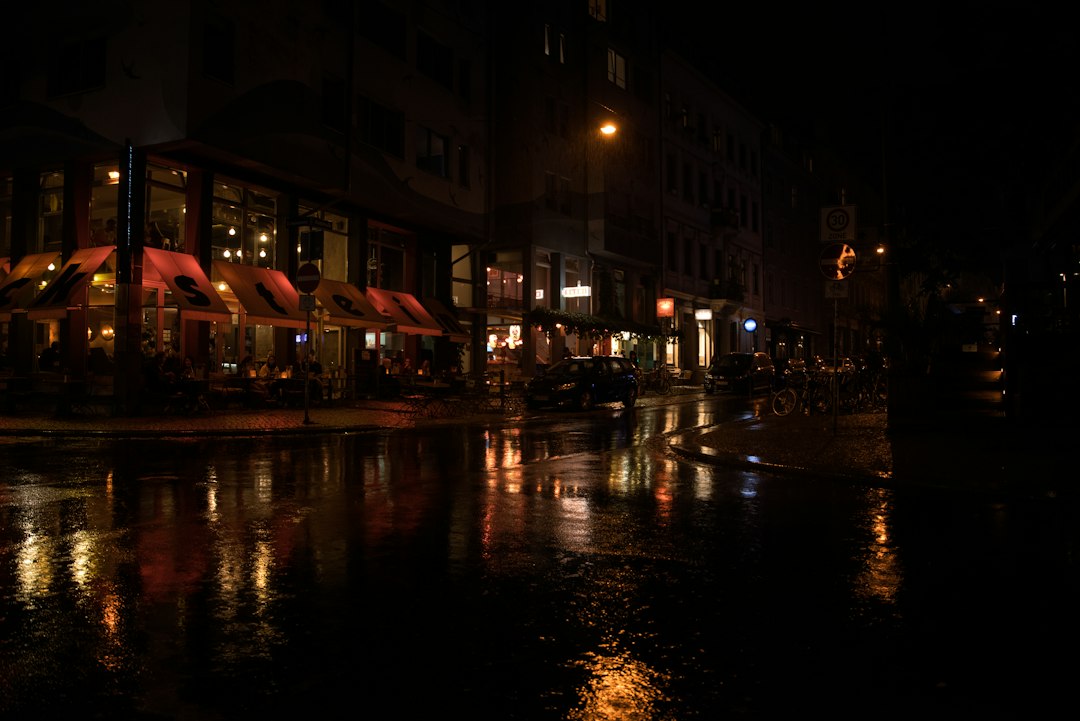
Why Movie Rain Always Falls at Night
Open any streaming service and search for rain scenes. You’ll notice a pattern: most of them happen after dark. Lovers reconcile in parking lots under streetlights. Detectives stand over bodies while water streams off their coats. Heroes walk away from explosions as a downpour begins. It’s not that rain never falls during movie daylight—but when filmmakers want rain to feel like rain on screen, they wait until night.
Rain Needs Light to Read on Camera
The core problem is visibility. Rain is mostly transparent. A droplet catches light for a fraction of a second as it falls, then disappears. In bright, diffuse daylight, individual drops become nearly invisible to the camera. What you end up with is a faint haze and wet ground, but no sense of the rain itself falling through the frame.
At night, cinematographers can control exactly where light hits the rain. A backlight placed behind the curtain of water makes every drop glow as it passes through the beam. Streetlights, car headlights, neon signs, and practicals in windows all create isolated pools of illumination that turn rain into visible streaks. The darkness between those pools gives the eye contrast, so the rain reads as texture rather than noise.
Daytime rain requires either overcast skies to dim the ambient light or a much higher volume of water to register on camera. Both options are expensive and harder to control. Night exteriors let a crew light the rain like a stage effect.
Hiding the Infrastructure
Movie rain doesn’t fall from clouds. It comes from rain towers, rain bars, and tanker trucks parked just outside the frame. These rigs use garden hoses, perforated pipes, and sometimes fire hoses to dump thousands of gallons over a small area. During the day, all that infrastructure is harder to hide. The trucks, the scaffolding, the hoses snaking across the ground—they all risk appearing in wide shots or reflected in windows.
At night, the same equipment disappears into the background. A rain tower twenty feet tall becomes invisible when it’s not lit. The crew can position rigs closer to the actors without worrying about shadows or silhouettes. Darkness is forgiveness.
Emotional Permission
There’s also a storytelling reason. Night rain gives the filmmaker permission to drench a character without explaining why they’re still standing outside. In daylight, audiences expect people to seek shelter, grab an umbrella, or at least react to getting soaked. At night, especially in moments of emotional extremity, we accept that a character might stand in a downpour because they’re too lost in grief, rage, or relief to care.
The noir tradition cemented this: rain-slicked streets at night became visual shorthand for moral ambiguity, urban isolation, and emotional breakdown. Filmmakers still draw on that vocabulary. When you see rain at night, you’re primed to read the scene as heightened, operatic, or emotionally raw in a way that a sunny drizzle would undercut.
The Practical Cost
Rain is one of the most expensive effects in filmmaking. Every surface that gets wet has to be dried or reset between takes. Actors need fresh costumes. Makeup has to be reapplied. Cameras need weather protection. And if you’re shooting at night, you’re already paying overtime rates for the crew.
But night exteriors also tend to be shorter shooting windows. A crew might only have four or five hours of full darkness, which forces efficiency. Rain scenes get blocked, rehearsed, and executed quickly. The time pressure and the expense combine to make every drop count—and that urgency shows up on screen as intensity.
Rain in movies is rarely about realism. It’s about making water visible, hiding the machinery, and giving emotion a physical shape. Night does all three.