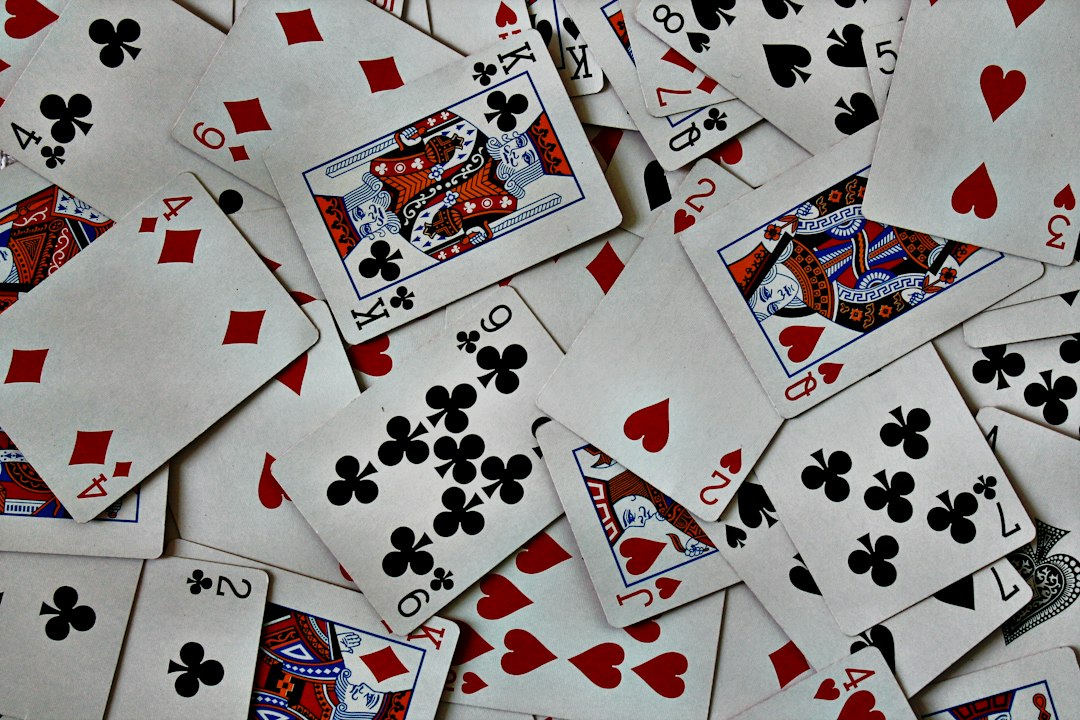
Photo by Amanda Jones on Unsplash
Why Movie Poker Players Never Look at Their Cards Twice
Watch any poker scene in a movie and you’ll notice something that would make any actual card player laugh: characters glance at their hand once, absorb the information instantly, and never look again. No matter how many minutes pass, no matter how the betting escalates, they remember their exact cards without a second peek.
Real poker players check their cards constantly. They forget if they have the jack or the ten. They sneak another look to confirm the suit. They verify their kicker before calling an all-in bet. It’s normal human behavior when managing information under pressure.
So why does cinema ignore this reality?
The Mechanics of Screen Time
Film poker operates under different rules than real poker because every second counts. A poker hand that takes fifteen minutes in real life needs to compress into ninety seconds on screen. Every glance at cards, every moment of confirmation, every redundant gesture is dead weight.
When a character looks at their cards once and puts them down, the scene maintains forward momentum. The camera can stay on faces, on betting patterns, on the psychological warfare between players. The instant the character needs to check their cards again, the camera must cut away from the human drama to show pieces of paper we’ve already seen.
Directors protect visual pace. Looking at cards twice means showing the cards twice, which means repeating information the audience already has. Cinema avoids repetition unless the repetition itself carries meaning.
Reading the Face, Not the Hand
Poker scenes are rarely about poker. They’re about character, power dynamics, and whether someone is bluffing their way through a confrontation. The cards matter less than the faces.
When James Bond glances at his hand and sets it down, the scene can focus entirely on his opponent’s tells, the sweat forming, the finger tapping the table. If Bond keeps checking his cards, the audience attention splits. The visual language says “the cards are the important thing,” when the scene is actually about nerve and deception.
Actors play poker scenes as mind games. They hold eye contact. They deliver dialogue. They make minute facial adjustments. All of that falls apart if they have to keep dipping their head to verify whether they’re holding two pair or a straight.
The Cognitive Shorthand
Movies also assume their characters possess perfect memory for plot-critical information. A detective remembers every clue without checking notes. A spy recalls a twelve-digit code after hearing it once. A poker player knows their cards.
This isn’t realism—it’s narrative efficiency. Characters inhabit a slightly heightened reality where mundane cognitive failures don’t intrude unless they serve the story. The same way movie characters never stumble over words unless they’re nervous, they never forget their cards unless the forgetting matters thematically.
The exception proves the rule: when a character does check their cards multiple times, it signals something. Uncertainty. Amateur status. A trick, where they’ve swapped cards and need to confirm the switch worked. Looking twice becomes a storytelling tool precisely because the convention is to look once.
Practical Production Constraints
There’s also a technical reason. Poker scenes require coverage from multiple angles, shot over hours or even days. Actors hold prop cards that may not match from take to take. Continuity becomes a nightmare if characters keep picking them up.
By establishing a rule—look once, then leave them face-down—script supervisors and editors can maintain visual consistency. The cards stay in one position. The actor’s hands stay visible and empty. The scene cuts together cleanly without worrying about whether the card angles match from the master shot to the close-up.
When Breaking the Rule Works
Occasionally, a film deliberately shows repeated card-checking to create a specific effect. A character who keeps looking appears nervous, unprofessional, or out of their depth. The contrast with the confident opponent who looked once heightens the power imbalance.
But these moments work because they violate the convention. The audience recognizes the anomaly. Checking the cards twice becomes a visual signal, the same way a character fidgeting or sweating signals their internal state without dialogue.
Cinema poker is not real poker. It’s a compressed, stylized version designed for an audience that needs clarity and momentum. The instant card memory is part of that stylization—a small sacrifice of realism that keeps the camera where it belongs, on the human drama rather than the cards.