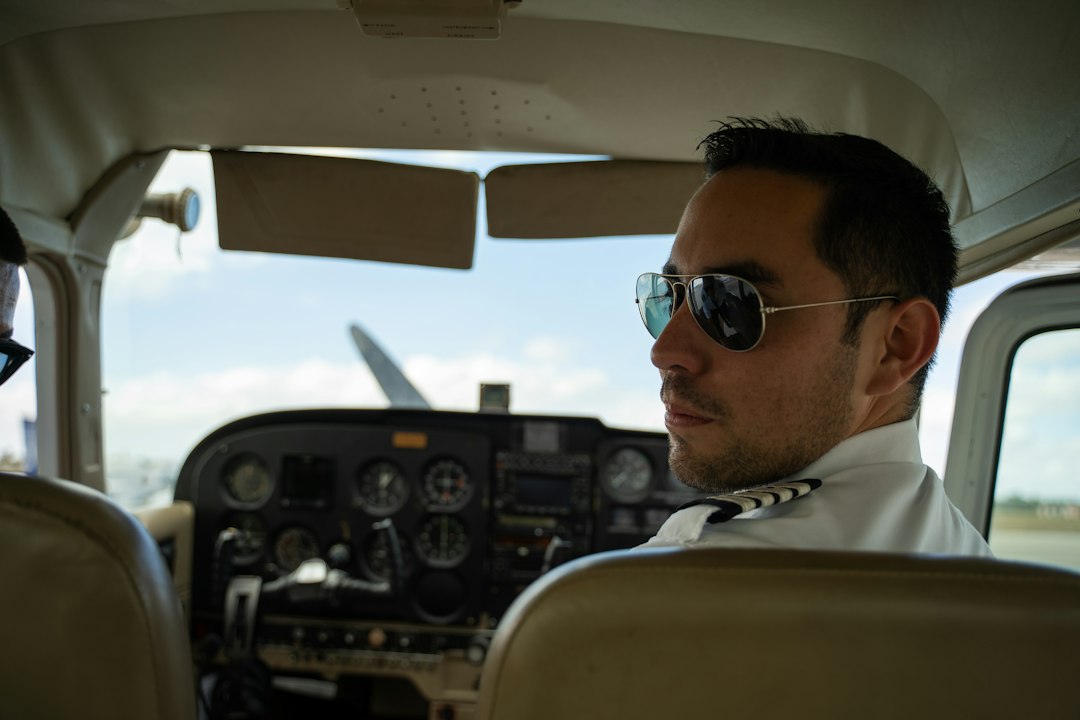
Photo by Pasqualino Capobianco on Unsplash
Why Movie Pilots Always Wear Aviator Sunglasses
Walk onto any movie set featuring a pilot character and you’ll find a pair of aviator sunglasses waiting in the costume rack. It’s so predictable it borders on parody: fighter pilots, commercial airline captains, helicopter crew, even vintage barnstormers all reach for the same teardrop-shaped frames. The convention is so deeply embedded that a pilot without aviators feels incomplete, like a detective without a trench coat or a hacker without a hoodie.
The choice isn’t arbitrary. Aviator sunglasses solve several practical filmmaking problems while delivering instant visual communication about competence, authority, and cool under pressure.
Visual Shorthand for Competence
Costume designers use aviators as instant character establishment. The moment an actor slips them on, the audience receives a bundle of associations: technical skill, steady hands, military discipline, calculated risk-taking. The sunglasses compress backstory into a single prop. No dialogue needed to establish that this character knows what they’re doing in a cockpit.
This works because aviators carry decades of real-world association with flight. Developed for military pilots in the 1930s, the design solved the genuine problem of glare at altitude while providing peripheral vision coverage. By the time cinema widely adopted them, aviators already signaled “professional aviator” in the public imagination. Filmmakers simply borrowed that existing cultural encoding.
The Reflection Problem
From a cinematography standpoint, aviators offer a crucial advantage: the large, curved lenses can be controlled in post-production or managed on set with careful lighting. When a character needs to look authoritative while piloting, you want to see some of their eyes for emotional connection, but you also need to manage reflections of lighting rigs, camera crew, and cockpit instrumentation that would break immersion.
Production designers can tint or treat aviator lenses to a specific darkness that blocks reflections while allowing the actor’s eyes to remain barely visible. The teardrop shape also means the lenses curve away from the camera in most angles, reducing the flat mirror effect you’d get from wayfarers or rectangular frames.
Continuity and Control
Sunglasses also solve an eye-line continuity problem. Cockpit scenes are often shot out of sequence over multiple days, sometimes with a real aircraft, sometimes on a gimbal stage, sometimes in front of a green screen. Maintaining consistent eye brightness, pupil dilation, and squint patterns across those shoots is nearly impossible.
Aviators give actors a consistent look across takes and setups. The script supervisor doesn’t need to match exact eye expression frame-by-frame when the eyes are partially obscured. This is especially useful in action sequences where coverage might be grabbed from multiple units or even different aircraft.
The Maverick Effect
While aviators have been cinema shorthand for decades, Top Gun in 1986 elevated them to iconography. The Ray-Ban 3025 frames became so synonymous with the film’s aesthetic that the style experienced a massive commercial resurgence. Every military aviation film since exists in that visual shadow.
Filmmakers now face a choice: embrace the association and use aviators to tap into that established visual language, or deliberately avoid them and risk the pilot feeling less authentic to audience expectations. Most choose the former. The cultural imprint is too strong, and fighting it means spending screen time re-establishing credibility that aviators grant instantly.
When Pilots Don’t Wear Them
The few times filmmakers omit aviators, it’s usually a deliberate signal. A commercial pilot in regular glasses reads as less action-oriented, more technical. A military pilot without sunglasses in a tense cockpit scene creates vulnerability or suggests something has gone wrong with protocol. The absence itself becomes a storytelling choice, which only works because the presence is so expected.
Aviator sunglasses have become more than a costume choice. They’re a visual grammar element, as codified as a judge’s gavel or a chef’s toque. The moment they appear, a specific set of character traits and narrative expectations engage, saving precious screen time while delivering exactly the image decades of cinema have taught audiences to read.