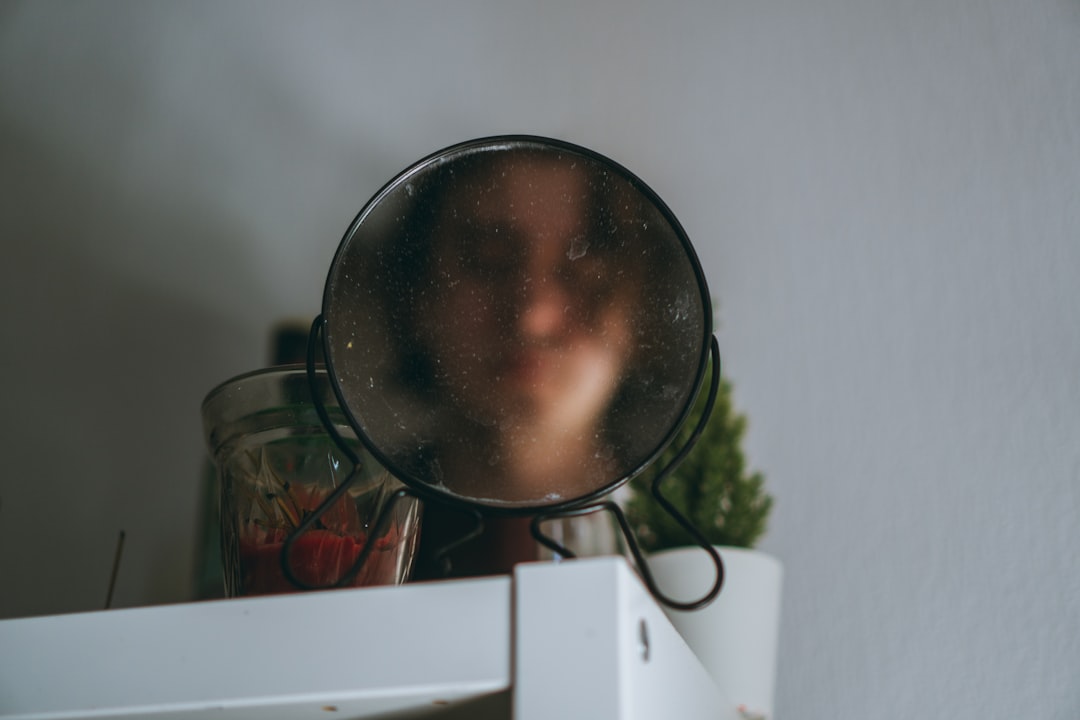
Photo by Alexander Grigoryev on Unsplash
Why Movie Mirrors Rarely Show Camera Reflections
Watch a character walk up to a bathroom mirror in a film and you’ll see their face perfectly reflected. What you won’t see is the camera operator, boom mic, lights, or crew standing directly in front of them. This isn’t luck or post-production wizardry in most cases. It’s careful choreography, optical geometry, and a handful of clever tricks cinematographers have refined over decades.
The Angle Is Everything
The simplest method is positioning. Cameras don’t shoot head-on into mirrors because they don’t have to. The audience needs to see the character’s reflection, not a documentary-accurate view of what a mirror would actually show. By placing the camera at an angle just outside the mirror’s reflective path, the lens captures the actor’s face in the glass while remaining invisible itself.
This works because of basic physics: the angle of incidence equals the angle of reflection. If you’re not standing in the geometric path between the mirror and the reflected subject, you won’t appear. Cinematographers map this out carefully, sometimes using laser pointers or small test mirrors during blocking to verify sightlines. The actor hits their mark, the camera holds its position, and the illusion holds.
When Angles Aren’t Enough
Sometimes the shot requires a straight-on view, or the mirror is too large to avoid. In these cases, crews turn to misdirection and masking. Strategic set dressing—a lamp placed just so, a door frame, a piece of foreground furniture—can hide the camera without the audience noticing. The reflection shows the character clearly, but the crew stays tucked behind a visual obstruction that feels natural to the scene.
Another option: shoot the mirror at a height or distance where the camera stays below or above the reflected frame. Low-angle shots of a character looking down into a compact mirror, or high shots of someone at a vanity, keep the equipment out of view by keeping it out of the mirror’s range entirely.
CGI and Removal Work
Digital tools do play a role, but less often than you might assume. Painting out a camera reflection in post-production is time-consuming and expensive. It requires rotoscoping, tracking, and often recreating parts of the background frame by frame. Most productions avoid this unless the shot is essential and no practical solution exists.
When removal is necessary, it’s usually because the creative vision demands an impossible angle or the mirror occupies too much of the frame to cheat. Even then, cinematographers try to minimize the work by keeping the camera as small and unobtrusive as possible, or by shooting in ways that make the paint-out simpler.
Shooting Through the Mirror
One advanced approach flips the problem entirely: the “mirror” isn’t a mirror at all. For certain setups, crews build a false wall with a window-sized opening and place the actor on the opposite side. The camera shoots through the opening, capturing the actor head-on, while the audience believes they’re seeing a reflection. This works particularly well for bathroom or bedroom scenes where the geography of the space isn’t fully established.
The actor performs as if looking at their reflection, but they’re actually staring through the empty frame toward the lens. Set dressing and lighting sell the illusion. It requires precise art direction to match what would be visible in a real mirrored space, but it guarantees zero reflections because there’s no reflective surface involved.
Why It Matters
These techniques aren’t about deception for its own sake. They preserve immersion. A visible camera snaps the viewer out of the story and reminds them they’re watching a constructed image. By hiding the apparatus, filmmakers keep the focus on character and emotion.
The mirror becomes a storytelling tool—a moment of self-examination, vanity, vulnerability, or revelation—rather than a technical hurdle. The craft lies in making the complicated look effortless, so the audience never thinks to ask how the shot was done. They just believe what they see.