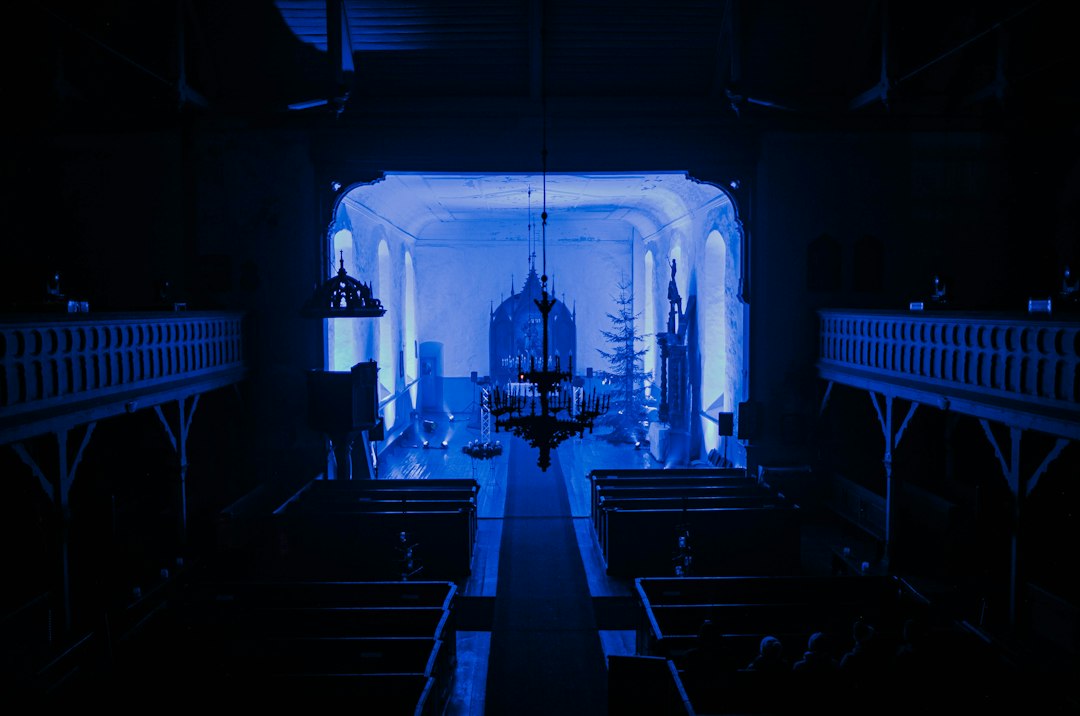
Photo by Artis Kančs on Unsplash
Why Movie Laboratories Are Always Dark
Walk into any real research laboratory and you’ll be greeted by overhead fluorescent panels casting flat, even light across every surface. Bench space is brightly lit for precision work. Safety requires visibility. But in movies, scientists conduct their experiments in near-darkness, illuminated only by the glow of monitors, bubbling beakers of colored liquid, and shafts of moody blue light.
The disconnect is so consistent that it’s become visual shorthand: dim lighting equals serious science.
Production Design Over Realism
The choice is entirely about mood and visual hierarchy. A brightly lit laboratory looks clinical, institutional, and visually flat—difficult to make cinematic. Darkness allows the production designer and cinematographer to control exactly what the audience sees. They can spotlight the important elements (the experiment, the scientist’s face, the ominous result) while letting everything else fall into shadow.
Selective lighting creates depth in the frame. It separates the subject from the background and adds dimension that would disappear under even fluorescent wash. A rack of test tubes glowing green in the foreground, a scientist’s face half-lit from below, a computer screen casting cold light—these are compositional choices that only work when most of the room stays dark.
Blue as the Color of Intelligence
Movie laboratories tend toward blue lighting specifically. Not the warm incandescent glow of a home, not the neutral white of an office—blue. The color has become coded as scientific, technological, and cerebral. It suggests precision and detachment. It’s the same reason computer screens in films always seem to cast an exaggerated blue glow onto faces, even when real monitors don’t.
Blue also contrasts well with skin tones and allows for pops of other colors—the red of a warning light, the green of a bubbling chemical—to register more dramatically. It’s a lighting palette that signals “this is a place where important, dangerous, or morally ambiguous work happens.”
Practical Considerations
There’s also a practical reason: actors look better in controlled, directional light than under flat overhead fixtures. Cinematographers can shape faces, create catchlights in the eyes, and add visual interest that would require significant effort to achieve in a fully lit space.
Real laboratories are bright because researchers need to see what they’re doing. Movie laboratories are dark because the audience needs to feel something about what’s happening. The lighting isn’t there to illuminate the science—it’s there to communicate tone.
The Trope in Action
This visual language is so embedded that it even extends to spaces that have no reason to be dark. A paleontologist examining fossils, a medical researcher running blood tests, a tech startup founder coding late at night—all of them work in moody half-light. The convention has spread beyond labs into any space associated with intellectual or technical work.
The result is a persistent gap between how research looks on screen and how it actually functions. But filmmakers aren’t trying to document reality—they’re building a visual grammar where darkness equals intensity, focus, and stakes. The laboratory isn’t lit for the scientist. It’s lit for the story.
Audiences accept the convention because it delivers the emotional beat the scene requires. We don’t question why the researcher doesn’t just turn on the overhead lights. We understand, without being told, that the darkness means the work is serious, secret, or dangerous. The lighting is doing narrative work that dialogue would otherwise have to carry.
Movie laboratories stay dark because cinema prioritizes emotion and composition over documentation. The choice sacrifices realism for mood, and after decades of repetition, that mood has become the realism we expect.