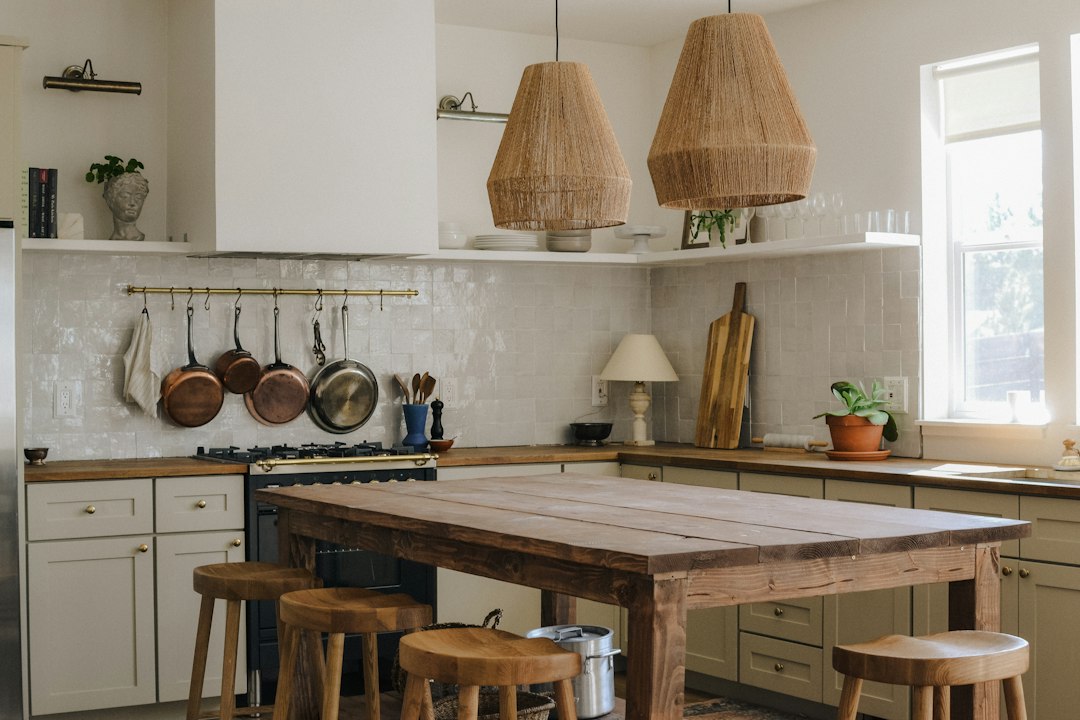
Photo by Sosey Interiors on Unsplash
Why Movie Kitchens Always Have the Light On
Walk into almost any movie kitchen during a daytime scene and you’ll notice something odd: the overhead lights are on. Not just on—they’re glowing conspicuously, even though sunlight streams through the windows. It’s a small detail that breaks from how real people live, yet it appears so consistently across films that it functions as an unspoken rule of cinema.
The choice isn’t carelessness. It’s a deliberate production decision rooted in three overlapping concerns: cinematography, continuity, and spatial legibility.
Practical Lights as Cinematography Tools
Cinematographers need to control every light source in a frame. Natural window light fluctuates with cloud cover, time of day, and sun position, making it unreliable for matching shots captured hours or days apart. A kitchen pendant light or under-cabinet fixture that stays on throughout filming acts as a constant, known source the DP can build around.
These practical lights—so called because they’re real fixtures visible in frame, not film lighting equipment—also motivate the broader lighting setup. If a pendant hangs over the island, the key light rigging can justify its direction and intensity by appearing to extend that same source. The audience accepts the lighting because they see a reason for it within the world of the film.
Leaving practicals on also prevents dead zones. Kitchens are spaces full of vertical elements: cabinets, refrigerators, doorways. Without strategic light sources, faces passing through can fall into shadow. An overhead fixture fills in those gaps and keeps actors visible as they move through the blocking.
Continuity Insurance
Film production shoots scenes out of sequence and captures multiple takes from different angles over hours. Imagine a conversation scene in a kitchen: master shot at 10 a.m., close-ups after lunch, inserts at 3 p.m. The sun has shifted dramatically, but the edited sequence will intercut all those angles as if they happened in the same continuous two minutes.
Keeping practical lights on throughout provides a consistent ambient baseline. The fixture itself appears identical in every shot, and the light it casts remains stable regardless of what the natural light outside is doing. Continuity supervisors have one less variable to track, and editors can cut freely without visible lighting mismatches.
This becomes even more critical in day-for-night shoots or scenes that straddle magic hour. A kitchen light left on throughout means the space reads consistently whether the windows behind are bright, dim, or color-corrected to look like dusk.
Spatial Hierarchy and Domestic Realism
Beyond technical necessity, lit practicals help the audience read the space. Kitchens in films are social hubs—characters cook, argue, reconcile, conspire. The frame often includes multiple planes: foreground action at the island, mid-ground movement at the stove, background figures at the table. Overhead lighting defines those layers and prevents the room from flattening into an indistinct box.
There’s also a paradoxical realism at play. While real people don’t leave lights on during bright afternoons, they do turn them on in the early morning, late evening, and overcast days—times when movie scenes also frequently take place. Keeping the light on signals “this is a lived-in home” more effectively than a dark fixture would. It implies someone just brewed coffee or is about to start dinner. The glow reads as warmth and habitation, even if the logic doesn’t quite track.
When Darkness Matters
Not every kitchen scene follows this convention. Thrillers and horror films frequently use unlit kitchens to create unease. A character entering a dark kitchen where the light should be on can signal danger or abandonment. In naturalistic dramas aiming for stark realism, DPs might choose to rely entirely on window light and let shadows fall where they may.
But for the vast majority of mainstream films, the kitchen light stays on. It’s a quiet compromise between how life looks and how cinema works—one more invisible decision that helps the story flow without calling attention to the craft behind it.