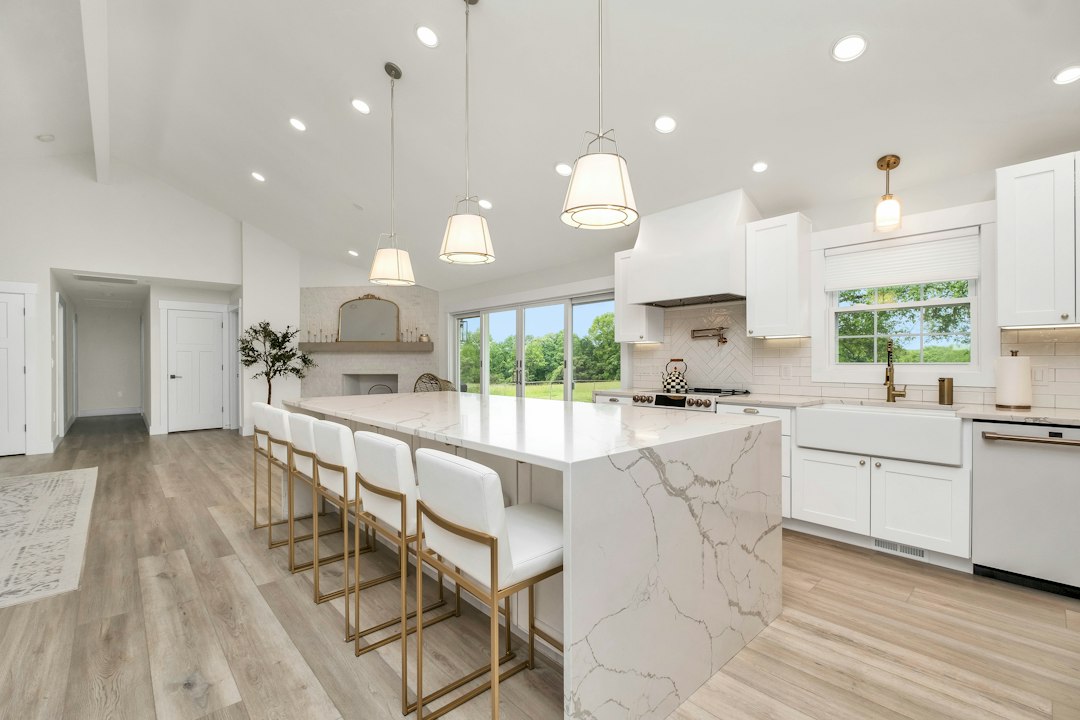
Photo by Zac Gudakov on Unsplash
Why Movie Kitchens Always Have Islands
Walk into almost any movie kitchen and you’ll find the same piece of furniture: a freestanding center island with bar stools tucked underneath. It shows up in Manhattan lofts, suburban colonials, and beach houses alike, regardless of whether the character could realistically afford one. The kitchen island has become one of cinema’s most reliable production design constants, and it’s there for reasons that have nothing to do with cooking.
The Blocking Solution
Kitchen islands solve a fundamental staging problem. When characters talk in a kitchen, they need something to do with their bodies and something to orient around. An island creates natural blocking: one character can stand at the stove or sink along the perimeter while another sits at the island or moves around it. This gives actors motivated positions and movement without forcing them into static shot-reverse-shot coverage against a wall.
The island also creates separation planes within a single room. A director can stage foreground and background action simultaneously—someone chopping vegetables at the island while another character enters through the doorway behind them, both in focus. It turns a kitchen into a staging arena rather than a narrow galley.
Conversation Architecture
Islands facilitate dialogue better than any other kitchen configuration. Two characters can face each other across the counter, establishing clear eyelines for coverage. One can lean on the island, creating a casual posture that reads as natural rather than theatrical. Another can walk around it, giving the scene movement and letting the camera follow or push in as tension builds.
The bar stools matter too. They give characters somewhere to perch that isn’t a formal dining table, maintaining the informality of kitchen conversations while keeping faces at a filmable height. A character sitting at an island stool can swivel, lean back, or stand up mid-scene—all small actions that add texture without requiring explanation.
Sightlines and Camera Access
From a cinematography perspective, islands open up the room. They pull the action away from walls and into the center of the space, giving the camera 360-degree access. A DP can shoot from the living room through to the island, or circle around it for a dolly move, or go handheld and weave between characters. The island becomes an anchor point that organizes the shot geometry.
Islands also help with lighting. Practical fixtures—pendant lights hanging over the island—provide motivated overhead sources that can be art-directed to match the scene’s tone. They create pools of light in the center of the frame while leaving the perimeter softer, naturally guiding the viewer’s eye to the action.
The Aspirational Kitchen
There’s also a cultural component. American production design leans heavily on the open-plan kitchen as a signifier of contemporary middle-class life, and the island is the centerpiece of that layout. It signals a certain level of taste and comfort without requiring explicit exposition. Even when a character is supposed to be struggling financially, the kitchen island persists—a small concession to visual language that audiences have learned to overlook.
The island has become so embedded in film grammar that its absence would feel deliberate. A kitchen without one reads as either stylized minimalism or a period choice, something calling attention to itself. For most domestic scenes, the island is invisible infrastructure, doing its job so well that no one stops to question why it’s there.