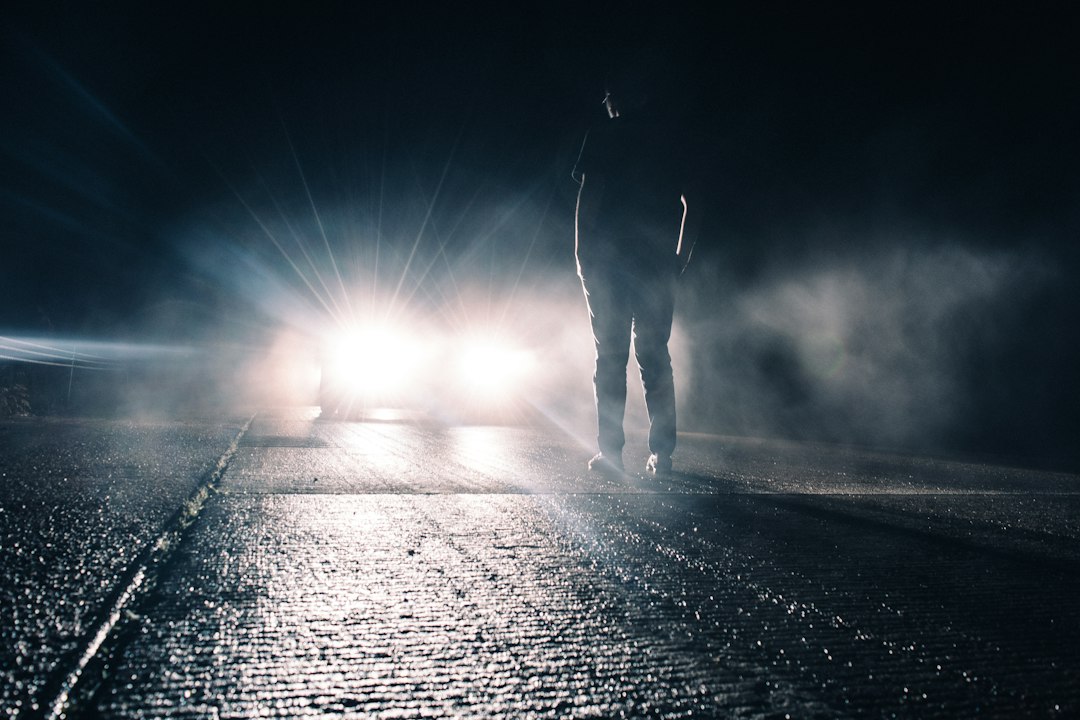
Photo by Eugene Triguba on Unsplash
Why Movie Headlights Always Cut Through Fog Like Laser Beams
Watch any suspenseful nighttime driving scene and you’ll notice something peculiar: the headlights don’t just illuminate the road ahead, they carve perfect geometric beams through the air itself. Twin columns of light slice through fog or mist like visible solid objects, making the car look like it’s drilling through the atmosphere. Real headlights don’t behave this way, and that’s entirely the point.
Manufacturing Visible Air
The effect requires two deliberate choices working together. First, the fog itself is precisely engineered. Film sets use specialized fog machines that produce atmospheric haze at exactly the right density—thick enough to scatter light into visible rays, but thin enough that the scene remains legible on camera. Too much fog and you lose the actor’s face; too little and the light beams disappear.
This isn’t the patchy, rolling fog you encounter on a real highway. It’s a uniform suspension maintained at a consistent density throughout the shot. Grips and special effects technicians monitor it constantly, adding more from fog machines positioned just off-camera to keep the atmosphere stable between takes.
The Light Has to Cooperate
Second, the headlights themselves are often augmented or replaced entirely. Real car headlights diffuse in multiple directions, designed for safe road visibility rather than dramatic beam projection. For cinema, lighting technicians frequently add high-powered spotlights or HMI lights mounted near the headlight housings, aimed to create those theatrical shafts.
The color temperature matters too. Movie headlights skew cooler and bluer than actual halogen bulbs, increasing contrast against warm-toned fog and making the beams read as sharp and clean rather than murky yellow. The goal is geometric clarity—you should be able to trace each beam’s path through space like a diagram.
What It Communicates
Those exaggerated beams do real narrative work. They turn empty air into visible space, giving the frame depth and structure. In a chase sequence, they telegraph speed and direction. In a horror scene, they carve out tiny islands of safety in an otherwise hostile darkness, showing exactly how limited the character’s visibility is.
The beams also create natural leading lines, drawing the viewer’s eye toward the road ahead or revealing what’s caught in the light—a deer, a figure, a dead end. Without them, nighttime driving footage flattens into murky shapes with little spatial information.
The Practical Limits
This technique demands control over the environment. It works on closed sets, empty roads, or studio builds where fog density and ambient light can be managed. It falls apart in real traffic or unpredictable weather, which is why high-speed chase scenes shot on practical locations often intercut studio work for close-ups and hero moments.
Cinematographers also have to account for how digital sensors handle fog differently than film stock. Heavy atmospheric haze can introduce noise and reduce contrast, requiring careful exposure and grading to keep the beams punchy while preserving shadow detail in the rest of the frame.
Why We Accept It
Audiences know headlights don’t actually look like this, but the convention has become so embedded in visual storytelling that it reads as correct. The beams are a kind of cinematic punctuation—an agreed-upon exaggeration that clarifies space and mood more effectively than realism would. Like the way rain always falls backlit and silver, or how every sword makes a metallic ring when drawn, movie headlights have their own grammar. They don’t show us how light works; they show us how to read the scene.