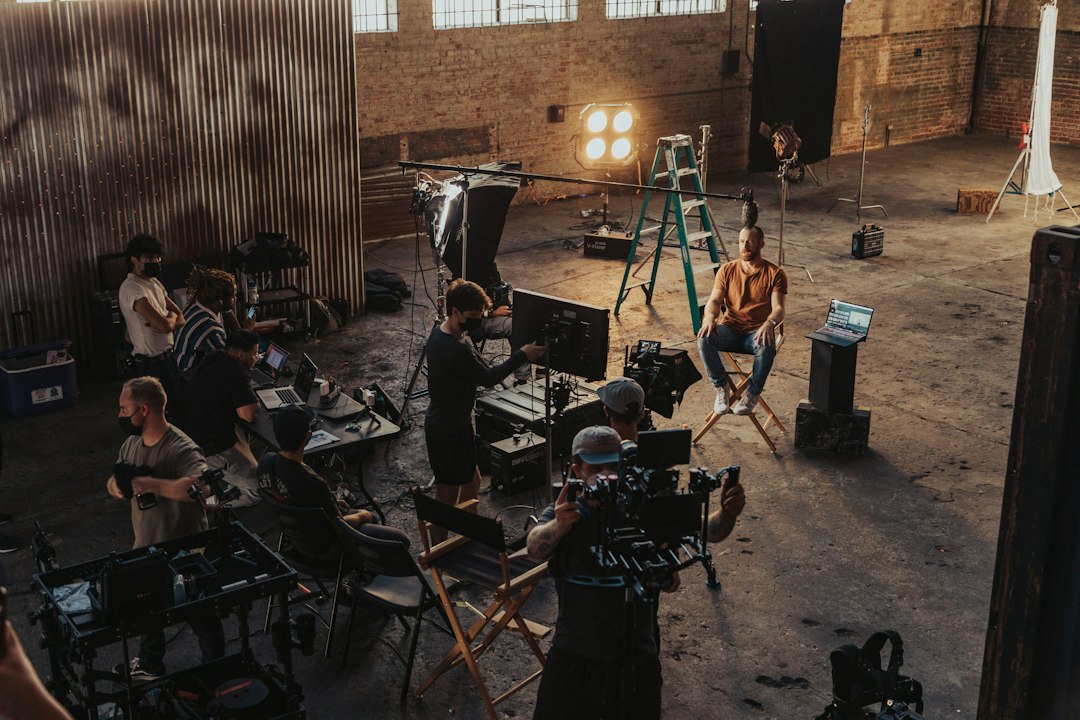
Photo by Jakob Owens on Unsplash
Why Movie Guns Have No Recoil in Wide Shots
Watch any action film and you’ll notice something odd: guns behave differently depending on the camera angle. In tight shots, pistols kick back hard and rifles punch into shoulders. Pull out to a wide shot of the same scene, and suddenly those same weapons fire with barely a tremor. The actor’s arm stays rigid, the muzzle stays level, and the only sign a gun has fired is a muzzle flash and some sound.
This isn’t lazy filmmaking. It’s a deliberate choice made shot by shot, driven by a tension between realism and readability.
The Physics Problem
Real firearms generate recoil. That’s basic physics—every action has an equal and opposite reaction. When a gun fires, the force that propels the bullet forward also pushes the gun backward. How much depends on caliber, gun weight, and grip, but it’s always there.
Cinematographers know this, and when they want impact, they use it. Close-ups capture the violence of a weapon: the slide snapping back, the ejected shell casing, the shooter’s wrist absorbing the kick. These shots sell the power and danger of the moment. The recoil becomes part of the performance.
But scale out to show the full geography of an action scene—two characters in a warehouse, or a chase across rooftops—and recoil becomes a liability.
Readability Beats Realism
In a wide shot, the audience needs to track multiple pieces of information at once: who’s shooting, where they’re aiming, who’s taking cover, who’s advancing. If every gunshot jerks the weapon ten degrees off-axis, that clarity vanishes. The eye loses the line of fire. Spatial continuity breaks down. The audience has to work harder to understand what’s happening, and action should never feel like homework.
So in wide coverage, actors often minimize or eliminate visible recoil. They hold their mark, keep their aim steady, and let the muzzle flash and sound design do the work. The gun becomes a visual pointer, a clear line connecting shooter to target. The scene stays legible.
The Coverage Toolbox
Directors and stunt coordinators have several ways to manage this. One is simply coaching: actors are told to absorb recoil differently depending on the shot size. In close-up, let it move. In the wide, lock it down.
Another is weapon choice. Blank-firing guns produce far less recoil than live firearms. Rubber or lightweight prop guns produce none at all, with muzzle flashes and sound added in post. If the shot is wide enough, the difference is invisible.
Sometimes the edit hides the seam. Cut to a close-up for the first shot in a burst, show the recoil, then cut wide for the rest of the magazine. The brain connects the two and assumes the recoil is still happening, even when it’s not on screen.
When Realism Wins
Not every filmmaker makes this trade. Some prioritize immersive realism over clarity and commit to showing recoil in every shot. It makes the action feel rawer, more grounded, and harder to parse—which can be exactly the point. Chaos is a choice.
But most action films live somewhere in the middle, code-switching between modes as the shot demands. Close equals visceral. Wide equals clear. The gun doesn’t behave consistently because consistency isn’t the goal. Communication is.
The Invisible Grammar
This is one of those unspoken rules that works because audiences don’t consciously notice it. We accept that close-ups and wide shots have different visual languages. We’ve been trained by thousands of hours of screen time to read them differently, to forgive the shifts in physical behavior as long as the story keeps moving forward.
It’s a small cheat in service of a larger truth: in filmmaking, what feels right on camera matters more than what’s technically accurate. Recoil in a wide shot might be real, but if it makes the scene harder to follow, it’s the wrong choice.
So the next time you watch an action sequence, pay attention to the gun. Watch it snap back in the close-up, then go eerily still when the camera pulls wide. You’re watching editors and directors make micro-decisions about what to show and what to suppress, all to keep you locked into the momentum of the scene. The recoil isn’t missing. It’s just been moved off-screen.