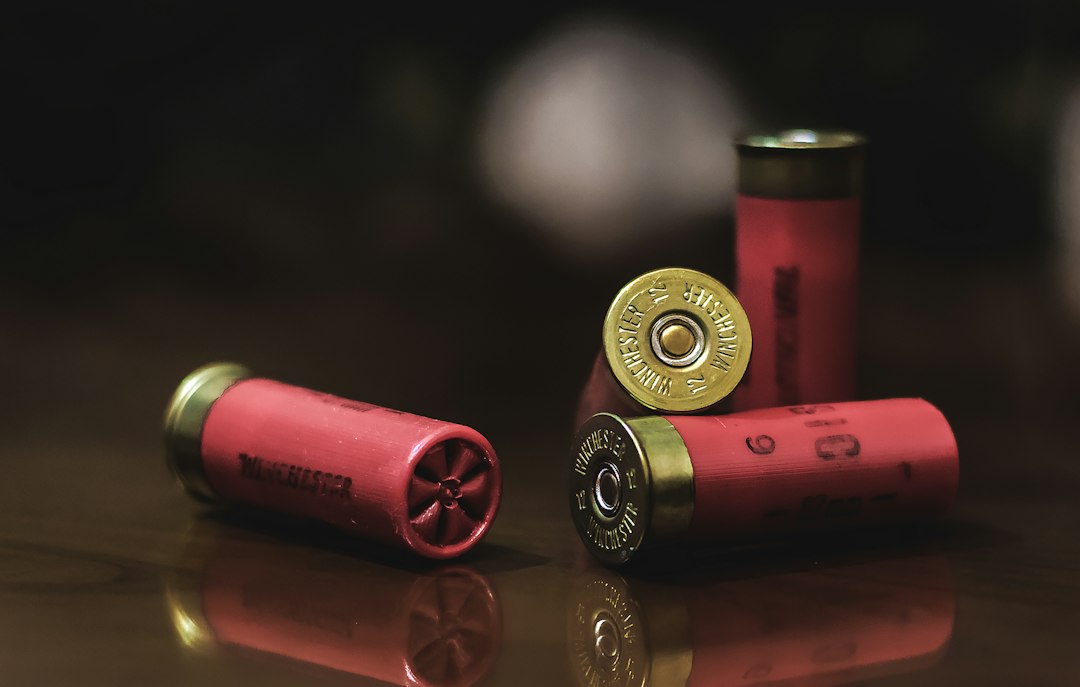
Photo by David Levêque on Unsplash
Why Movie Guns Eject Shells That Never Hit the Ground
When a character fires an automatic pistol in a film, the brass shell casing flies out of the ejection port in a satisfying arc. What you almost never see—or hear—is that casing hitting the ground. It doesn’t bounce off the pavement with a telltale clink, doesn’t roll across the floor, and rarely appears in the next shot. The shells seem to vanish mid-air, and that disappearing act is entirely intentional.
The Continuity Problem
Spent shell casings are small, unpredictable, and nearly impossible to wrangle between takes. They bounce at random angles, roll into corners, and land in different positions every time an actor fires. If a wide shot shows three casings on the ground to the left of the hero, the close-up filmed an hour later needs to match that exactly—same number, same placement. Miss one detail and the error is frozen in the edit.
Rather than fight this losing battle, most productions avoid showing ejected shells hitting the ground altogether. The camera frames the action above waist level, cuts away before the casing lands, or positions the shooter so the ejection port aims out of frame. If you do see a shell hit the floor, it’s usually a deliberate story beat—a silent moment where the ringing metal emphasizes the aftermath of violence.
Catching Shells on Set
When a scene requires sustained automatic fire or close coverage of the weapon itself, the crew has to manage the physical casings in real time. One common solution is a shell catcher: a small mesh bag or nylon net that attaches to the ejection port and traps the brass before it scatters. These are standard tools on ranges and have been adapted for film use, though they add visible bulk to the weapon and need to be hidden or removed in post if the gun appears in profile.
For scenes where the catcher would be visible or interfere with the action, crew members sometimes stand just outside the frame holding nets or blankets to catch ejected shells. On larger productions shooting with blank-firing replicas, an armorer might rig a magnetic catch tray beneath the ejection port, especially for weapons mounted on vehicles or firing from prone positions.
The One-Casing Insert
Occasionally a director wants the visceral detail of a spent casing hitting concrete or tile—the sharp metallic ring adds texture to a gunfight or punctuates a moment of silence. In these cases, the effect is usually captured as an insert shot: a tight frame of a single casing tumbling through the air and striking the ground, filmed separately with full control over lighting, sound, and timing.
That insert might be filmed with a hand-dropped casing rather than one actually ejected from the weapon, ensuring it lands exactly where the camera expects. The sound is almost always added in post, recorded clean in a Foley stage where the pitch and decay can be adjusted to match the space.
Why We Notice the Absence
Most viewers never register that shell casings disappear, but once you notice the pattern it’s difficult to unsee. It’s a reminder that gunfights in movies are choreographed with the same precision as dance numbers—every movement, every piece of flying debris, every sound has to be repeatable and controllable. The moment a detail becomes random, it becomes a continuity trap.
Ejected shell casings are one of dozens of small elements that film crews have learned to suppress or tightly manage: glass shards after a break, blood spatter, falling water droplets, even dust kicked up by footsteps. If it moves unpredictably and can’t be reset between takes, the safest approach is often to keep it out of frame entirely.
The vanishing shell casing is a invisible compromise, the kind of creative problem-solving that holds the illusion together one detail at a time.