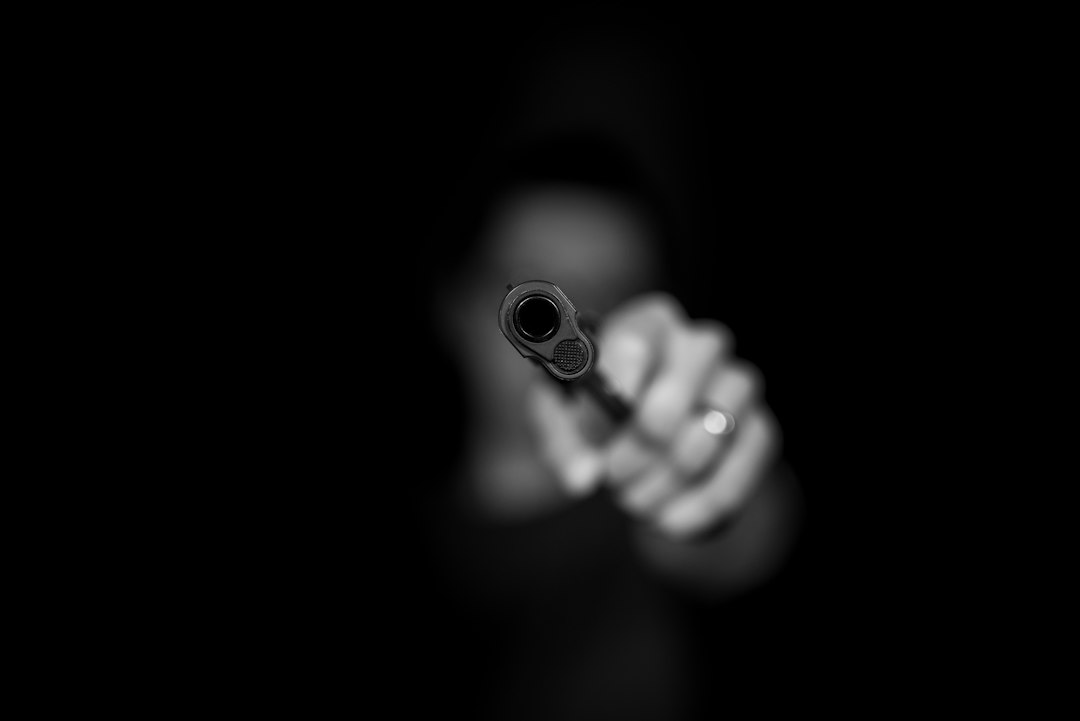
Photo by Max Kleinen on Unsplash
Why Movie Guns Always Click When Pointed
You’ve seen it a thousand times: a character raises a pistol, and the moment it levels at someone’s face, a crisp metallic click punctuates the threat. Sometimes it’s a sharp snap, sometimes a mechanical ratchet. The gun itself might not even move—just the aim shifting—but that sound still fires.
Real firearms don’t work that way. Once a gun is loaded and cocked, aiming it produces no sound at all. The click is a fabrication, a piece of audio shorthand that exists purely in the grammar of film.
The Sound That Shouldn’t Exist
In reality, most of the clicks and clacks associated with guns happen during loading or manual cocking. Racking a slide, chambering a round, thumbing back a hammer—those actions do make noise. But once the gun is ready, changing where you point it is silent. There’s no mechanism in a firearm that produces a click simply because the barrel moved thirty degrees to the left.
Yet movies add it anyway, and for good reason. The sound isn’t meant to be literal. It’s a storytelling beat, a way to underscore the exact moment a situation turns deadly. The click marks the transition from “there’s a gun in the room” to “the gun is now a active threat pointed at you.” It’s the audio equivalent of a exclamation point.
Why It Works
Film grammar relies on clarity and emphasis, especially in tense scenes where every frame counts. The problem with real guns is that they’re too quiet during the moments that matter most. A character can pull a weapon, aim it, and the audience might not register the danger until a line of dialogue or a reaction shot makes it explicit.
The click solves that. It’s immediate, visceral, and unmistakable. You don’t need to see the gun clearly or wait for someone to react—the sound itself communicates menace. It also gives the editor a clean audio cue to cut on, sharpening the rhythm of the scene.
Sound designers treat it as a punctuation mark. In the same way that movie swords ring when drawn (despite real swords sliding out silently), the gun click is about emotional truth rather than acoustic accuracy. It feels like the sound a gun should make when it’s suddenly pointed at someone, even though physics says otherwise.
When the Click Happens
The timing is key. The click almost always lands on the exact frame the gun reaches its target—usually a character’s face or center mass. It can accompany a slow, deliberate raise or snap in during a quick draw. Sometimes it’s layered with other sounds: a foley rustle of fabric, a breathing shift, the faint creak of a finger tightening on the trigger guard.
Directors and sound teams also use it to modulate tension. A soft, oiled click might suggest control and professionalism. A louder, more mechanical sound can make the weapon feel older, cruder, more dangerous. The absence of the click can be just as powerful—a silent aim can feel cold and inevitable, especially if the scene has been training the audience to expect the sound.
The Convention Endures
This is one of those cinematic lies that audiences have fully internalized. No one watching a thriller stops to wonder why the Glock clicked when it was already cocked three scenes ago. The sound has become part of the visual language of threat, as accepted as the whoosh of a punch or the hum of a lightsaber.
Real guns are mechanically interesting, but they don’t perform for the camera the way movie guns do. Film weapons exist in a heightened sonic world where every gesture has a sound, every motion has weight, and danger announces itself with a click.