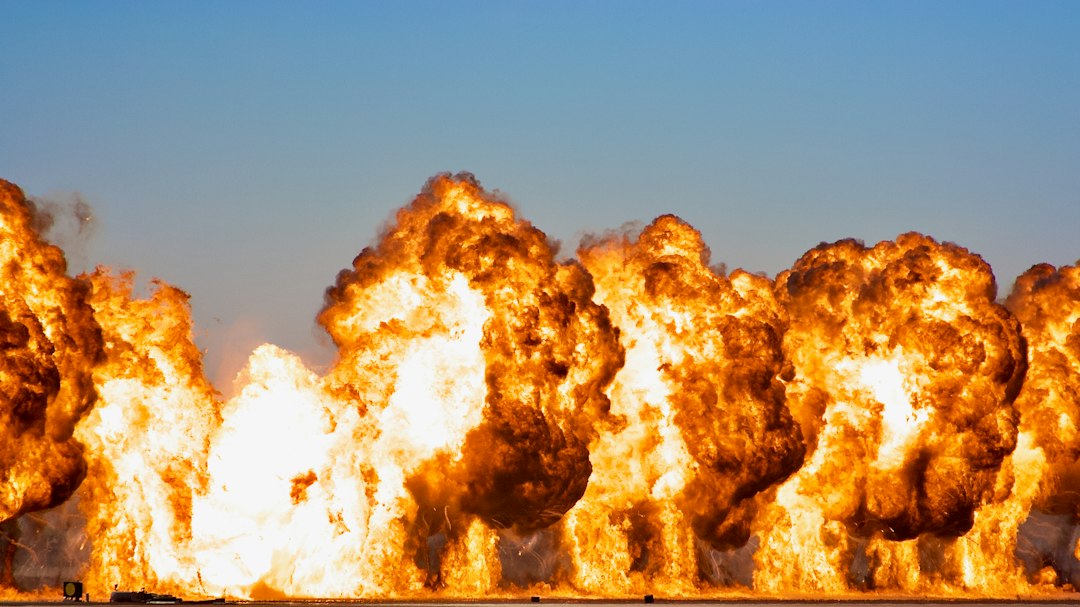
Photo by Luke Jernejcic on Unsplash
Why Movie Explosions Are Always Orange
When a car explodes in a movie, it erupts in a rolling ball of orange flame that rises majestically into the sky. The explosion is bright, clean, and unmistakably cinematic. Real explosions rarely look like this. Military ordnance produces gray-black smoke and a brief flash. Gasoline fires burn yellow and irregular. The classic movie fireball is a deliberate construction, built from specific materials chosen because they photograph well.
The Gasoline Problem
Gasoline, the fuel that actually powers most vehicles, burns poorly on camera. It ignites quickly and produces a fast, low flame with little visual presence. The combustion is over in a moment, and what remains is dark smoke that obscures the frame. Worse, gasoline is dangerously unpredictable. Its fumes ignite before the liquid does, and the flame front can travel in unintended directions. For a shot that needs to be choreographed, timed, and captured in a single take, gasoline offers little control and less spectacle.
Enter the Fireball Mix
The signature orange explosion uses a gasoline base cut with diesel fuel, thickened with a gelling agent, and often mixed with additional accelerants. Diesel burns slower and dirtier than gasoline, creating a longer flame and more visible smoke. The gel—essentially the same napalm mixture developed for military use—allows the fuel to atomize into the air in droplets that ignite individually, creating the rolling, expanding fireball effect. When the mixture is distributed in the air before ignition, using a small primary charge, the result is a sustained, volumetric flame that reads clearly on camera.
Some effects crews add rubber, plastics, or other petroleum-based materials to increase the black smoke that trails the fireball. The contrast between bright orange flame and dark smoke gives the explosion depth and scale. Others mix in metal powders—aluminum or magnesium—that burn white-hot and add sparkle to the frame. These additives are chosen for their visual properties, not their realism.
Why Orange Specifically
The orange color comes from incomplete combustion. When hydrocarbon fuels burn in open air without sufficient oxygen, they produce carbon particles that glow as they heat. This incandescence peaks in the orange-yellow range of the visible spectrum. The thicker the fuel mixture and the larger the fireball, the less oxygen reaches the interior, and the more intense the orange glow. Cinematographers prefer this color because it contrasts strongly with both daylight skies and nighttime darkness, and because orange reads as “fire” to audiences in a way that gray smoke or brief flashes do not.
Modern digital color grading can enhance the orange further, pushing the hue into a saturated amber that would be physically impossible in reality. The result is an explosion that looks more like an explosion than an explosion does—a heightened version of combustion that has become the visual language for danger, destruction, and spectacle.
The Practical Reality
Rigging a movie explosion requires precision. The fuel must be distributed evenly, the ignition sequence timed to the frame, and the blast positioned so the camera captures the expanding fireball without lens flares or obstruction. Stunt coordinators and special effects supervisors rehearse the timing with air cannons and marker charges before committing to the full fuel load. The goal is a fireball that blooms at the right moment, expands at the right speed, and clears the frame before the smoke makes the shot unusable.
The technique is so standardized that audiences now expect it. An explosion that looks realistic—a quick flash and a cloud of dust—reads as underwhelming or cheap. The orange fireball is not a documentary record of combustion. It is a designed image, built from materials selected for their photographic properties and refined over decades into a visual cliché. When a car flips and erupts in flames, what you are watching is not chemistry but cinematography.