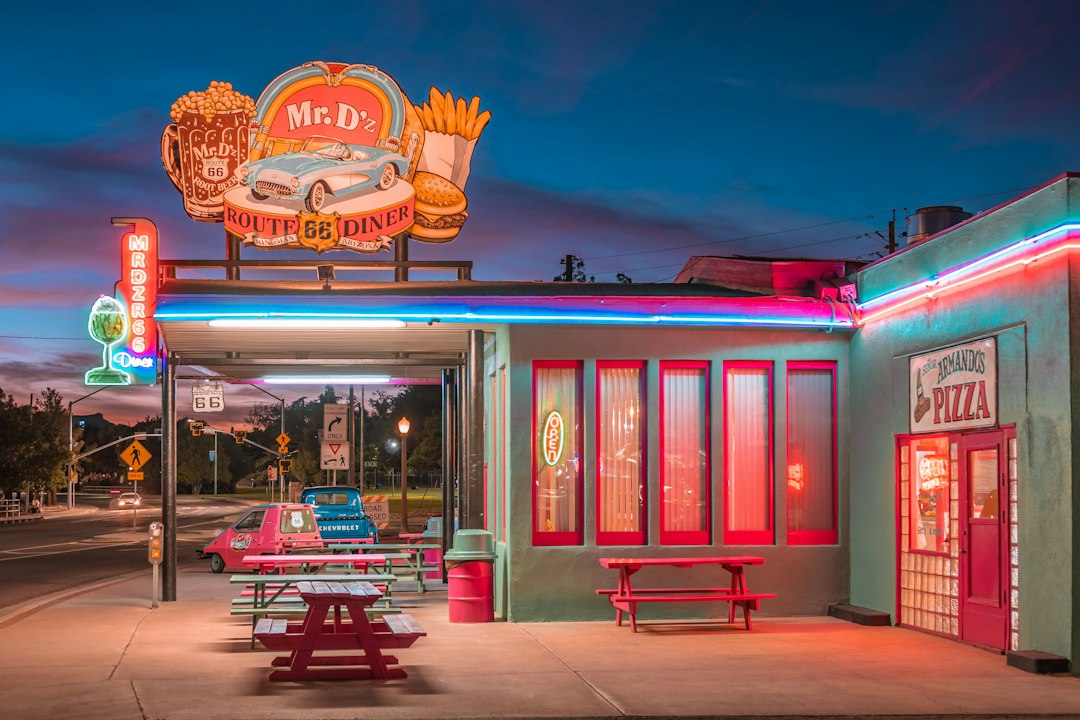
Photo by Pretty Pink on Unsplash
Why Movie Diner Scenes Always Happen at Night
The diner booth at 2 AM is a recurring stage in cinema. Whether it’s a heist crew debriefing, a detective interrogating a witness, or a couple confronting the end of their relationship, filmmakers return to the late-night diner with remarkable consistency. It’s not just convenience or nostalgia. The nighttime diner offers a specific confluence of visual, emotional, and practical advantages that few other locations can match.
Light and Atmosphere in a Single Location
A diner at night is a self-contained lighting setup. Fluorescent overheads create flat, institutional illumination inside, while neon signs glow in the windows and sodium vapor lamps cast amber pools in the parking lot. This built-in contrast gives cinematographers layers to work with: characters can be overlit and exposed at the counter, silhouetted against the windows, or isolated in a booth with a practical lamp overhead.
The surrounding darkness makes the diner feel like an island. Outside, the world is reduced to passing headlights and empty streets. Inside, the space becomes a kind of purgatory—a place between destinations where characters are temporarily suspended from their lives. That isolation is both visual and emotional, and it requires no additional production design. The location does the work.
A Liminal Space for Liminal Moments
Diners exist outside normal time. They’re open when everything else is closed, serving breakfast at midnight and coffee to people who have nowhere else to be. That liminality makes them ideal for scenes of transition, decision, or reckoning. Characters meet in diners when they’re between jobs, between relationships, or between versions of themselves.
The diner is also democratizing. A cop and a criminal can sit in adjacent booths without raising questions. A CEO and a drifter can occupy the same counter. It’s a space where social boundaries soften, and conversations that wouldn’t happen in an office or a home become plausible. The late hour amplifies this effect—everyone there is slightly outside the normal order of things.
Practical Production Benefits
From a production standpoint, shooting a diner at night solves several problems at once. Permits for overnight shoots are often easier to obtain, and ambient street noise is lower. A real diner location after hours can be rented and controlled without disrupting business. If the production builds a diner set on a stage, shooting at “night” eliminates the need to black out windows or match exterior daylight.
The diner also offers flexible staging. Booths provide natural two-shots and over-the-shoulder frames. The counter allows lateral staging and depth, with the kitchen or the street visible through windows behind. The layout is understood by audiences—no one needs exposition to know how a diner works—so the scene can begin immediately.
Genre and Iconography
Certain genres have claimed the nighttime diner as essential iconography. Film noir made it a place for informants and compromised cops. Crime films use it as neutral ground for tense negotiations. Road movies and neo-Westerns use it as a waystation. Even science fiction and horror films deploy the diner as a last outpost of normalcy before or after something catastrophic.
The diner’s aesthetic has been codified by repetition: checkerboard floors, chrome fixtures, vinyl booths, and pie under glass. Filmmakers lean into this familiarity because it frees them to focus on performance and dialogue. The audience already knows the space, so the scene can do its work without distraction.
Silence and Exposure
Late at night, a diner is often nearly empty, which means conversations play out without the protective noise of a crowd. Characters are exposed—not just to each other, but to the waitress refilling coffee, the cook visible through the kitchen window, the stranger in the corner booth. That exposure adds tension. Every line of dialogue feels like it could be overheard.
At the same time, the diner offers a kind of anonymity. No one there knows your name, and no one will remember you in the morning. It’s a place where secrets can be told because they won’t follow you home. Filmmakers exploit both sides of this paradox, depending on what the scene requires.
The nighttime diner endures because it delivers atmosphere, narrative flexibility, and visual richness in a single package. It’s a location that feels both specific and universal, grounded and cinematic, ordinary and haunted. When a filmmaker needs to stop the plot and let two people talk—really talk—the diner at 2 AM is waiting.