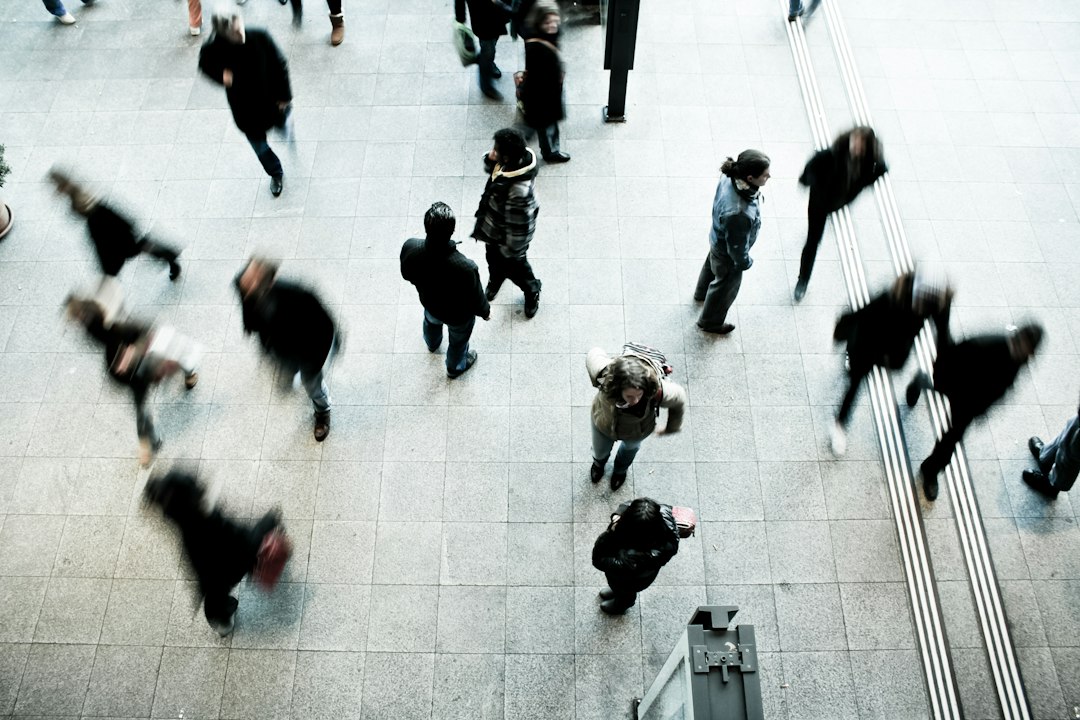
Photo by Timon Studler on Unsplash
Why Movie Crowds Always Part for the Hero
Watch any film where a character rushes through a busy train station, bustling market, or packed sidewalk. No matter how urgent their stride or how dense the crowd, pedestrians seem to sense them coming and step aside at exactly the right moment. The hero never collides with anyone, never has to stop and navigate around a stroller, never gets stuck behind someone walking too slowly. The crowd parts like water around a boat.
This isn’t lazy filmmaking. It’s careful choreography designed to keep the camera and the audience’s attention locked on what matters: the character and their emotional trajectory.
The Problem with Real Crowds
Real crowds are chaos. People move unpredictably, at different speeds, in opposing directions. They stop without warning, cluster in doorways, walk three abreast on narrow paths. For a film production, chaos is the enemy of visual clarity.
If a character actually had to navigate a genuine crowd the way we all do in real life—sidestepping, pausing, squeezing past—the momentum of the scene would collapse. The camera would struggle to maintain a clean frame. Background actors would accidentally block the principal performer. Every take would be different, making continuity matching nearly impossible.
More importantly, realistic crowd navigation would fracture the audience’s focus. We’d start watching the crowd instead of the character’s face, their body language, the story being told through their movement.
Choreographed Flow
Productions achieve the parting-crowd effect through meticulous blocking. Background performers receive specific marks and timing instructions. As the principal actor approaches, extras execute rehearsed movements—stepping left or right, turning away, pausing their conversation—all calibrated to create a clear channel.
The choreography is timed to camera movement. If the shot is a Steadicam follow, background actors key their movements to the camera operator’s position, not just the actor being followed. They’re creating a corridor of space that moves with the lens.
This technique relies on background actors who understand their role in the visual hierarchy. They’re not trying to act realistic. They’re there to create negative space, to form a human frame that guides the eye toward the principal performer.
Speed and Urgency
The parting crowd serves dramatic function beyond visual clarity. It communicates character importance and emotional state without dialogue.
When a crowd parts smoothly, the character appears driven, purposeful, someone on a mission. The environment bends to their will. We read this as determination, urgency, or authority. The technique shorthand tells us: this person and this moment matter.
Conversely, when filmmakers want to show a character as lost, overwhelmed, or powerless, they do the opposite. The crowd doesn’t part. People bump into them, cut them off, ignore their attempts to pass. The character becomes just another body in the mass, their agency stripped away.
The Moses Shot
Some films make the parting literal and visible, turning functional staging into symbolic imagery. The camera pulls back to a high angle or wide shot, and we see the crowd split down the middle as the character walks through. The reference is obvious: the parting of the Red Sea, a visual metaphor for destiny or supernatural intervention.
This works because audiences have internalized the basic version of the technique. We’re so accustomed to seeing crowds cooperate with protagonists that making it overt registers as mythic rather than ridiculous.
Practical Necessity
There’s also a simple production reality: background actors are expensive, and managing large groups is time-consuming. Creating the illusion of a dense crowd while maintaining clear sightlines requires fewer people than an actual packed space would contain.
By choreographing strategic placement and movement, a production can make thirty background actors feel like a hundred. Those thirty can be directed, rehearsed, and wrangled. A real crowd of hundreds would be uncontrollable, unsafe, and prohibitively costly.
The parting crowd is moviemaking choosing legibility over realism, understanding that audiences care more about following the story than watching someone realistically navigate foot traffic. It’s invisible craft that keeps the film moving forward—literally.