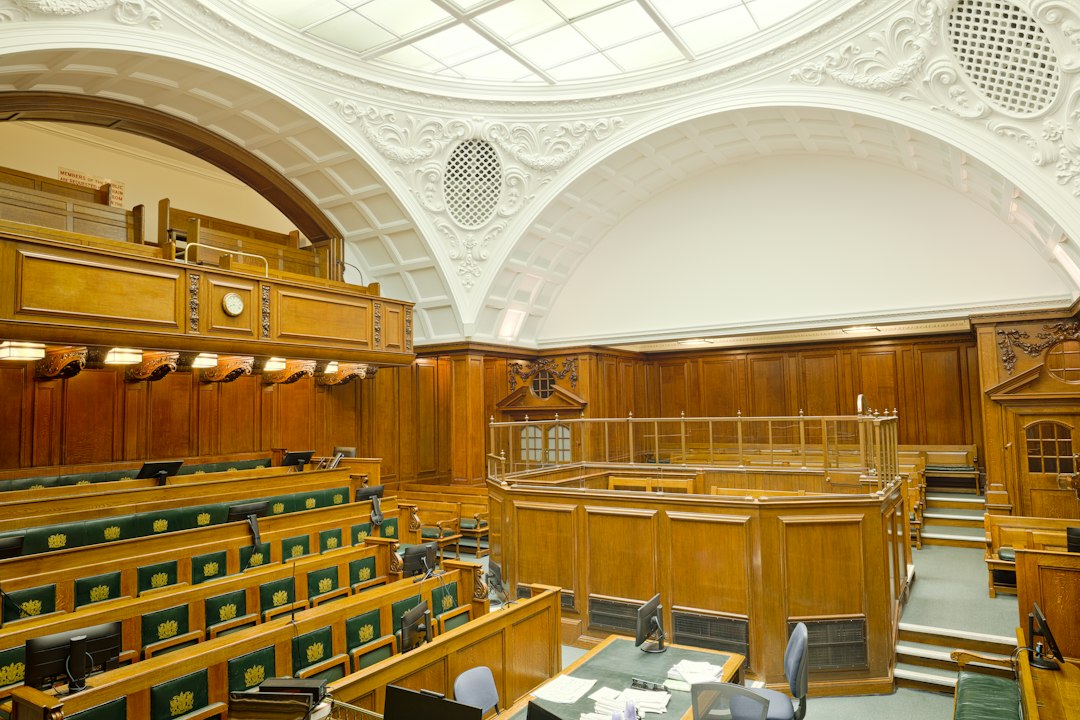
Photo by Michael D Beckwith on Unsplash
Why Movie Courtrooms Have Wooden Benches in the Gallery
Walk into any courtroom scene in a film and you’ll notice the same visual vocabulary: the judge’s bench elevated and centered, counsel tables flanking the well, a witness stand to the side, and behind a low divider, rows of wooden benches stretching back into the gallery. Those benches aren’t just set dressing pulled from legal tradition—they’re a deliberate production design choice that gives filmmakers control over blocking, framing, and the emotional weight of a trial scene.
The Dividing Line
The wooden rail separating the gallery from the well of the court—often called “the bar”—serves as both a literal and visual threshold. In real courtrooms, it marks the boundary between participants and observers. In film, it becomes a compositional tool that anchors the frame and draws a clear line between the main action and the audience within the scene.
Production designers favor wooden benches because they reinforce this division without dominating the frame. Unlike individual chairs, which would create visual clutter and require meticulous continuity between takes, uniform benches create clean horizontal lines that recede into the background. This makes it easier to shoot coverage from multiple angles without worrying about mismatched chair positions or distracting gaps.
Staging Reactions
Courtroom scenes depend on reaction shots—the gasp from the gallery, the family member’s tearful nod, the defendant’s parent gripping the bench rail. Wooden benches force extras and day players into predictable positions and postures. Sitting upright on a hard bench, bodies naturally align in rows, and the lack of armrests means hands rest on laps or the bench itself, creating consistent silhouettes.
This uniformity makes it easier for the director to isolate a single reaction in a sea of faces. A medium shot down a bench row lets the camera find one character while keeping others in soft focus, maintaining the sense of a crowded room without the chaos of individually composed extras.
Historical Weight Without Period Accuracy
Most movie courtrooms don’t actually resemble the specific jurisdictions they’re meant to represent. Real courtrooms vary widely in layout and decor depending on era, region, and court level. But films default to a generalized, slightly old-fashioned aesthetic because it reads as serious and institutional.
Wooden benches carry connotations of gravitas and tradition without requiring the film to commit to a specific decade or jurisdiction. They evoke the feeling of a courtroom as a temple of justice—a place where process and history matter—without the production needing to research whether a particular county courthouse in 1987 actually used oak pews or plastic seating.
Practical Concerns on Set
From a logistics standpoint, benches are easier to manage than rows of individual seats. They can be built or rented in modular sections, moved quickly between setups, and secured to the floor to prevent creaking or shifting during takes. Fewer pieces mean fewer potential points of failure and faster turnarounds when the crew needs to adjust the layout for a new camera angle.
Benches also help control extras. Assign a bench section, and you’ve assigned a group. Continuity becomes simpler because the positions are discrete and the sight lines are fixed. If an extra needs to stand or lean forward in anguish, the bench itself provides a consistent reference point for matching the movement across multiple takes.
Why Not Modernize?
Some contemporary legal dramas do place characters in modern courtrooms with upholstered seating, fluorescent lighting, and laminate surfaces. But those spaces often feel less cinematic—flatter, more bureaucratic, less charged. The wooden gallery, like so many production design conventions, persists not because it’s accurate but because it works. It frames the human drama, anchors the composition, and signals to the audience that this is a space where stakes are high and every glance matters.
The benches stay because they help tell the story cleanly, and in filmmaking, clarity is its own kind of truth.