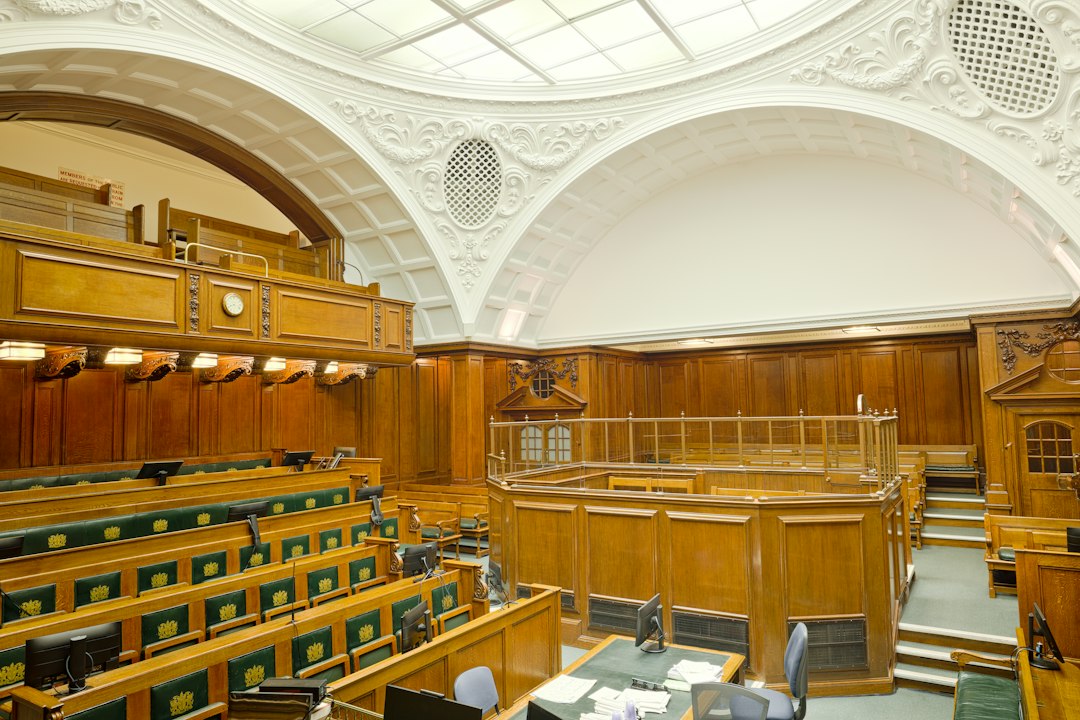
Photo by Michael D Beckwith on Unsplash
Why Movie Courtrooms Have Wooden Railings
Every courtroom scene in film features the same distinctive element: a waist-high wooden railing separating the gallery from the well of the court. This barrier, called “the bar,” appears so consistently that audiences rarely question it. But its presence in movie courtrooms reflects both the architecture of real legal spaces and the specific staging requirements of filmed drama.
The Real-World Origin
The bar exists in actual courtrooms as a boundary marker. Only licensed attorneys are permitted to pass beyond it—hence the phrase “admitted to the bar” for licensed lawyers. The railing creates a threshold between the public space of the gallery and the privileged space where legal business occurs. Film production designers replicate this architecture because it signals “courtroom” instantly to viewers, carrying centuries of legal tradition in a single visual element.
Real courtrooms use the bar for crowd control and security. It keeps spectators at a safe distance from proceedings and marks the formal separation between participants and observers. Movies inherit this spatial logic but repurpose it for cinematic storytelling.
A Natural Frame Within the Frame
The bar rail solves a fundamental problem in shooting courtroom scenes: how to organize multiple characters in a visually clear hierarchy. The railing creates a strong horizontal line that divides the frame, allowing directors to separate witnesses, lawyers, defendants, judges, and spectators into distinct spatial zones without confusion.
When a lawyer crosses the bar to address the judge or approach a witness, that movement becomes visually significant. The act of passing through the gate takes on dramatic weight because the frame itself has established the boundary as meaningful. Characters entering or leaving the well of the court are making a transition the audience can see and feel.
The railing also provides a practical leaning post for actors. Lawyers grip it during tense moments, witnesses clutch it while watching testimony, family members rest their hands on it during emotional beats. These small physical interactions give actors something concrete to do with their bodies and ground the performances in tactile reality.
Staging Depth and Separation
Cinematographers use the bar to create layers within the shot. By positioning characters on either side of the railing, they can shoot foreground-background compositions that show reactions and interactions simultaneously. A defendant’s family watching from behind the bar can appear in the same frame as the defendant at the defense table, creating visual irony or emotional resonance without cutting away.
The rail functions as a visual anchor for dolly shots and pans. The camera can track along the bar during an opening shot to survey the courtroom, or push past it to follow a witness to the stand. The consistent horizontal line gives these camera moves a geometric clarity.
The Symbolic Threshold
Beyond practical staging, the bar carries symbolic weight. Crossing it represents entering the machinery of justice. When a defendant rises to hear a verdict or a witness walks nervously through the gate, they’re crossing from one status to another—from observer to participant, from accused to convicted, from civilian to person under oath.
Films amplify this threshold symbolism. Directors often frame the moment of crossing with a slow push-in or a low angle that emphasizes the gravity of the transition. The wooden rail becomes a visual metaphor for the barrier between ordinary life and the formal ritual of the courtroom.
A Convention That Works
The bar rail appears in courtroom scenes because it works on multiple levels simultaneously. It’s historically accurate, spatially useful, dramatically meaningful, and visually clear. Like many elements of production design, it does its job so well that viewers absorb its function without conscious thought.
The next time you watch a courtroom drama, notice how often characters interact with that wooden barrier—gripping it, leaning on it, passing through it. That simple architectural element is quietly organizing the entire scene, turning legal architecture into cinematic grammar.