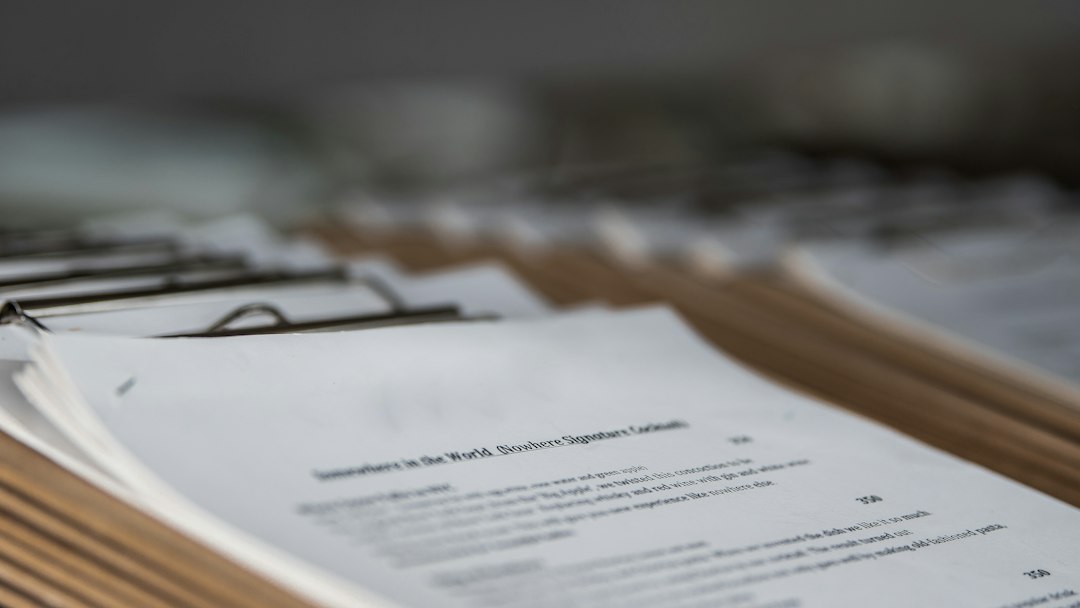
Photo by Arisa Chattasa on Unsplash
Why Movie Courtrooms Use Paper Files Instead of Laptops
Walk into any real courtroom today and you’ll see attorneys hunched over laptops, judges consulting digital case management systems, and evidence displayed on monitors. Walk into a movie courtroom and you’ll see something entirely different: stacks of manila folders, lawyers rifling through paper files, and key evidence pulled from overstuffed briefcases. This isn’t an oversight. It’s a deliberate choice rooted in visual storytelling.
Paper Reads on Camera
The fundamental problem with digital devices in courtroom scenes is that they flatten the drama. When an attorney finds a crucial piece of evidence on a laptop, the audience sees someone staring at a screen. There’s no physical gesture, no visible transformation of the room’s energy. Paper solves this. A lawyer can slam a document on the table, hold up a photograph for the jury to see, or frantically flip through a folder as the clock runs out. These actions register immediately in wide shots and create kinetic energy that keeps scenes from becoming static.
The texture matters too. Paper has weight, thickness, and presence. A thick case file telegraphs complexity and importance without a word of dialogue. When that file gets dropped on a desk, it makes a sound. When pages scatter across a conference table during a heated argument, the mess becomes a visual metaphor for chaos or breakthrough. Screens can’t do any of that.
Reading the Room
Courtroom scenes depend on the audience reading faces, body language, and spatial relationships between characters. Laptops create a barrier. When everyone’s looking down at their own device, the frame loses eye contact, blocking, and the physical geometry that creates tension. Paper keeps heads up and hands visible.
Consider the classic moment when a lawyer pulls a surprise document from a folder and approaches the witness stand. The movement across the room builds suspense. The physical handoff forces the witness to react in real time, and the camera can stay on their face as they read. With a laptop, that same moment involves someone clicking a file attachment and staring at their screen while the lawyer stares at theirs. The connective tissue between characters dissolves.
The Ritual of Discovery
Film audiences understand paper as a symbol of official record and institutional weight. A stamped, dog-eared document carries the visual language of bureaucracy, history, and verification in ways that a PDF on a screen simply doesn’t. When an attorney unearths a decades-old case file from a storage box, we’re watching archaeological discovery. The physical object connects past to present.
This symbolic weight extends to the way paper organizes narrative information for viewers. When a lawyer spreads documents across a table while building a theory, the audience can track the argument spatially. Different stacks represent different threads of evidence. The geography of the workspace mirrors the logic of the case. Digital files hidden in nested folders and browser tabs don’t offer that same visual clarity.
Production Practicality
There’s also a technical reason filmmakers stick with paper. Screens create problems for cinematographers. They cast blue light on actors’ faces, they flicker at rates that don’t sync cleanly with camera frame rates, and they introduce bright rectangles that compete for attention in the frame. Controlling what appears on screen in every take adds complexity to continuity and post-production. Paper, by contrast, is consistent, controllable, and requires no power source.
When period pieces set in the 1990s or earlier require courtroom scenes, paper isn’t just aesthetically appropriate—it’s historically accurate. But even contemporary courtroom dramas often choose to keep paper in frame because it’s become part of the grammar of how we expect these scenes to look and feel.
The Exception
Occasionally, filmmakers do incorporate screens into courtroom scenes, but usually when the technology itself is part of the story—displaying surveillance footage to a jury, for instance, or showing how a hacker manipulated digital evidence. In these cases, the screen becomes the subject rather than a tool, and the scene’s blocking is built around making that screen visible and dramatic.
But for the bread-and-butter work of legal drama—arguments, cross-examinations, and document-based revelations—paper remains the tool of choice. It’s visible, physical, and expressive. It allows actors to perform with their whole bodies and gives directors a vocabulary of gestures that registers clearly on camera. Sometimes the old way simply works better on screen.