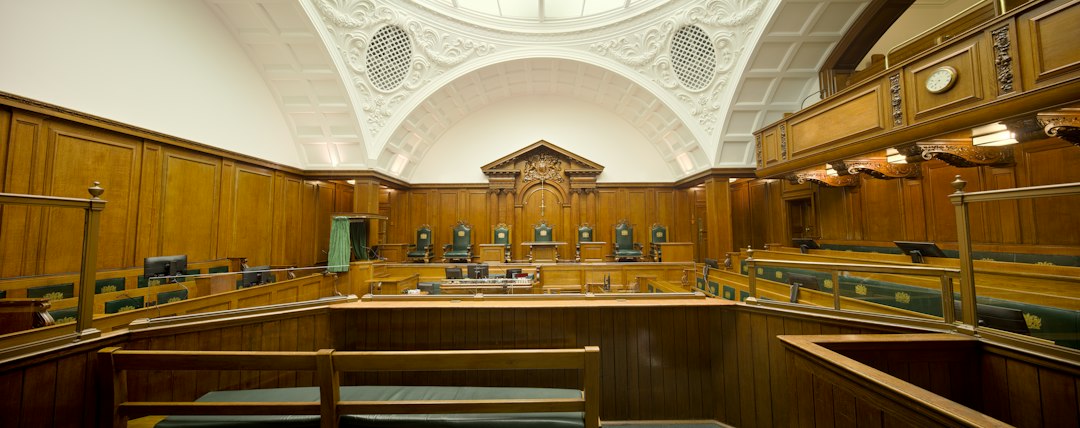
Photo by Michael D Beckwith on Unsplash
Why Movie Courtrooms Look Nothing Like Real Ones
Anyone who has spent time in an actual courtroom knows the experience: cramped benches, poor acoustics, fluorescent lighting, and a layout that often feels more like a DMV waiting room than a theater of justice. Yet the courtrooms we see on screen follow a completely different template—one that prioritizes drama, sight lines, and visual storytelling over anything resembling legal reality.
The Geography of Drama
Movie courtrooms are built around a central performance space. The witness stand sits prominently in the middle ground, equidistant from both the defense and prosecution tables, allowing attorneys to pace dramatically between their position and the witness. In real courtrooms, the witness box is typically tucked beside the judge’s bench, often at an awkward angle that makes it difficult for spectators to see the witness’s face clearly.
This repositioning serves the camera. Film courtrooms are designed so that a single camera setup can capture the attorney, the witness, and the jury’s reaction in one frame. The geometry creates natural blocking: an attorney can cross from their table to the witness stand in a straight line, giving the actor a motivated reason to move through the frame while maintaining eye contact with their scene partner.
The Lighting of Judgment
Real courtrooms are lit for function, not mood. Overhead fluorescent tubes cast flat, even illumination designed to help court reporters see their work and ensure video depositions capture faces clearly. Movie courtrooms, by contrast, often feature tall windows with dramatic shafts of light, dark wood paneling that creates contrast, and practical lamps that allow cinematographers to sculpt faces with shadow.
This shift serves emotional storytelling. A defendant bathed in hard side-light from a window conveys isolation. A prosecutor stepping from shadow into a pool of light gains visual authority. These lighting choices have become so codified that audiences read them instantly as “courtroom” even when the actual space looks nothing like a legal venue they might visit.
The Jury as Chorus
In film courtrooms, the jury box is almost always positioned in clear view of the main action, often elevated slightly and arranged in two neat rows. Jurors face forward toward the witness stand, creating a visual echo of a theater audience. This placement lets reaction shots punctuate testimony—a juror’s raised eyebrow or subtle nod can tip the audience to how they should interpret a piece of evidence.
Real juries sit in configurations determined by architecture and space constraints. They may be perpendicular to the witness, or seated in a single long row at floor level. Their sightlines are rarely optimized for viewing testimony, and their positions often make it difficult for cameras or spectators to see their faces. For cinema, this won’t do. The jury must be visible because they function as a stand-in for the audience’s own judgment.
The Sound of Order
Movie courtrooms have impossible acoustics. Attorneys speak in normal conversational tones and every word lands clearly throughout the room. Objections ring out crisply. The judge’s gavel—itself a rarity in modern American courts—produces a satisfying crack that cuts through the space.
Real courtrooms are often acoustic nightmares, especially older buildings with hard surfaces and high ceilings. Witnesses mumble. Court reporters constantly ask people to repeat themselves. Microphone systems hum with feedback. This reality would slow cinematic courtroom scenes to a crawl, so films simply ignore it. The courtroom becomes a space where every spoken word carries weight and clarity, where verbal sparring matches unfold without technical interruption.
Why the Template Persists
These stylized courtrooms have become a visual shorthand so powerful that even legal procedurals aiming for realism rarely abandon them entirely. The template serves the needs of drama: clear sight lines, controlled lighting, and spatial relationships that allow characters to move meaningfully through the frame. We recognize these spaces instantly not because they resemble justice, but because they resemble every other movie courtroom we’ve ever seen—a parallel universe where the law performs itself for an audience that expects spectacle alongside verdict.