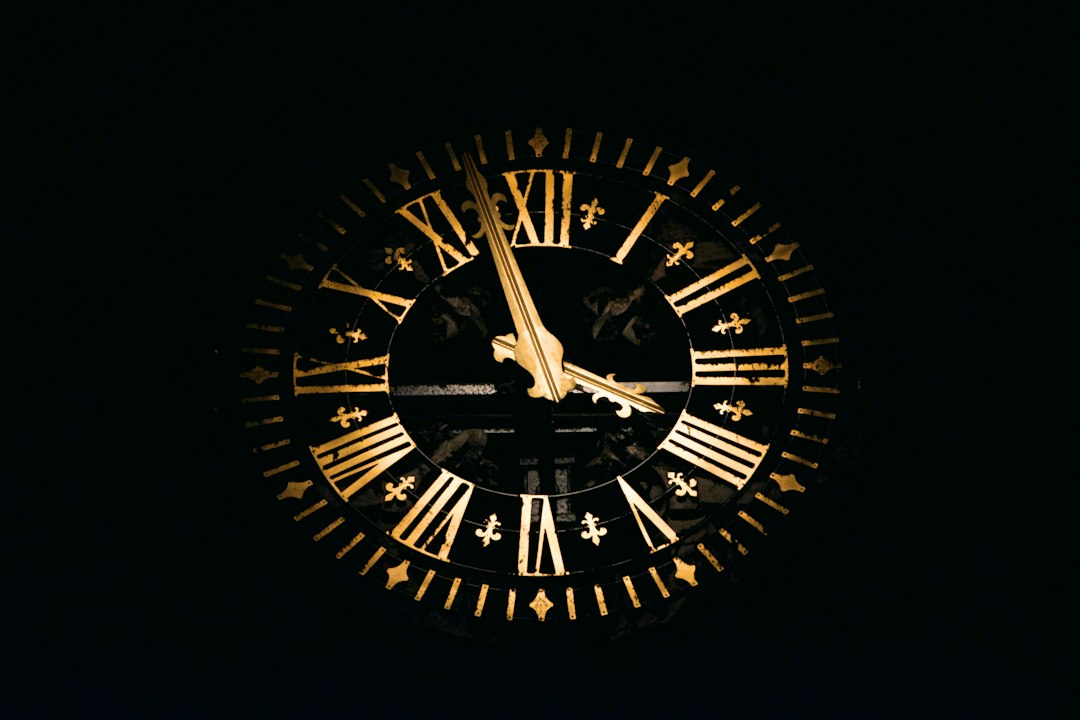
Photo by Thomas Bormans on Unsplash
Why Movie Clocks Always Run Backwards in Time-Travel Scenes
Watch any time-travel sequence and you’ll spot it within seconds: a clock face with hands spinning counterclockwise. It’s become such reliable visual grammar that audiences instantly decode the meaning without a single line of dialogue. But this wasn’t always the standard way to show temporal displacement on screen, and the technique carries more craft than it might seem.
The Problem of Showing the Invisible
Time travel presents a fundamental challenge for visual storytelling. Unlike a car chase or a fistfight, moving through time has no inherent physical action to photograph. Early filmmakers tried everything—swirling dissolves, characters aging rapidly through makeup, calendars flipping pages—but these techniques either felt too abstract or required extensive setup.
The reversed clock emerged as an elegant solution because it leverages something the audience already understands. We all know clocks measure time’s passage, so seeing one run backward communicates temporal reversal immediately. It’s environmental storytelling at its most efficient: a single shot that requires no explanation, no exposition, and no pause in pacing.
How the Effect Actually Works
Creating a backward-running clock is simpler than most viewers assume, though the execution matters. For analog clocks, production designers often build custom timepieces with reversed mechanisms, or they film a normal clock and reverse the footage in post-production. The latter approach sounds easy, but it creates a tell: any numbers or asymmetric details on the clock face will appear backward to careful viewers.
The best time-travel sequences use purpose-built props. A clockmaker reverses the gearing so the hands genuinely run counterclockwise on set. This allows the clock to appear in wider shots alongside actors without requiring careful framing to hide reversed text or branding. It also means the effect holds up in uninterrupted takes, which sells the reality of the moment far better than cutting away.
Digital displays complicate the technique. LED or LCD clocks can’t “run backward” in any visually meaningful way—numbers just change. That’s why time-travel films still favor analog clock faces even when the story takes place in modern or futuristic settings. The mechanical nature of spinning hands gives the effect tactile weight.
Why It Became Universal Shorthand
The backward clock achieved critical mass because it solves multiple problems at once. It’s immediately legible, it requires minimal screen time, and it works across genres. Whether you’re making a hard science-fiction film or a magical fantasy, a reversed clock signals the same thing.
More importantly, it gives the editor a flexible tool. Time-travel montages often layer multiple reversed clocks—Big Ben, a pocket watch, a wall clock in a laboratory—over each other. Each clock can spin at different speeds to suggest acceleration or the passage of years rather than minutes. The technique scales from a quick two-second insert to a sustained thirty-second sequence depending on the story’s needs.
The universality also helps international distribution. Visual symbols like reversed clocks require no translation and carry no cultural ambiguity. A counterclockwise clock means the same thing in every market.
The Limitations and Alternatives
Despite its ubiquity, the backward clock has limits. Overuse has made it feel a bit like a cliché, the temporal equivalent of a record scratch for a flashback. Some filmmakers now avoid it deliberately, finding other ways to mark time shifts—reversed rain falling upward, smoke flowing back into cigarettes, crowds walking backward.
These alternatives can feel fresher, but they also demand more setup. A clock is stationary and always in frame; rain and smoke need specific staging to be visible. That’s why even films that avoid the backward-clock montage will still often include one reversed timepiece as part of a larger sequence. It anchors the more elaborate effects, giving viewers a familiar reference point.
The technique endures because it’s efficient, legible, and adaptable. It’s not trying to dazzle the audience—it’s simply doing one job very well. In an art form where every second of screen time matters, that kind of focused utility never goes out of style.