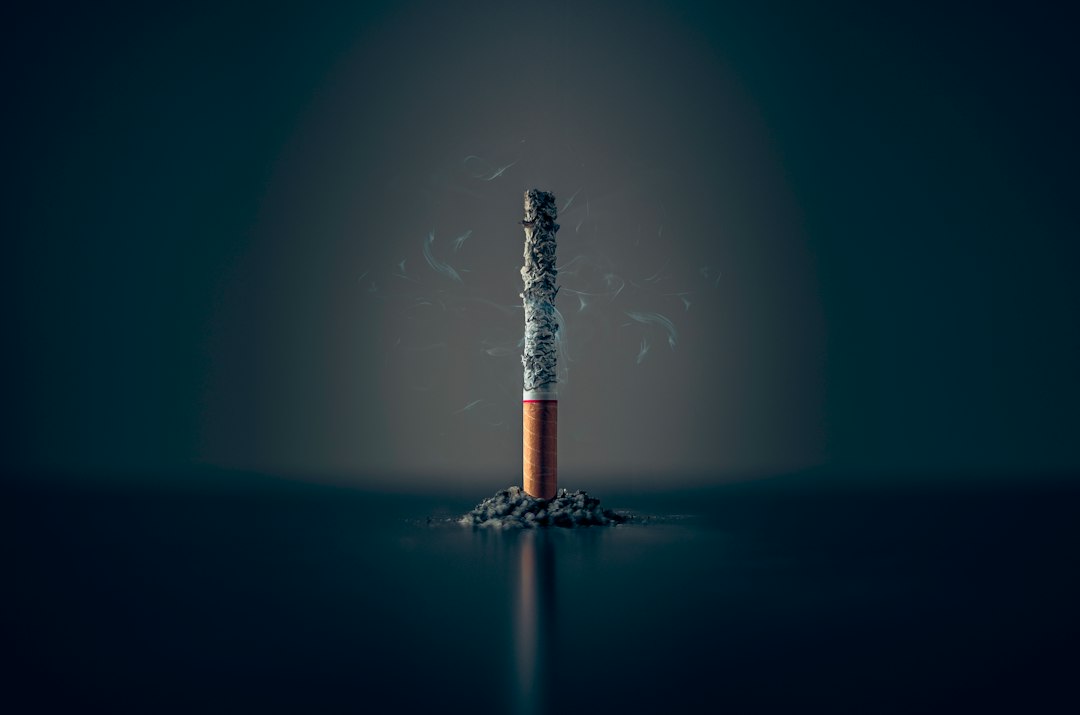
Photo by Mathew MacQuarrie on Unsplash
Why Movie Cigarettes Glow So Bright on Screen
If you’ve watched a noir film or a moody character drama, you’ve probably noticed how cigarettes seem to glow like embers in the dark, their tips radiating an almost supernatural orange light. In real life, a lit cigarette barely registers in dim conditions. On screen, it becomes a beacon. That’s not an accident—it’s a deliberate cinematographic choice involving practical lighting, timing, and sometimes a little movie magic.
The Real Cigarette Problem
A cigarette tip in natural light produces only a faint cherry glow. Under normal circumstances, even in a dimly lit room, that glow doesn’t stand out enough to read on camera. Film and digital sensors need a certain threshold of light to register detail, and a naturally burning cigarette simply doesn’t emit enough luminance to show up meaningfully. If a cinematographer exposed the scene to make the cigarette visible, the surrounding environment would fall into noisy shadow or the actor’s face would disappear entirely.
The solution is to cheat. That warm, unmistakable glow you see is almost always enhanced by a tiny, precisely placed light source rigged near the cigarette or hidden just out of frame. In some cases, a small LED or micro tungsten bulb is mounted inside a prop cigarette or held just beneath the actor’s hand. When the actor takes a drag, the light is dimmed up slightly to simulate the brightening of the coal. This gives the effect of a realistic ember without relying on combustion alone.
Timing the Glow
Lighting a cigarette isn’t just about brightness—it’s about rhythm. A cinematographer or gaffer will often time the intensity of the hidden light source to match the actor’s inhale. As the actor draws on the cigarette, the light subtly intensifies, mimicking the way real tobacco glows brighter when oxygen flows through it. When the actor exhales or lets the cigarette rest, the light dims back down. This choreography between actor and lighting crew sells the illusion.
In practical terms, this might involve a dimmer board operator watching the actor closely and adjusting a small light on cue. In more controlled setups, the light might be embedded in a prop cigarette with a button-activated LED that the actor or a nearby technician can trigger. Either way, the coordination has to be invisible. Any mismatch between the glow and the actor’s breathing breaks the illusion immediately.
Why It Matters for Mood
The exaggerated glow isn’t just about visibility—it’s about tone. A brightly lit cigarette tip acts as a focal point in a dark frame, drawing the viewer’s eye to the character’s face, hand, or mouth. It can signal isolation, contemplation, danger, or exhaustion depending on the context. In film noir, the glowing cigarette is shorthand for moral ambiguity or world-weariness. In war films, it might mark a brief moment of respite before chaos. The light itself becomes a storytelling device.
Directors and cinematographers also use the glow to create contrast and depth. A single point of warm light in a sea of cool shadow gives the frame dimensionality. It separates the character from the background without requiring a full lighting setup. It’s economical, atmospheric, and instantly recognizable.
The Practical Limits
Not every smoking scene gets the full treatment. In bright daylight or well-lit interiors, the natural cigarette might be sufficient, especially if the goal is realism rather than stylization. But in low-key lighting scenarios—the kind that define mood-heavy cinema—filmmakers almost always intervene. The cost of not doing so is a dull, unreadable prop that adds nothing to the frame.
Some productions use herbal or prop cigarettes that don’t actually burn, eliminating smoke and health concerns while giving total control over the lighting effect. Others use real cigarettes but augment them with hidden sources. The choice depends on the production’s priorities, the actor’s comfort, and the desired look.
The Takeaway
The glowing cigarette is a small detail that carries enormous weight in visual storytelling. It’s a reminder that even the most naturalistic-looking images are the result of countless invisible interventions. Next time you see a character smoking in a shadowy room, watch the tip of that cigarette. Chances are, someone just off camera is making sure it shines.