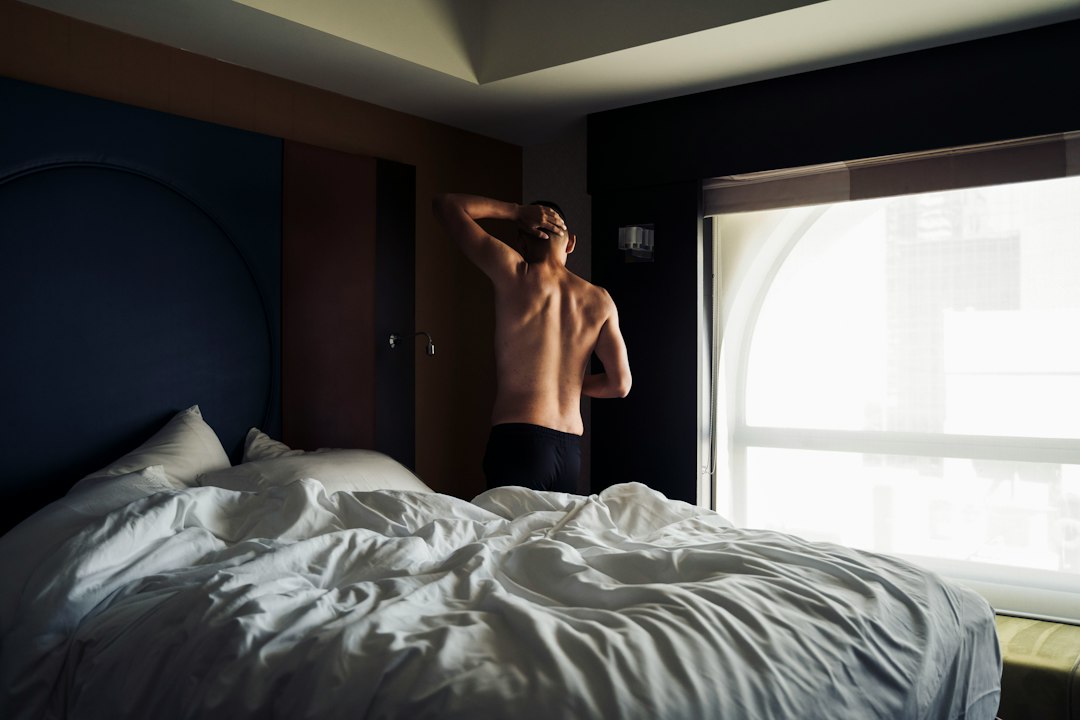
Photo by Diego Lozano on Unsplash
Why Movie Characters Always Wake Up Gasping
Watch someone wake up in real life and you’ll see a gradual process: slow stirring, a yawn, maybe some disoriented blinking. Watch someone wake up in a movie and they bolt upright with a sharp inhale, eyes wide, often sweating. The gasp-awake has become so standard that it’s almost invisible, yet it solves several practical filmmaking problems at once.
The Compression Problem
Film operates in compressed time. A character going to sleep and waking up eight hours later needs to happen in seconds of screen time. The gasp-awake acts as a visual exclamation point that marks the transition instantly. There’s no ambiguity about whether the character is still drowsy or half-awake. One moment they’re unconscious, the next they’re fully alert. It’s a hard cut made physical.
This compression matters because movies rarely have time to show the mundane reality of waking up. The plot needs to keep moving. The gasp delivers maximum narrative efficiency: it tells us the character is awake, it tells us something significant just happened (either in a dream or in the story before sleep), and it primes us to expect the character to take immediate action.
Signaling Emotional State
The specific way a character wakes up telegraphs their mental state. A character gasping awake from a nightmare carries visible distress. A character gasping awake in an unfamiliar location signals confusion or danger. A character gasping awake after being knocked unconscious tells us they’re disoriented and vulnerable.
The gasp itself is a borrowed language from genuine panic responses. When someone experiences a nightmare or sleep paralysis, they sometimes do wake with a sharp intake of breath as their nervous system resets. Cinema borrows this physiological reaction and applies it broadly, even to ordinary morning wake-ups, because it reads clearly on camera. A subtle return to consciousness doesn’t convey much. A gasp conveys everything.
The Actor’s Tool
From a performance standpoint, the gasp-awake gives actors a clear beat to play. Going from “asleep” to “awake” is surprisingly hard to make believable on camera, especially when you’re not actually asleep. The gasp provides a physical action to anchor the transition. It’s a gesture that requires the whole body: the chest expands, the shoulders lift, the face activates. It’s actable, repeatable across multiple takes, and it gives the editor a clean moment to cut on.
Directors can also modulate the intensity. A small gasp suggests mild concern. A violent gasp-and-sit-up combo suggests terror or urgency. The vocabulary is flexible enough to serve horror films and quiet dramas alike.
When It Doesn’t Happen
Pay attention to scenes where characters wake up without gasping. These tend to be moments of calm, domesticity, or romance. A character waking naturally beside a partner, a child waking on a lazy morning, someone waking in a safe space after a resolution—these scenes often skip the gasp because the point is to convey peace, not tension.
The absence of the gasp becomes its own signal. It tells us the character is, for now, free from whatever threat or anxiety has been driving the story. The filmmakers are trusting a quieter rhythm, which only works because the gasp-awake is so expected everywhere else.
The Convention Endures
Like many film conventions, the gasp-awake persists because it works. Audiences understand it instantly, actors can perform it consistently, and it keeps scenes moving without bogging down in realism. Real people wake up slowly and groggily, but movie characters wake up ready for the next plot point. The gasp is the hinge between rest and action, and it does its job so well that we barely notice we’re watching the same gesture in film after film.