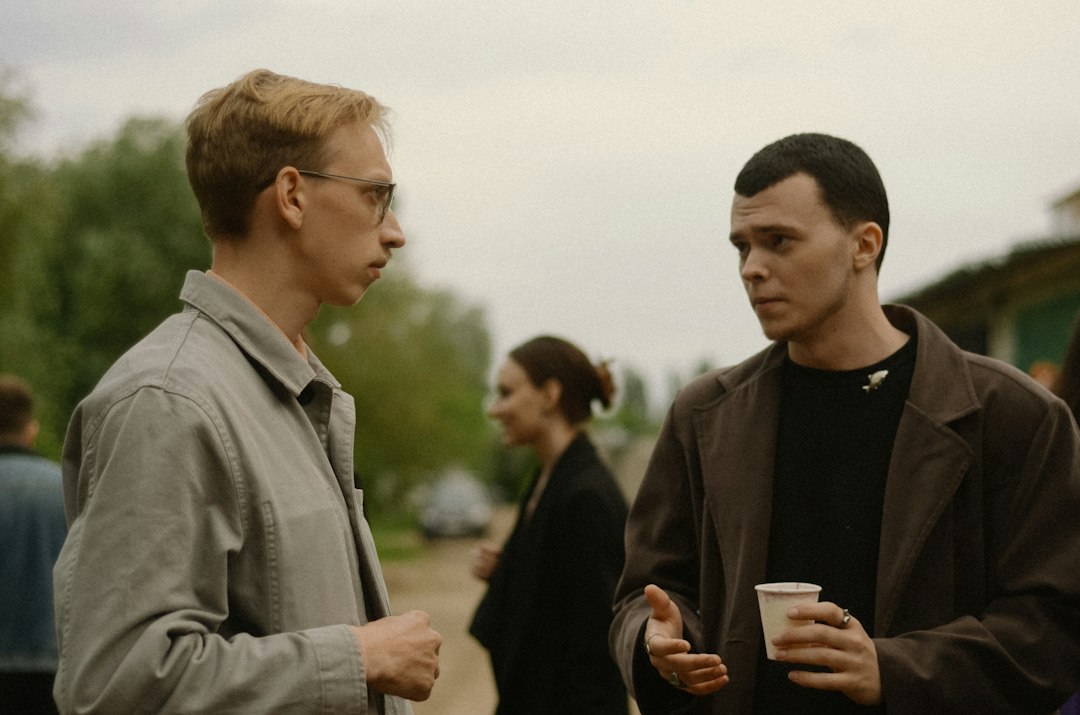
Photo by Kate Bezzubets on Unsplash
Why Movie Actors Rarely Say "What?" in Dialogue
Watch a hundred films and you’ll notice something odd about how people communicate on screen: characters almost never mishear each other. No one says “What?” or “Come again?” or “Sorry, I didn’t catch that.” Even in crowded restaurants, during rainstorms, or over the roar of helicopter blades, every line of dialogue lands perfectly the first time.
This isn’t realism. It’s storytelling efficiency, and it governs nearly every conversation you see in cinema.
The Momentum Problem
Dialogue exists to advance plot, reveal character, or build atmosphere. When a character asks someone to repeat a line, the film’s forward momentum stops dead. You’re not moving the story ahead—you’re literally retreading ground you just covered.
Screenwriters call this “dead air,” and it’s one of the most reliable ways to deflate a scene’s energy. The audience already heard the line. They don’t need to hear it again, and they definitely don’t want to watch a character process the logistics of mishearing it. Every second spent on “Huh?” is a second stolen from actual story.
Real Conversation vs. Screen Conversation
Real people mishear each other constantly. We say “what” dozens of times a day. We interrupt, talk over each other, leave sentences unfinished, and circle back to clarify meaning. Actual human speech is a mess of false starts and repairs.
Film dialogue strips all that away. It’s sculpted, purposeful, and illegally articulate. Characters speak in complete sentences, land their points with precision, and almost never stumble over their words. The exchange feels natural enough to be believed, but it’s been compressed and polished to eliminate anything that doesn’t serve the scene.
Asking someone to repeat themselves is one of the first casualties of that compression.
When “What?” Actually Appears
The rare moments when a character does say “What?” are almost always doing extra work. It’s not about mishearing—it’s about disbelief, shock, or stalling for time.
A character hears devastating news and responds with a stunned “What?” They’re processing emotion, not asking for clarification. Or someone asks a question they don’t want to answer, and “What?” buys them a moment to formulate a lie. In these cases, the word isn’t about communication failure. It’s about subtext.
Comedies occasionally play with the convention for laughs, especially in scenes where characters are genuinely trying to shout over absurd noise. But even then, the joke usually pivots away from repetition quickly—often by having the character misunderstand in a funny way rather than simply asking again.
The Craft of Crystal-Clear ADR
There’s also a technical reason dialogue always registers cleanly: most of it is recorded in a quiet studio long after filming wraps. Automated dialogue replacement (ADR) allows actors to re-record lines with perfect clarity, stripping away wind noise, traffic, and the chaos of the actual set.
Even when characters are screaming over a helicopter or whispering in a thunderstorm, you hear every syllable. That’s not microphone magic on location—it’s an actor in a padded booth watching playback and syncing their performance to picture. The sound design may add back layers of environmental noise, but the dialogue itself is always front and center, perfectly intelligible.
Filmmakers can make characters mishear each other if they want to. They choose not to, because clarity serves the audience better than realism.
The Unspoken Contract
Cinema asks us to accept a hundred small unrealities in exchange for a smoother, more focused experience. Characters never stumble on words unless it’s a character trait. They don’t say “um” or lose their train of thought mid-sentence. And they don’t ask each other to repeat things, because we’ve already moved on.
It’s one more invisible edit, a tiny refinement that keeps the story gliding forward instead of snagging on the friction of real human interaction. We don’t notice it’s missing until someone points it out—and then you’ll never stop noticing it again.