Photo by Kate Bezzubets on Unsplash
Why Movie Actors Turn Their Bodies During Conversations
Watch two people talk in real life and they’ll usually face each other directly, especially in intimate conversations. Watch the same conversation in a film and the actors are almost always angled slightly away from each other, their bodies opened toward the camera. This isn’t an accident. It’s a technique called “cheating out,” and it’s one of the invisible adjustments that separates screen acting from everyday behavior.
The Camera Changes Everything
In theater, actors can afford to turn their backs to portions of the audience because the stage is three-dimensional and viewers watch from fixed positions. Film is different. The camera represents every viewer simultaneously, and if an actor’s face is hidden, it’s hidden for everyone. The medium depends on facial expressions, and cheating out ensures the audience can see them.
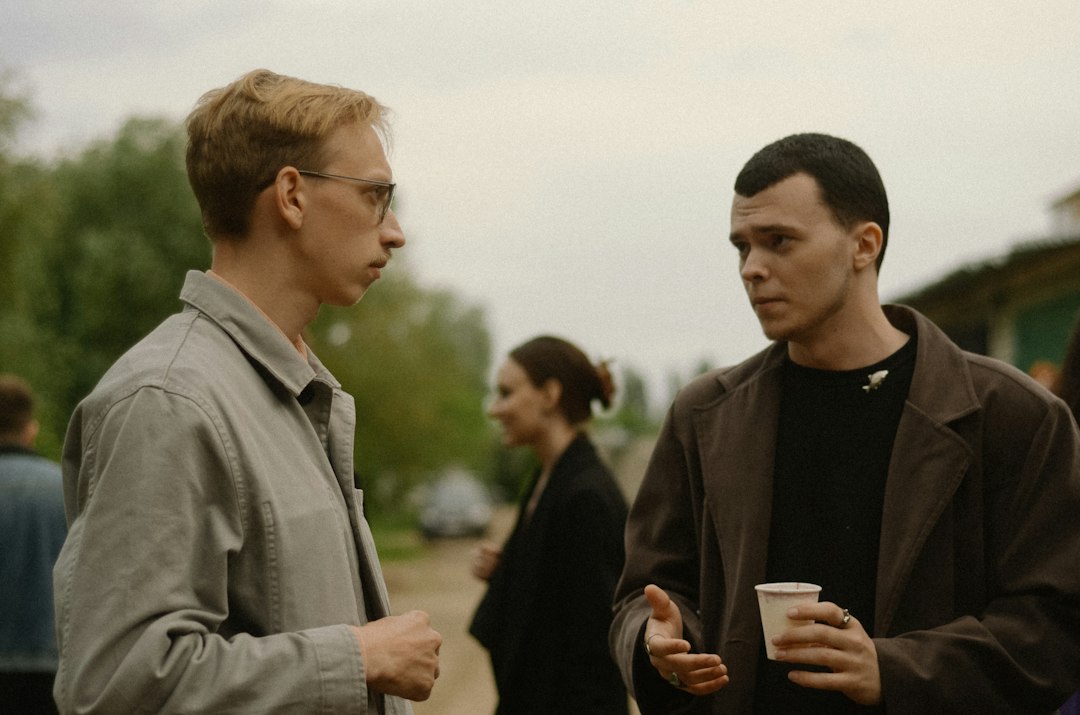
When two actors stand perfectly opposite each other in a scene, the camera positioned to the side captures both of them in profile. Profiles work for certain moments, but sustained profile shots make it harder to read emotion. You lose the eyes, the subtle shifts in expression, the micro-movements that communicate what a character is thinking beneath their words. By angling their bodies fifteen to thirty degrees away from their scene partner and toward the camera, actors keep their faces visible while maintaining the illusion that they’re fully engaged with each other.
The Geography of a Two-Shot
Directors and cinematographers plan for this from the blocking stage. In a typical over-the-shoulder setup, the camera is positioned behind one actor, looking past their shoulder at the other. The actor facing the camera needs to cheat out enough that their full face reads, but not so much that it looks like they’re talking to someone three feet to the left of their conversation partner.
The actor whose back is to the camera has to cheat out too. If they face their partner straight-on, they block the other actor’s face. By opening their stance, they create a lane for the camera to see through. It’s a collaborative geometry, both actors adjusting to keep the frame honest.
Naturalism vs. Visibility
The technique can feel artificial when you first learn it. Experienced actors make it invisible by keeping their eye contact authentic. They cheat their body but not their focus. Their gaze stays locked on their scene partner while their shoulders and hips rotate just enough to give the camera access. The adjustment is physical, not emotional.
Some directors lean into more natural blocking and accept the trade-offs. Long takes with moving cameras can follow actors as they turn, capturing them from multiple angles without requiring them to hold a fixed position. But even in those scenes, actors instinctively open their bodies during key emotional beats. The camera pulls performance toward visibility.
When the Rule Breaks
Profile shots do have their place. They emphasize distance between characters, isolation, or moments when someone deliberately won’t look at the person they’re speaking to. A character in profile, staring straight ahead while delivering bad news, can be more powerful than a cheated-out angle precisely because it withholds the face.
But those moments work because they’re exceptions. The rest of the time, actors cheat out, directors position cameras to maximize facial real estate, and audiences never notice the adjustment. It’s one more invisible contract between filmmakers and viewers: we’ll angle ourselves unnaturally so you can see us naturally. The craft hides itself so the story can breathe.