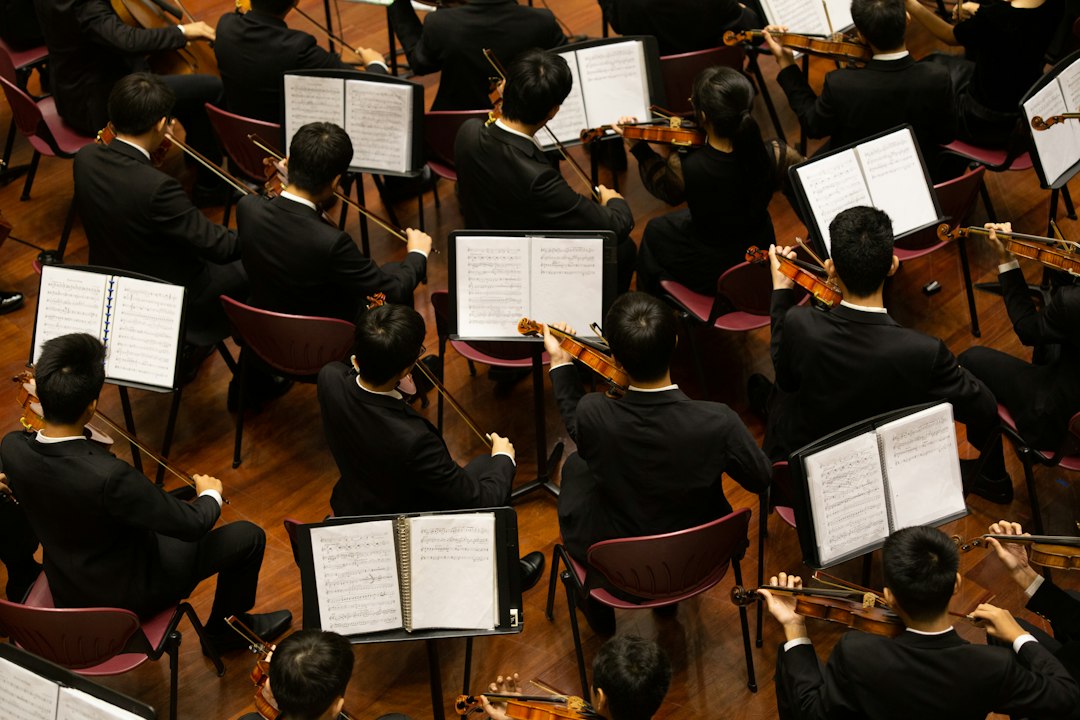
Photo by Samuel Sianipar on Unsplash
Why Movie Soundtracks Lean on Strings to Make You Cry
Think of the last movie scene that made you tear up. There’s a good chance that underneath the dialogue, or in the silence after it, a string section was doing most of the emotional work. Violins, violas, cellos, basses, swelling or trembling or holding a single aching note. It’s one of the most consistent patterns in film scoring, and it’s not just habit or convention. Strings do something specific to the human ear and nervous system that other instruments struggle to replicate.
The Instrument That Sounds Most Like a Voice
Strings are unique among orchestral instruments in how closely they can mimic the human voice. A bowed string can slide continuously between pitches, swell in volume gradually, and vibrate with the same kind of waver a trembling voice has. Brass and woodwinds attack a note and then sustain it, but they can’t glide between pitches the way a string player’s finger can slide along a fingerboard, producing a portamento that sounds uncannily like a sigh or a sob.
That gliding quality, called portamento when used expressively, mimics the pitch bends of human speech and crying far more closely than a piano or a trumpet can. Composers have known this for centuries. Opera composers used solo strings to shadow a singer’s line because the instrument could “sing” alongside them without competing for the same sonic space. Film composers inherited that trick wholesale.
Mass and Texture
A full string section also has a textural quality that other sections don’t. When forty violins play the same line slightly out of unison, a natural chorus effect emerges, a subtle blur called “ensemble” that gives the sound a shimmering, enveloping quality. It doesn’t sound like forty individual instruments. It sounds like one continuous wash of sound, which is part of why a string swell feels like it’s filling the room rather than coming from a specific point.
This matters for emotional scenes because the goal usually isn’t to draw attention to the music itself. A blaring trumpet solo asks to be noticed. A string section rising under a quiet conversation can work on the audience almost subliminally, coloring the emotional temperature of a scene without competing with the dialogue or the actors’ faces.
Sustained Tension Without Interruption
Unlike piano or percussion, bowed strings can sustain a note indefinitely, for as long as the bow keeps moving. That means a composer can build a long, unbroken crescendo under an entire scene, slowly raising the emotional stakes in real time as the drama escalates on screen. This mirrors how real emotional buildup works, as a gradual tightening rather than a series of discrete beats. A string section can start almost inaudibly and climb for sixty or ninety seconds without ever needing to stop and breathe, which wind and brass players physically have to do.
That capacity for continuous, controlled swell is one reason strings dominate scenes of mounting dread, grief, or revelation. The music can track the emotional curve of the scene with a smoothness that matches how feelings actually build, rather than announcing themselves in sudden bursts.
The Minor Second and the Ache
Strings also make certain harmonic and melodic choices sound more affecting than they would on other instruments. Close, dissonant intervals like minor seconds, when played by strings with vibrato, create a kind of harmonic friction that reads as yearning or unease. The vibrato itself, that small oscillation in pitch a string player adds with their left hand, physically resembles the wavering quality of an unsteady human voice. Strip the vibrato away and the same notes on a synthesizer or a flute can sound comparatively flat, almost clinical.
Composers also exploit the string section’s register range. A cello or viola sitting in its lower-middle range sounds warm and intimate, close to the pitch of a speaking human voice, which is part of why solo cello is such a common choice for scenes of quiet sorrow rather than, say, a solo clarinet in the same register.
Why It Still Works Even Though We Know the Trick
Audiences are generally aware, at some level, that swelling strings are a cue to feel something. Composers know this too, and some directors deliberately avoid the device to keep a scene from feeling manipulated. But even viewers who can name the trick still respond to it, because the effect isn’t really about surprise or deception. It’s rooted in how closely the sound maps onto cues the human brain already associates with emotional vocal expression. Recognizing the device doesn’t cancel out the physiological response any more than knowing a joke’s structure stops you from laughing at it.
That’s the real durability of the string section in film scoring. It isn’t a stylistic fashion that will eventually look dated, the way certain synth sounds mark a movie as distinctly from one decade. It’s closer to a physiological shortcut, built on how bowed instruments can imitate the voice, sustain tension, and blend into an enveloping wash of sound. As long as composers want audiences to feel something without being told to, strings will keep doing the quiet work underneath the picture.