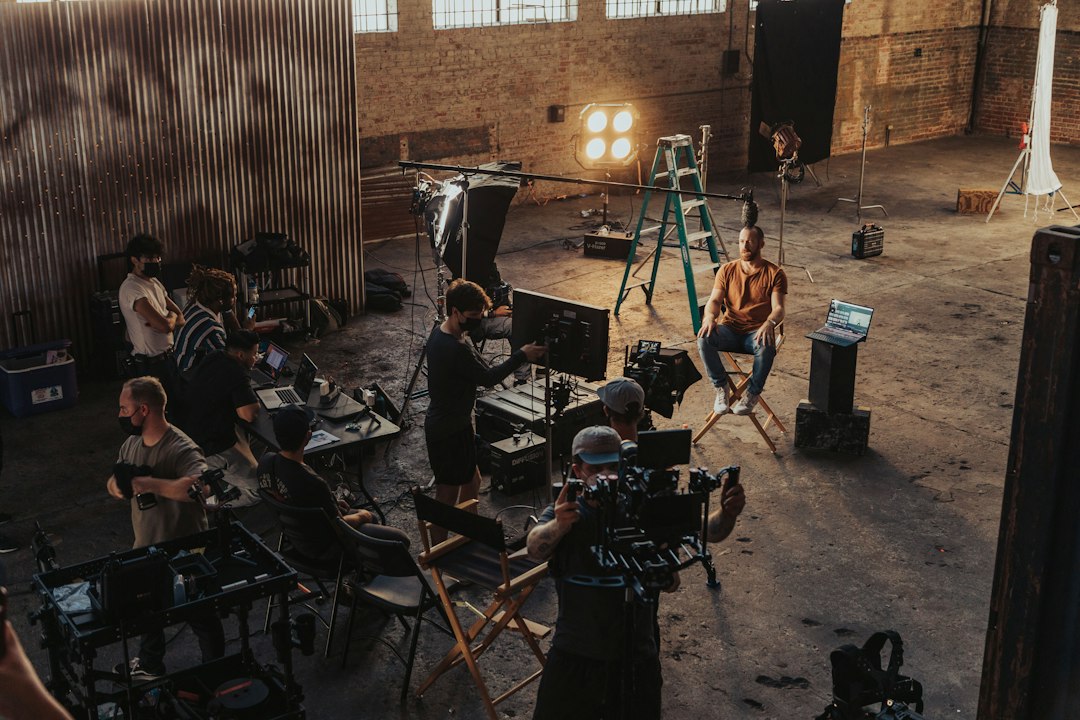
Photo by Jakob Owens on Unsplash
Why Film Crews Call It "Wrapping"
On every film set, when the director finishes the last shot of the day, someone calls out “That’s a wrap!” The crew starts breaking down equipment, actors head to their trailers, and the machine of production winds down. It’s one of the most universal phrases in filmmaking, spoken on student shorts and blockbusters alike. But where does “wrap” actually come from?
The Most Common Origin Story
The prevailing explanation traces “wrap” to an acronym: “Wind, Reel, and Print.” In the early days of cinema, when a scene was finished to the director’s satisfaction, the film negative would be wound back onto its reel and sent to the lab for printing. The theory suggests that crew members would shout “WRAP” as shorthand for this three-step process.
It’s a tidy origin story, and it’s been repeated in countless film textbooks and on sets for decades. The problem is that there’s very little historical evidence to support it. Acronyms weren’t common in early 20th-century film production terminology, and contemporaneous documentation doesn’t mention “Wind, Reel, and Print” as a phrase anyone actually used.
The More Likely Explanation
The word “wrap” almost certainly comes from the ordinary English verb meaning to cover, enclose, or finish up. By the 1920s, “wrap up” was already standard American slang for completing or concluding something. When shooting finished for the day, production would “wrap up” — pack away the equipment, secure the film stock, and close down the set.
Over time, “wrap up” became simply “wrap,” a compact verb that captured the entire shutdown process. By the 1940s, the term was firmly established in Hollywood production culture, appearing in trade papers and studio memos as the standard way to signal the end of a shoot.
How “Wrap” Functions on Set
Today, “wrap” operates at several scales. A single actor might be “wrapped” when they’ve finished all their scenes for the day, even if shooting continues with others. The entire day’s shooting wraps when the assistant director calls it. And when principal photography ends, the production wraps entirely — though post-production, of course, continues for months.
The phrase carries weight because it’s unambiguous. On a chaotic set with dozens of crew members and constant noise, “That’s a wrap” cuts through. Everyone knows exactly what it means: stop what you’re doing, secure your equipment, and transition to the next phase.
Why the Acronym Myth Persists
The “Wind, Reel, and Print” explanation endures because it feels right. It’s specific, technical, and rooted in the physical process of filmmaking. It satisfies our desire for film terminology to have concrete, mechanical origins tied to the craft itself.
But film language, like all professional jargon, usually evolves more organically. Most set terminology comes from ordinary words that took on specialized meanings through repeated use. “Martini shot” refers to the last shot of the day because the next drink is a martini. “Abby Singer” is the second-to-last shot, named after a production manager who would warn his crew two shots before wrap. These terms emerged from practice, not from planned acronyms.
The Ritual Remains
Whether “wrap” comes from an acronym or from everyday English doesn’t change its power on set. It’s a word that marks a threshold — between work and rest, between production and post, between the controlled chaos of a shoot and the return to normal life. When you hear it called out, you know something has been completed. And in an industry built on long days and uncertain schedules, that sense of completion matters.