Why Movie Cameras Use T-Stops Instead of F-Stops
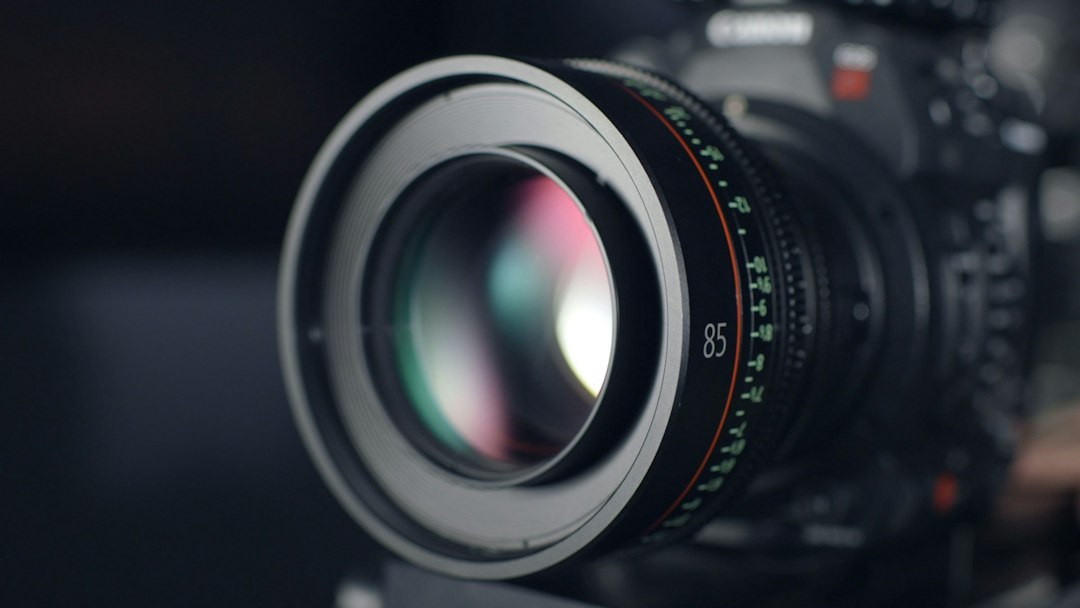
If you’ve ever looked at a cinema lens, you’ve probably noticed something unusual: instead of f/2.8 or f/4, the aperture ring is marked with T2.8 or T4. That “T” isn’t a typo or a branding quirk. It represents a fundamentally different way of measuring light, and it’s the reason professional filmmakers can match exposure seamlessly across multiple cameras, lenses, and shooting days.
F-Stops Measure Geometry, Not Light
An f-stop is a mathematical ratio between the lens’s focal length and the diameter of its aperture opening. If you have a 50mm lens with a 25mm aperture opening, that’s f/2. It’s clean, it’s calculable, and it’s been the standard for still photography for over a century.
But there’s a problem: f-stops don’t account for how much light actually passes through the lens. Every piece of glass in a lens reflects, absorbs, or scatters a small percentage of light. A simple prime lens with five elements might lose 5% of the light that enters it. A complex zoom lens with twenty elements and multiple coatings can lose significantly more. Two lenses can share the same f-stop but deliver noticeably different exposures because their internal construction differs.
T-Stops Measure Transmission
T-stops, short for “transmission stops” or “true stops,” measure the actual amount of light that reaches the sensor or film. A lens marked T2.8 transmits the same amount of light as a theoretically perfect f/2.8 lens with no internal light loss. If a lens is geometrically f/2.8 but only transmits 80% of the expected light due to its internal elements, it might be rated T3.2.
This isn’t theoretical hairsplitting. When you’re shooting a scene with three cameras using three different lenses, you need all three images to match in exposure. If one lens is f/2.8 and another is also f/2.8 but optically less efficient, the footage won’t match without correction in post. T-stops eliminate that variable. Set all three lenses to T2.8, and the exposure is consistent.
Why Still Photography Skips This
Photographers rarely need T-stops because most photography is a single-shot, single-camera medium. You set exposure for the lens you’re using, take the shot, and you’re done. If the next lens behaves differently, you adjust. There’s no continuity requirement across multiple angles shot simultaneously.
Film production operates differently. A conversation scene might involve a master shot, two singles, and an over-the-shoulder, all captured with different lenses and often different cameras. The colorist needs those shots to start from the same baseline. T-stops provide that baseline by guaranteeing that T2.8 on a 35mm prime matches T2.8 on a 50mm prime matches T2.8 on a 24-70mm zoom, even though their internal designs are completely different.
The Cost of Precision
Cinema lenses are measured and calibrated by manufacturers to provide accurate T-stop markings. This requires testing each lens individually under controlled conditions and engraving the true transmission values on the aperture ring. It’s one reason cinema lenses cost significantly more than their still-photo counterparts, even when the optical formula is similar.
Still lenses, even expensive ones, typically only publish f-stop values because that’s sufficient for their use case. Some high-end photo lenses do have T-stop measurements available, but they’re rarely marked on the barrel itself.
A Language of Control
T-stops are part of a larger production language built around consistency and repeatability. Just as film sets use color-temperature meters instead of eyeballing white balance, and just as focus pullers measure distances with tape instead of guessing, cinematographers rely on T-stops to remove one more variable from an already complex equation. When the director calls for another take six hours later under different lighting conditions, the DP knows exactly where the aperture was set, and that setting will behave identically across every lens in the kit.
It’s a small detail that reveals a larger truth about filmmaking: the craft is built on eliminating uncertainty wherever possible, so the only variables left are the ones that matter creatively.