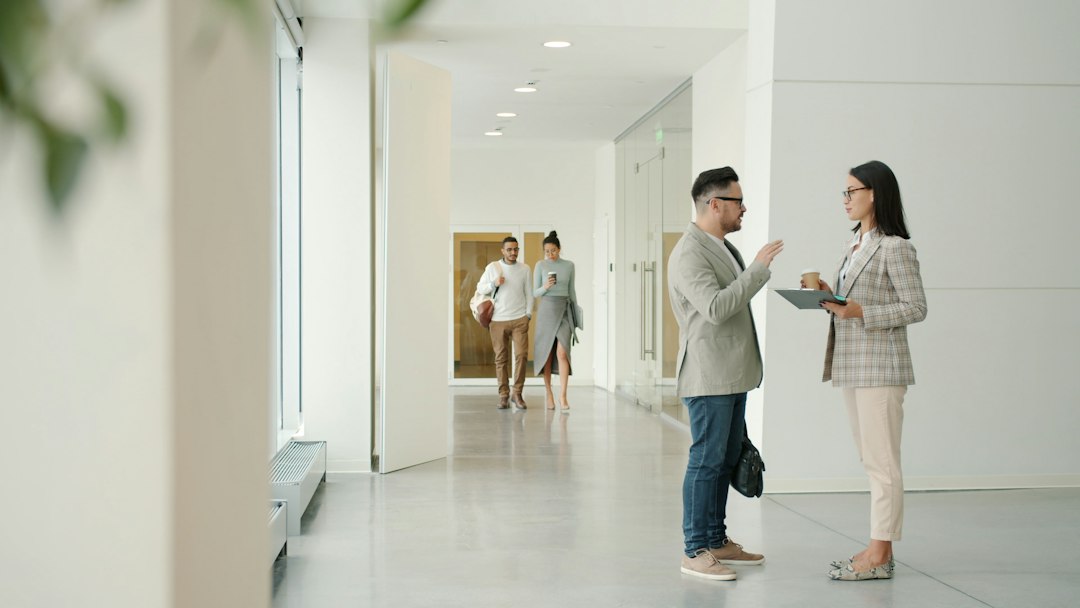
Photo by Vitaly Gariev on Unsplash
Why Movie Briefings Always Happen While Walking
In countless films and television shows, when characters need to exchange crucial information—mission parameters, case details, technical specifications—they rarely sit down to discuss it. Instead, they stride through corridors, cross parking lots, or navigate busy streets while talking. This isn’t accident or coincidence. It’s a deliberate technique that solves one of screenwriting’s most persistent challenges: how to deliver exposition without boring the audience.
The Static Information Problem
Exposition is necessary but dangerous. Audiences need context, backstory, and technical details to follow the plot, but long stretches of people explaining things can drain momentum from a scene. When characters sit across a desk and methodically discuss what happened or what needs to happen next, the camera has limited options. Cut between faces, push in slowly, maybe rack focus to a meaningful object—but the visual language remains constrained by the stationary setting.
The walk-and-brief technique injects literal forward movement into what would otherwise be a static exchange. As characters move through space, the camera moves with them. Hallways provide natural depth and leading lines. Doorways create transitions between locations. Passing extras and changing backgrounds generate visual variety. The scene stays kinetically alive even though its primary purpose is information delivery.
Controlled Pacing Through Geography
Walking naturally meters the flow of dialogue. A character can deliver one piece of information as they round a corner, another as they push through a door, a third as they reach their destination. The physical journey gives structure to the verbal one, breaking a single long speech into digestible segments punctuated by small physical actions—opening a file folder, pressing an elevator button, nodding to a colleague.
This geography also provides built-in scene transitions. The briefing can begin in one location and end in another, collapsing time and space. Characters might start a conversation on the ground floor and conclude it as they enter the tactical operations room three floors up, skipping the elevator ride entirely through a simple cut. The audience accepts this compression because the walking itself signals transition.
The Authority Dynamic
The walk-and-brief often involves a power relationship. A senior officer briefs a junior one, a seasoned detective brings a rookie up to speed, a mission commander outlines parameters to the team. The person doing the briefing frequently walks slightly ahead or sets the pace, a subtle blocking choice that reinforces hierarchy without explicit discussion of rank.
This staging also allows the listener to be the audience surrogate. When the camera follows from behind or alongside the person receiving information, viewers discover details at the same moment the character does. The physical following becomes narrative following.
Practical Production Benefits
From a production standpoint, walk-and-brief scenes are efficient. They’re typically shot with a Steadicam or on a dolly, allowing the camera to track smoothly alongside or ahead of the actors. This fluid camera movement gives directors and editors flexibility—the scene can be shortened or lengthened in post-production by trimming the walk without disrupting visual continuity.
The technique also disguises the repetitive nature of coverage. Instead of cutting between static close-ups that all look similar, the changing background provides inherent variety in every shot. Even a simple over-the-shoulder becomes more dynamic when office doors, windows, and passing personnel constantly shift in the frame behind the speaker.
When the Walking Stops
Interestingly, many walk-and-brief scenes conclude when the characters stop moving. The walking delivers the setup and context, but the critical emotional beat or final crucial detail often comes after they reach their destination and turn to face each other. The cessation of movement focuses attention on what matters most—the moment when exposition transforms into dramatic choice.