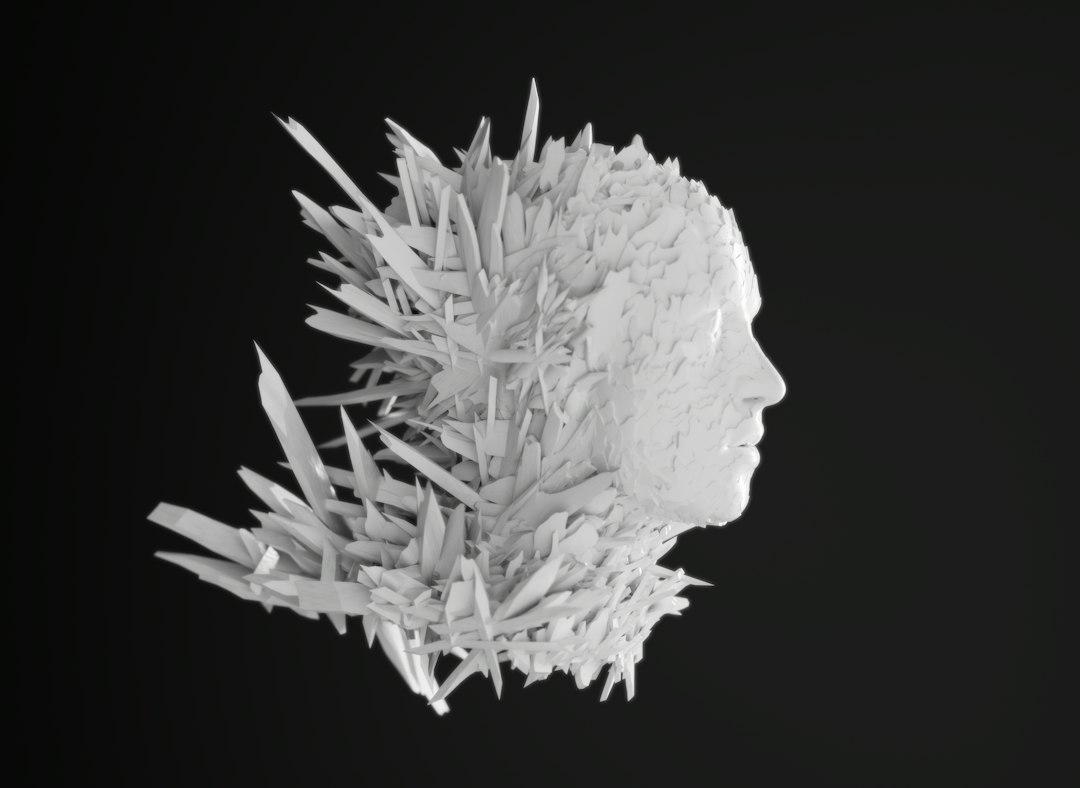
Photo by Point Normal on Unsplash
Why CGI Humans Still Creep Us Out: The Uncanny Valley in Film
Every few years, a movie promises a photorealistic digital human and audiences respond with the same word: creepy. It happens with de-aged actors, digital stunt doubles, and fully synthetic characters alike. The technology keeps improving, and the discomfort keeps showing up anyway. That reaction has a name: the uncanny valley.
What the Uncanny Valley Actually Describes
The term comes from robotics, not film. In 1970, researcher Masahiro Mori proposed that as a robot’s human likeness increases, our emotional response to it becomes more positive, but only up to a point. Just before a robot looks fully human, comfort drops sharply into revulsion, then climbs back up once the resemblance becomes convincing. Plotted on a graph, that dip looks like a valley. The theory has been applied to animation and CGI ever since, because the same pattern shows up when a rendered face gets close to real without quite arriving.
The valley isn’t really about how good the visual effects are. It’s about mismatch. A cartoon character with huge eyes and no nose reads as charming because nobody expects it to behave like a real person. A digital human rendered with pores, subsurface skin scattering, and individually simulated hair strands invites a much stricter comparison, and any small error becomes glaring by contrast.
Why Faces Are the Hard Part
Human beings are extraordinarily well tuned to reading faces. We track micro-expressions, eye movement, and the timing between a thought and the muscle twitch that follows it, mostly without conscious effort. This is a survival skill, not a filmgoing one, and it doesn’t turn off in a theater.
Digital faces struggle most with the eyes and the timing of expression. Real eyes have moisture, subtle saccades, and pupils that respond to light and emotion. Real expressions are asymmetrical and slightly delayed relative to speech, because muscles don’t fire in perfect sync with words. When animators smooth those imperfections out to make a face look polished, they often strip out the very cues that read as alive. The result can be technically flawless and emotionally hollow at the same time.
The Motion Capture Paradox
Motion capture was supposed to solve this by recording real actors and mapping their performance onto a digital model. It helps, but it introduces its own gap. A performance captured on an actor’s face in a gray studio, stripped of context, then retargeted onto a different digital rig, can lose the connective tissue between expressions. The actor is being real, and the software is trying to be honest to that performance, but the translation step is where subtlety gets lost. This is why some of the most convincing digital characters lean into non-human proportions, like heavily stylized creatures or aliens, rather than close human doubles. The less literally human the target, the more forgiving the valley becomes.
How Filmmakers Work Around It
Knowing this, productions often make deliberate choices to stay out of the valley rather than try to power through it. Digital de-aging and doubles are frequently used in short bursts, lit dramatically, or shot from angles that hide the face during the most demanding moments. Some films favor practical prosthetics and makeup for close-ups, saving CGI for wide shots or physically impossible actions where scrutiny is lower. Others cast the effect as the point, using an obviously synthetic look for characters who are supposed to feel artificial, sidestepping the comparison to real humans altogether.
Will the Valley Ever Close
Rendering technology keeps narrowing the gap, and some recent digital humans blur the line convincingly under controlled conditions. But the valley isn’t purely a resolution problem. It’s a perceptual one, tied to how finely tuned human face-reading is. Closing it fully may require not just better graphics, but a better model of the thousand tiny, imperfect things a real face does without trying. Until then, the smartest use of the technology isn’t chasing perfect realism. It’s knowing exactly how much digital face an audience will accept before their instincts start arguing with their eyes.