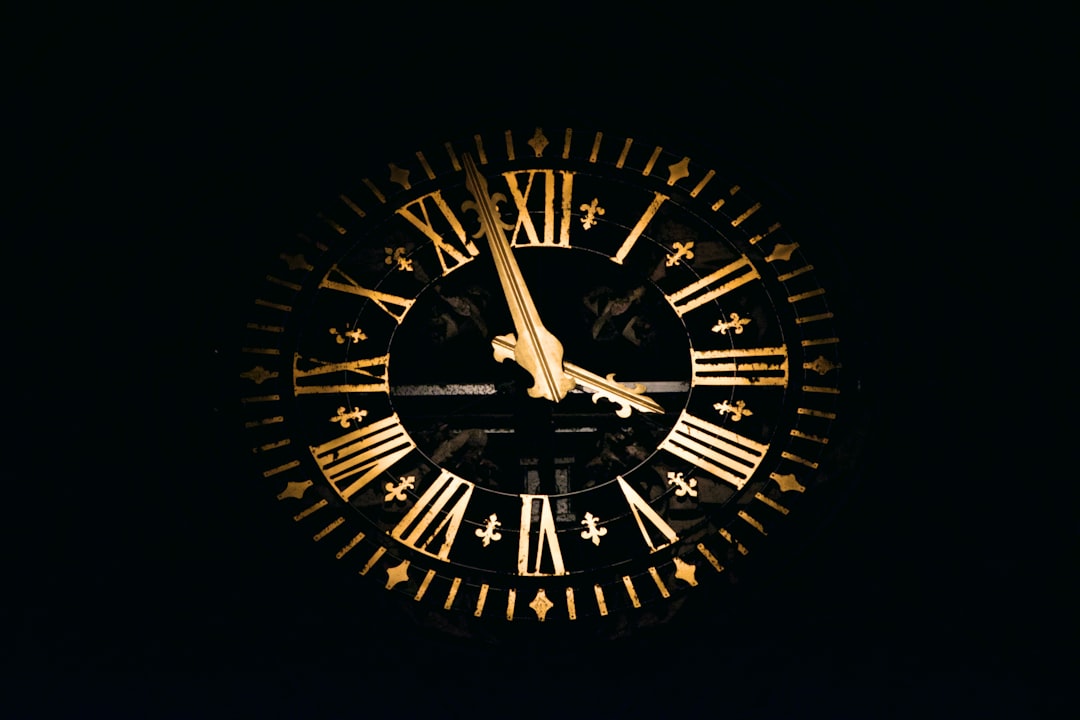
Photo by Thomas Bormans on Unsplash
The Ticking Clock: How Films Engineer Urgency
The Ticking Clock: How Films Engineer Urgency
The ticking clock is one of cinema’s oldest tension devices — a deadline, a countdown, a window before something irreversible happens. It doesn’t have to be a literal timer on screen. It’s a structural mechanism that transforms passive watching into active anxiety, and understanding how it works explains a lot about why certain films feel propulsive and others, even well-crafted ones, feel inert.
What the Device Actually Does
At its core, the ticking clock gives the audience a reason to care about time. Without it, scenes can accumulate without generating pressure — things happen, but nothing is at stake. Once a deadline is established, every scene between now and that moment becomes charged with potential failure. The audience starts doing the math involuntarily: how long does she have? can he make it?
This works because of how attention responds to scarcity. A finite window triggers the same cognitive urgency whether the stakes are fictional or real. The brain doesn’t distinguish cleanly between the two, which is exactly what filmmakers are counting on.
External and Internal Clocks
The ticking clock appears in two broad varieties, and the best films often use both simultaneously.
An external clock is concrete and legible: a bomb, a departure time, a closing surgical window, a sunrise that ends a character’s advantage. The audience can always understand how much time remains and what failure looks like. These are easy to read and hard to ignore.
An internal clock is more abstract and usually more emotionally durable. A terminal diagnosis. A relationship fraying past the point of repair. A character slowly losing their grip on who they are. There’s no scoreboard, but the audience feels the compression. The stakes are permanent loss rather than immediate destruction — which often cuts deeper.
Many films layer the two deliberately. The external deadline raises the heartbeat. The internal deadline raises the meaning. A race-against-time thriller becomes something more when you realize the protagonist isn’t just trying to stop something from happening — they’re trying to become someone before they run out of chances to try.
How Editors and Directors Make It Felt
A clock on a wall is the bluntest instrument available. Skilled filmmakers make the audience feel time pressure without ever showing a countdown.
Cutting rhythm is one of the most powerful tools. As a sequence builds, editors shorten individual shot durations — the visual pace quickens even if no one announces that time is running out. Parallel editing (cross-cutting between converging lines of action) multiplies this effect: we see the protagonist running, then the obstacle closing, then the protagonist again. Each cut is an implicit question about whether they’ll close the distance in time.
Sound design reinforces pressure through subtraction. Ambient noise drops away, isolating a single pair of footsteps or a single breath. A score introduces a rhythmic motif — something that mirrors a heartbeat or a metronome without imitating either. The acoustic environment narrows, mimicking how human perception actually behaves under stress.
Staging makes the passage of time visible as physical resistance. Characters pushing through crowds, climbing stairs against indifferent strangers, fighting traffic — the body laboring against the world communicates that time costs something.
When the Clock Expires
One underappreciated craft decision is what filmmakers do when the deadline arrives.
Some films carry through the consequences when the clock runs out — which can be devastating in the right story. Others reveal that the deadline was misdirection; the real clock was counting down to something the audience hadn’t quite identified. Others reset: a harder, tighter deadline replaces the first, and the audience learns the opening terms were generous.
The version that damages trust is the ticking clock that isn’t honored — where urgency is manufactured, then casually dissolved without consequence. Audiences feel this even when they can’t name it. They were made to care about time, and the film lied about whether time mattered.
The most memorable clocks do something subtler. They make you realize, after the fact, that the deadline you were watching wasn’t the real one. It wasn’t the bomb — it was the relationship. Not the flight, but the decision to take it. The literal timer was a decoy, and what actually ran out was something the film was quietly measuring all along.