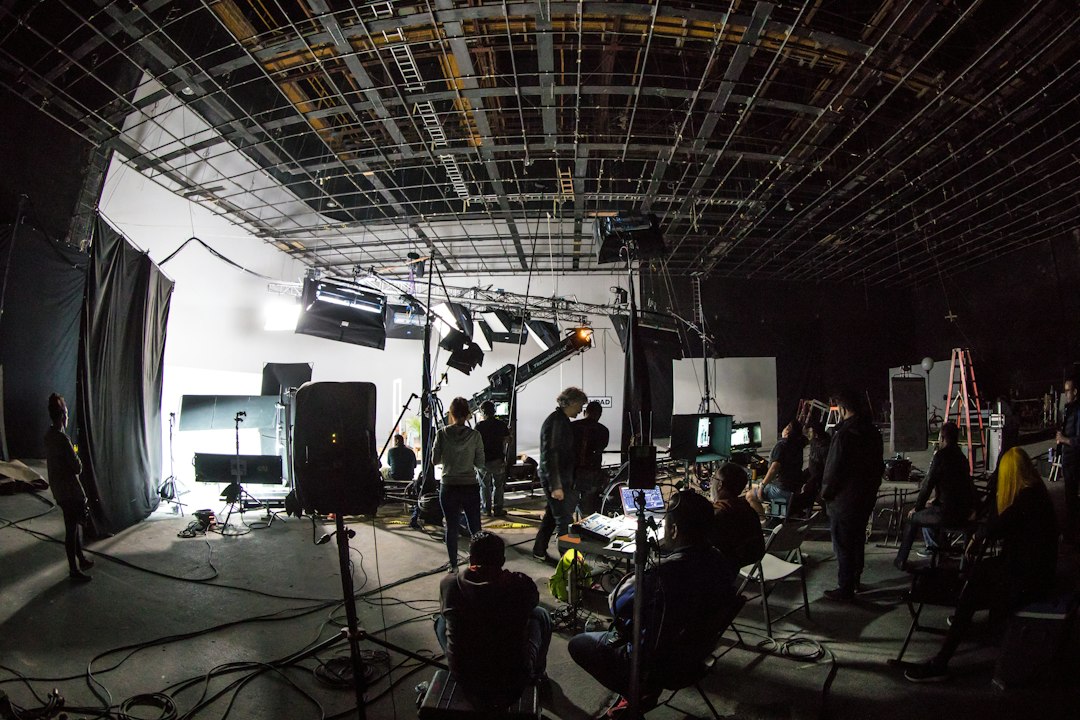
Photo by Brands&People on Unsplash
Three-Point Lighting: The Formula Behind Every Well-Lit Film
Three-Point Lighting: The Formula Behind Every Well-Lit Film
Most cinematography concepts are invisible to casual viewers. Three-point lighting is the rare one that, once explained, becomes impossible not to notice. It shows up in virtually every interview, every scene with two people talking across a table, every product shot — and yet it operates so naturally that audiences never register it as a choice. That invisibility is the whole point.
The Three Lights and What They Do
The system uses exactly what the name promises: three distinct light sources, each with a specific job.
The key light is the primary source. It’s placed to one side of the subject, typically at a 45-degree angle both horizontally and vertically, and it does the heavy lifting — illuminating the face, establishing direction, creating the initial shadows that give a subject three-dimensional form. Whatever story the lighting is telling, the key starts that conversation.
The fill light answers the key from the opposite side. Its job is not to eliminate the shadows the key creates, but to control their depth. A fill set to roughly the same intensity as the key produces a flat, evenly lit image — fine for news broadcasts, not very cinematic. A fill set much lower than the key lets those shadows go dark and dramatic. The ratio between key and fill is one of the most important creative decisions a cinematographer makes on any given setup.
The backlight (sometimes called the rim light or hair light) sits behind and above the subject, aimed toward the camera. It’s not there to illuminate — it traces a rim of light along the edges of the subject’s shoulders and hair, separating them from the background. Without it, subjects can flatten visually against whatever is behind them. With it, they pop forward, gaining presence and depth. It’s a small detail that makes an enormous perceptual difference.
The Ratio Is the Mood
Understanding three-point lighting is really understanding the key-to-fill ratio and what it communicates emotionally.
High-key lighting — bright fill, minimal shadow, low contrast — reads as safe, optimistic, even sterile. Romantic comedies, daytime television, and institutional spaces all tend toward high-key setups because shadow implies danger or ambiguity, and those genres want to remove both. The world looks knowable and cheerful.
Low-key lighting — weak or absent fill, deep shadow, high contrast — is where drama and tension live. It has a long history going back to chiaroscuro painting, the deliberate play of light against dark to sculpt form and suggest moral weight. Noir cinematography pushed this to its extreme: faces half-consumed by shadow, a single streak of light across a set. The viewer is never fully comfortable because the image itself withholds information.
Most dramatic filmmaking operates somewhere between these poles, adjusting the ratio scene by scene as the story’s emotional temperature changes.
Why Cinematographers Break It
The three-point system is a formula, and formulas exist to be violated for effect.
Shooting a scene with only a key and no fill produces harsh, unflattering contrast that reads as harsh or sinister — useful when the story calls for it. Lifting just the fill with no backlight flattens the image and creates an uncanny lack of depth. Lighting from below the key line (under-lighting) reverses the natural logic of how light falls on a human face, triggering an immediate unease in audiences because faces simply don’t look like that in ordinary life.
Even the placement of the backlight can tell a story. A hard rim that looks like a window suggests real geography. A backlight with no visible motivation draws attention to itself as pure artifice — a stylistic declaration rather than a simulation of reality.
A Tool, Not a Rule
Three-point lighting endures because it solves a genuine problem: the camera flattens three-dimensional space into two dimensions, and lighting is the primary tool for restoring the illusion of depth. The three-point system is the most efficient, reliable way to achieve that. But the cinematographers who use it best treat it as a starting point — a framework to push against rather than a checklist to complete. Every light placed on a set is a decision about what the audience feels, and the best lighting makes those feelings seem like they came from the story itself.