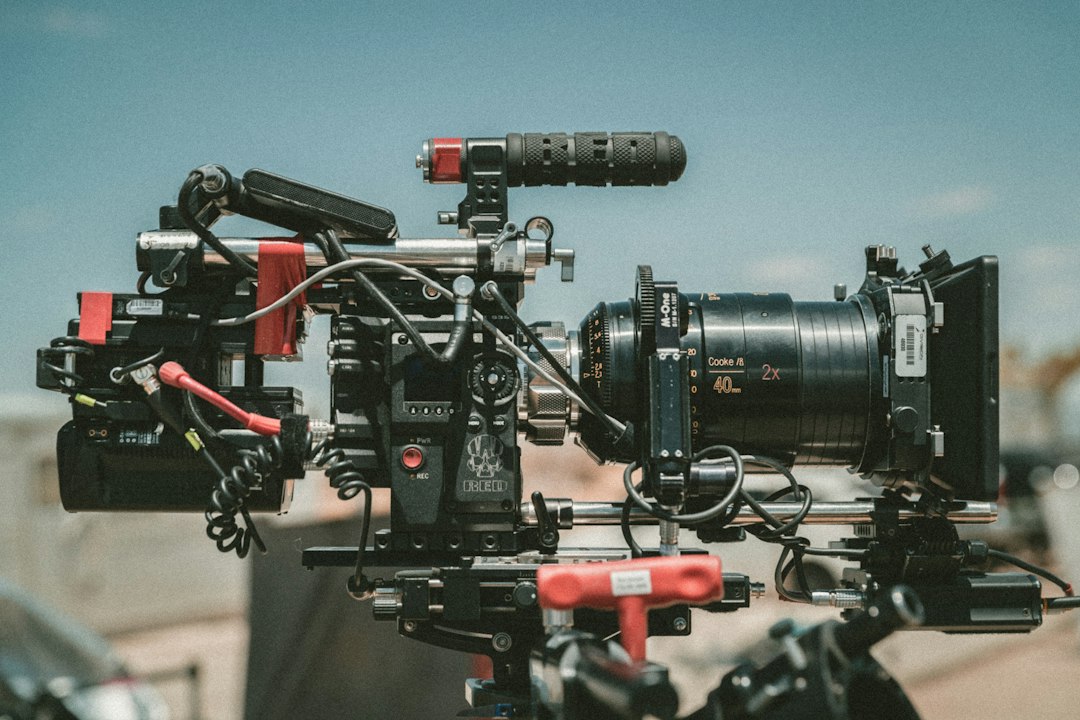
Photo by Jakob Owens on Unsplash
The Steadicam Revolution: How a Stabilizing Rig Changed the Way Movies Move
For most of film history, camera movement came in two flavors: smooth and shaky. A dolly on tracks or a crane could glide, but only where rails or arms allowed. A handheld camera could go anywhere, but every footstep showed up as a jolt. There was no way to get fluid, floating motion through a real, unpredictable space, until an inventor named Garrett Brown solved the problem with a mechanical rig that redistributed weight instead of fighting it.
The Problem It Solved
A body is a terrible camera mount. Even a strong, careful operator transmits the bounce of walking straight into the lens. Dollies fixed this by taking the human out of the equation entirely, but a dolly needs a flat, prepared path. Directors who wanted to follow a character up a staircase, through a doorway, and into a crowded room were stuck cutting the shot into pieces or accepting the shake.
Brown’s device, developed in the mid-1970s, used a counterweighted arm attached to a vest worn by the operator. The arm isolated the camera from the operator’s body movements through a spring-loaded gimbal, so footsteps and shifts in balance got absorbed by the mechanism instead of the frame. The operator could walk, climb stairs, even run, while the camera itself seemed to float, unhooked from gravity and momentum.
What It Actually Changed
The technical fix mattered less than what it made possible dramatically. Before this rig, a long take through a complex environment required either a dolly track built to match the actor’s path or a crane that couldn’t turn corners. After it, a camera could trail a character through spaces no rail could reach: narrow hallways, spiral staircases, packed rooms, uneven ground. The famous training-run sequence in Rocky and the hotel corridor scenes in The Shining are both frequently cited as early demonstrations of what the technology could do once filmmakers understood its range, since both involve sustained, unbroken pursuit through environments that would have been impossible to dolly through cleanly.
This unlocked a specific storytelling tool: sustained proximity. A Steadicam shot can stay glued to a character’s shoulder for a full scene, tying the audience’s spatial awareness to that person’s experience of moving through the world. It reads differently than a static shot or a cut-heavy sequence. The unbroken motion creates a sense of real time and real space, while the smoothness keeps it from feeling frantic or subjective the way handheld footage often does.
The Middle Ground Between Control and Chaos
What makes this technology interesting from a craft perspective is that it occupies a middle register. Locked-off shots and dolly moves feel composed and deliberate. Handheld footage feels urgent and unstable. A stabilized moving shot feels neither. It has the polish of planned camera work with the freedom of movement usually associated with improvisation. That combination is why it became the default choice for scenes that need to travel through architecture: walking into a party, trailing someone down a corridor toward a confrontation, following a character from a private moment into a public one without a cut.
Directors also use it to manage tension precisely because it’s so smooth. A shot that glides calmly behind a character approaching danger creates a different kind of dread than a shaky one. The steadiness itself becomes unsettling, since the audience senses that something is being tracked with unnatural calm.
Why It Still Matters
Digital gimbals and drone systems have since expanded on the same basic idea, mechanical isolation of the camera from the operator’s motion, and now let filmmakers achieve similar floating movement from vehicles, cables, or handheld stabilizers a fraction of the size of the original rig. But the underlying grammar was established well before any of that hardware existed. Once directors had a way to move a camera continuously through real space without a visible tether to rails or cranes, long, unbroken sequences through complicated environments stopped being a technical impossibility and became a deliberate stylistic choice. That shift in what was filmable is still shaping how scenes get blocked and shot today.