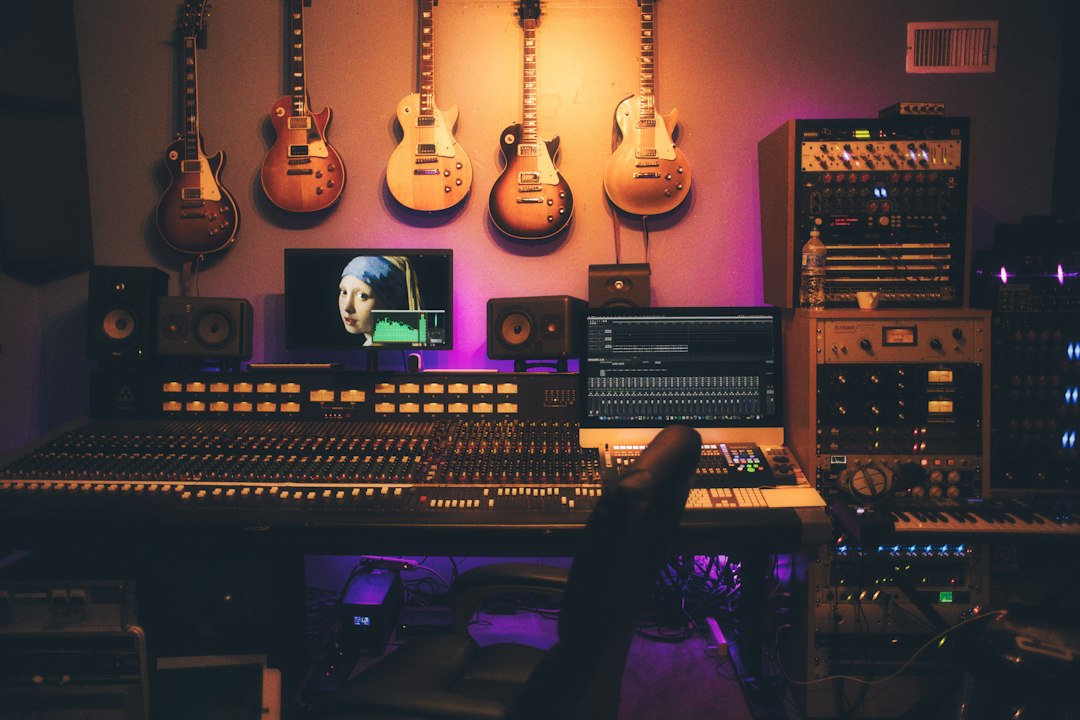
Photo by Caught In Joy on Unsplash
Why Movie Sounds Change with Distance
When a character shouts from across a canyon or whispers close to camera, audiences don’t just hear the difference in volume. They hear distance itself. Sound designers sculpt audio to match visual perspective, creating an illusion so seamless that most viewers never consciously notice the craft behind it.
This technique is called sound perspective, and it’s one of the fundamental tools that separates flat, unconvincing audio from the immersive soundscapes that make films feel real.
The Three Dimensions of Distance
Sound designers manipulate three key properties to simulate distance: volume, frequency content, and reverberation. Volume is the obvious one, but it’s actually the least important. A distant sound isn’t just quieter; it’s fundamentally different in character.
High frequencies dissipate faster than low frequencies as sound travels through air. A gunshot ten feet away has sharp, crackling highs. The same gunshot half a mile away becomes a muffled thump, its treble absorbed by atmosphere. Sound designers replicate this by filtering out high frequencies, a process called low-pass filtering, to push sounds farther into the background.
Reverb and early reflections complete the picture. Close sounds arrive at your ear directly, with minimal room bounce. Distant sounds accumulate reflections from walls, ground, and obstacles, arriving wrapped in a subtle haze of echoes. By adjusting the ratio of direct sound to reflected sound, designers place audio anywhere in three-dimensional space.
Matching Picture to Sound
When a camera cuts from a close-up to a wide shot, the sound must follow. If an actor’s voice stays crisp and present while they shrink to a dot on the horizon, the illusion breaks. Sound editors create multiple passes of dialogue and effects, each tailored to the camera’s distance from the action.
For a conversation scene, this might mean three or four different mixes of the same dialogue: an intimate close-up version with full frequency range and minimal reverb, a medium-shot version with slight filtering and room tone, and a wide-shot version that sounds like it’s reaching the audience from across the space.
This is why ADR sessions often record multiple intensities of the same line. An actor might perform a shout both at full stage volume and at a more moderate level, giving the mixer options when the shot scale changes.
The Invisible Cut
Sound perspective is particularly powerful during long takes or oners where the camera moves continuously through space. As a Steadicam glides from an exterior street into a building’s interior, sound designers gradually shift the balance from open-air ambience to enclosed room tone, add wall reflections, and adjust the frequency response to match the acoustic dampening of indoor materials.
The audience reads this as continuous motion through real space, never questioning why the sonic character evolves. It’s an invisible cut made entirely through audio.
When Distance Lies
Not every shot demands realistic sound perspective. Filmmakers routinely cheat audio closer than the picture suggests, especially for dialogue. A character might be fifty feet from camera in a wide establishing shot, but their voice remains clear and present, defying physics in service of narrative clarity.
Action sequences exploit this constantly. Explosions stay punchy and visceral even when they occur in the background of frame. Footsteps remain distinct during chase scenes shot from a distance. The rule isn’t realism; it’s clarity and emotional impact.
Sound designers walk a constant tightrope between acoustic accuracy and dramatic necessity, pulling sounds forward or pushing them back based on what the story needs the audience to focus on at any given moment.
The Spatial Contract
Great sound perspective works because it honors the unspoken contract between filmmaker and audience: visual scale implies acoustic scale. When that relationship holds, viewers sink deeper into the world onscreen. When it breaks, even for a moment, the artifice shows through.
The craft lies in knowing when to respect physics and when to bend it, using distance not just as a technical parameter but as a storytelling tool that shapes how audiences experience space, intimacy, and isolation.