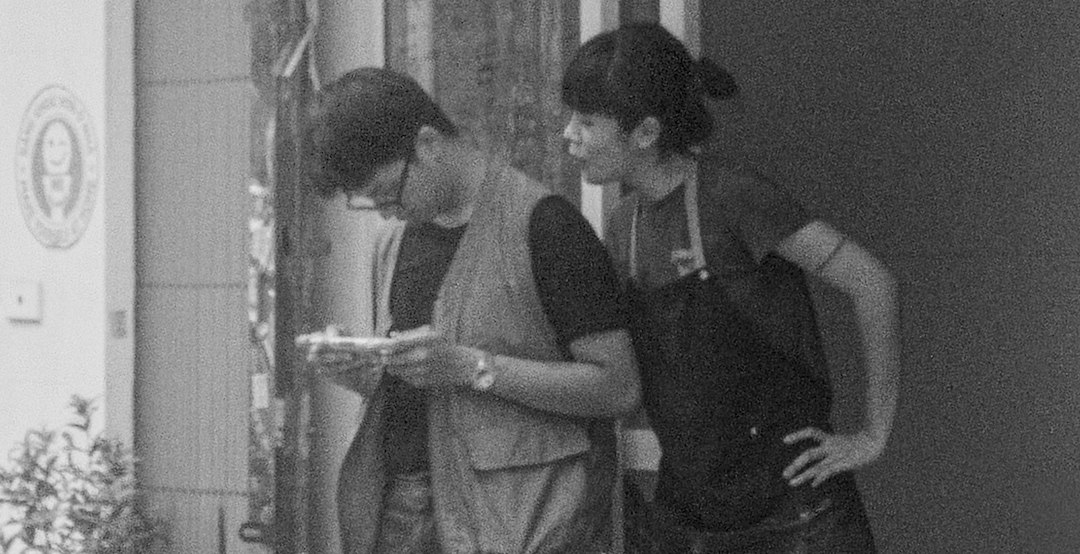
Photo by Aleksandr Dalakian on Unsplash
Shot/Reverse Shot: The Grammar of Conversation on Screen
Watch any two characters talk in a movie and you’re almost certainly watching a pattern so familiar it’s become invisible: a shot of one person speaking, then a shot of the other, back and forth, cut to the rhythm of their exchange. This is shot/reverse shot, and it’s one of the most quietly powerful tools in the editor’s kit. It doesn’t announce itself the way a dolly zoom or a Dutch angle does. It just works, which is exactly the point.
What It Actually Is
Shot/reverse shot alternates between two complementary camera angles, typically looking at each speaker from roughly the position of the other person. Character A faces the camera and speaks; cut to Character B, facing the opposite direction, responding. Often these are shot as over-the-shoulder frames, with a sliver of the other person’s shoulder or head visible at the edge, which helps orient the viewer in physical space.
The technique depends on the eyeline match: each character’s gaze should land at a consistent point just off-camera, roughly where the other actor would be standing. When the eyelines are consistent, our brains stitch the two shots into a single continuous space, even though the actors may have been filmed hours or days apart, sometimes without ever occupying the same room together. It’s an illusion of presence built entirely in the edit.
Why It Works Psychologically
Shot/reverse shot succeeds because it mimics how attention actually moves during a real conversation. When someone talks to you, you look at them. When they finish, your attention shifts to whoever responds. Film editing exploits that instinct directly, cutting to whichever person currently holds the narrative weight of the scene. The technique is less about showing us information and more about directing where our empathy sits moment to moment.
This connects to an older idea in film theory sometimes called suture, the notion that editing “stitches” the viewer into a scene by making them feel like an implied third participant in the conversation, occupying the gaps between shots rather than a fixed camera position. You’re not watching the conversation from outside it. You’re positioned inside the rhythm of it, turning your head, in effect, along with the cut.
Coverage and Control
Shot/reverse shot is also a practical solution to a production problem. Dialogue scenes need coverage, meaning enough footage of every angle and performance beat that an editor can assemble the scene multiple ways in the cutting room. A director might shoot a wide master of both actors, then individual close-ups of each, then reaction shots, all designed to intercut smoothly later. This flexibility is why the pattern became the default grammar of dialogue scenes in classical Hollywood and remains so today: it gives editors maximum control over pacing, emphasis, and performance without requiring reshoots.
That control matters because the choice of when to cut, not just where the camera points, is doing real dramatic work. Holding on a listener’s face instead of cutting back to the speaker can reveal doubt, calculation, or restraint that the dialogue itself never states. Directors who want tension often delay the reverse shot, letting a reaction linger a beat longer than expected.
When Filmmakers Break the Pattern
Because shot/reverse shot is so normalized, deviating from it draws attention fast. A director might shoot an entire tense conversation in a single unbroken two-shot, refusing to let the edit relieve the discomfort of watching both characters simultaneously. Others withhold the reverse shot entirely, keeping one character offscreen to make their presence feel threatening or diminished. These choices land precisely because audiences have absorbed the standard pattern so thoroughly that any departure feels like a decision, not an accident.
That’s the real trick of shot/reverse shot: it’s one of the few techniques that works best when nobody notices it, and reveals its craft most clearly the moment someone chooses to break it.