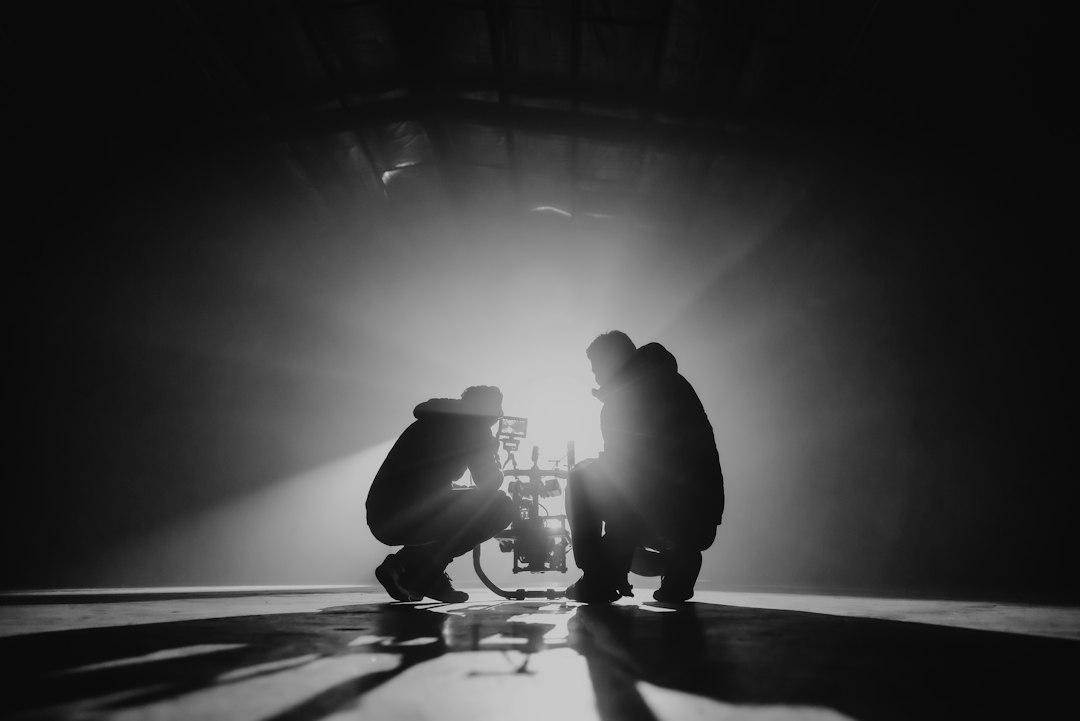
Photo by Natalie Parham on Unsplash
Shooting the Light: Why Cinematographers Frame the Source
Watch enough films with an eye toward lighting and you’ll notice something: the best cinematographers don’t just use light to illuminate their subjects—they put the light itself in the shot. Desk lamps glow in the corner of the frame. Neon signs bleed into the edges. Windows become glowing rectangles that anchor the composition. This technique, sometimes called “shooting the light” or “shooting practicals,” transforms flat images into three-dimensional spaces.
The Difference Between Lit and Motivated
Every scene needs illumination, but not every scene needs visible light sources. A cinematographer can flood a room with soft, even lighting that makes everything look pleasant and clear—but also somewhat artificial. The light comes from nowhere in particular, and the audience’s eye knows it.
When you shoot the light, you’re showing where illumination comes from within the world of the story. A table lamp isn’t just a prop; it’s a working source that casts real light on an actor’s face. A streetlamp in the background isn’t just set dressing; it creates a pool of amber that gives the night scene depth. The technique answers an unspoken question the viewer’s brain asks constantly: where is this light coming from?
This doesn’t mean every light in frame needs to be the actual source doing the work. A practical lamp might provide ten percent of the illumination on an actor while hidden movie lights do the heavy lifting. But including that visible source sells the reality of the scene. It gives the lighting a motivation that feels true.
Creating Depth and Atmosphere
Shooting the light adds dimensionality that’s hard to achieve any other way. When light sources appear at different distances from the camera—a candle in the foreground, a chandelier in the mid-ground, a window in the deep background—they create distinct planes that pull the eye through the frame. Each glowing element acts as a depth cue, making two-dimensional cinema feel genuinely spatial.
The technique also builds atmosphere in ways that pure illumination cannot. A single bulb hanging in an interrogation room feels different from shadowless overhead lighting, even if both approaches deliver the same amount of light to an actor’s face. The visible bulb tells you something about the space, the mood, the reality of the moment. Film noir built entire visual languages around shafts of light cutting through darkness, with the sources themselves—venetian blind slats, doorway cracks, naked bulbs—becoming characters in the composition.
The Technical Challenge
Including bright light sources in frame creates real problems for cinematographers. Camera sensors and film stocks have limited dynamic range—they can only capture so much difference between the brightest and darkest parts of an image before something clips to pure white or crushes to black. Point a camera at a practical lamp and either the bulb blows out to a featureless blob or the rest of the frame goes dark.
The solution requires careful balancing. Cinematographers might use lower-wattage bulbs than you’d expect, or dim practicals to levels that feel natural to the eye but don’t overwhelm the sensor. They’ll expose for the highlights and let shadows fall deeper, or use techniques like negative fill to control how bright the surrounding space becomes. Sometimes they’ll embrace a small amount of bloom around a light source, letting it flare just enough to feel authentic without losing all detail.
Modern digital sensors handle highlights differently than film stock did, which has changed how much bloom and halation cinematographers can design into their images. Some add these characteristics back in post-production, recreating the optical qualities that made older films feel warm and lived-in.
When to Leave the Light Out
Not every scene benefits from visible sources. Shooting the light works best when you want to emphasize reality, texture, and atmosphere. It thrives in practical locations, night scenes, and moments where the environment itself matters to the story. But sometimes a cinematographer wants a more stylized, less grounded look—fashion-film smoothness, dreamlike ambiguity, or simply the flexibility to light an actor’s face without worrying about where that light would logically come from in the space.
The choice reveals a fundamental tension in cinematography: the balance between showing how light behaves in real spaces and using light as pure visual design. The best work understands when to honor physics and when to abandon it entirely.